Recently, I added this very early C. W. Tucker photo postcard to my Covina ephemera collection.

Click on the image above to view a clean enlargement.

Although the view looks very different today, and the palms are way taller now, I doubt someone who grew up in Covina would have too much difficulty recognizing where this picture was taken.
But, just in case not, we are looking north on Hollenbeck Avenue from only a few feet north of its intersection with Badillo Street.
And the year? Well, let's play history detective and see what we can come up with!
First of all, Mr. Tucker opened his photographic studio in Covina in November, 1903,1 and the postcard message from "Aunt Sofie" to "Miss Mary" was dated September 26, 1908, so, obviously, the photo must have been taken sometime in between. However, I think we can narrow that range even further.
An additional clue is that a variant of the postcard picture, shown below, is in a booklet promoting Covina published in 1907.2 It also appears opposite page 97 in Pflueger (1964) with the caption: "Hamilton Temple drives his 1901 Merry Oldsmobile down Hollenbeck Avenue."3
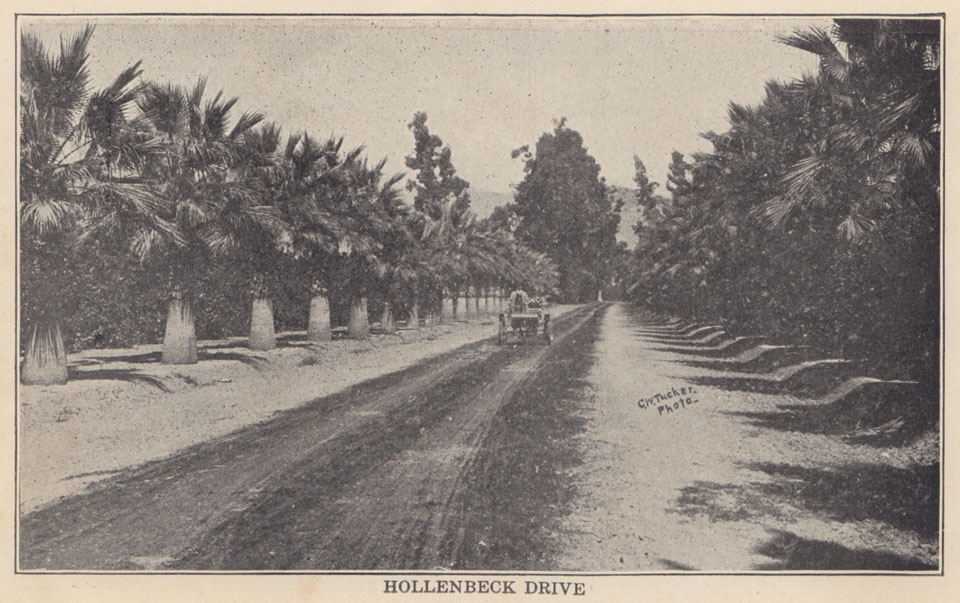
Note that the tracks in the dirt are basically identical to the ones in the postcard, so both photos were taken the same day and probably only minutes apart.
Also, since it's doubtful that one of the very first things Mr. Tucker did after coming to Covina was to go around taking pictures of the local scenery, I think it's safe to say that the postcard photo dates to no earlier than 1904. And, since I know another picture in the 1907 booklet was taken precisely on October 11, 1906,4 I think the latest year we can logically assign to these photos is also 1906. So, with 1904-1906 being the plausible range of possibles, I conclude that splitting the difference and saying Tucker shot his pictures of Hollenbeck c.1905 is about as accurate a date as we can hope for.

Now, what about the palms themselves? We don't have any specific documentation about who planted them or when—at least none that I know of—but can we maybe formulate an educated guess? Let's see!
To start out with, the palms are of the species Washingtonia filifera var. filifera: the California fan palm. And how old are they here? I asked a former botanist colleague, and, based on their height,a he guesstimated the palms show about 30 years of growth. So, if our postcard photo is from c.1905, that would mean the palms began life around 1875.b
Then there's the matter of who planted them here. The first settlers in this immediate vicinity were the Badilla brothers in 1876,3 and then Covina founder Joseph Phillips in 1882.3
However, we can quickly eliminate the Sres. Badilla as the palms' planters. Reason being, Hollenbeck Avenue itself didn't even exist yet when they came here; the road was created during the Eaton survey of 1884.5 Julian Badilla had already left the country a full five years prior to that,6 and Antonio Badilla—who stayed until 18867—did not own the property that was adjacent to the new road.5
So that leaves Phillips as the father of the palms. But not so fast—there might be another possible suspect: James H. Adams, who bought the land after Phillips was foreclosed upon in 1889.8 In 1905, the Adams family still owned both sides of Hollenbeck.9 So perhaps it was Mr. Adams who planted the palms?
I tend to favor the theory that it was Phillips, though. For me, what tips the balance are the palms I have circled in the photo below:

Aerial view of the former residence of Covina founder J. S. Phillips, taken June 10, 1954. U.C. Santa Barbara Geospatial Collection.
As indicated, there was another row of fan palms in front of Phillips's manse on San Bernardino Road. Seems reasonable that Covina's founder might have believed the sight of his grand house with palms lining the main road from Los Angeles would attract the interest of passersby, and perhaps encourage them to peruse his then-new development. Thence turning south from San Bernardino Road onto Hollenbeck, travelers would have beheld a neat little "palm drive:" a statement of status and high civilization that was all the rage in southern California in the 1880s and 1890s.10

The view south on Hollenbeck from San Bernardino Road. Notice the locally famous stone pillars are not present yet on the left side of the street.
This scenario is speculation, of course, but I tend to think it's the most likely explanation of why the palms were planted where they were, and by whom. Whether or not we ever know their origin for certain, though, the Hollenbeck palms are indisputably among the last living survivors of Covina's pioneer days.
As a postscript, who was "Aunt Sofie," the sender of our postcard? It wasn't too difficult to discover via FamilySearch.org and Ancestry.com that she was Sofia Anderson Broadwell (1865-1953).

Miss Mary Anderson's father was Aunt Sofie's younger brother, Charles.
Clipping from The Deming Headlight (New Mexico Territory), August 6, 1904.
Sofia Anderson married Walter B. Broadwell (1863-1926) in 1891.11 A prominent citizen of Covina, he was the founder and proprietor of the popular Broadwell's dry goods store on the east side of the 100 north block of Citrus Avenue.

Broadwell's in 1914. Photo courtesy California State Library.
And, small world, it just so happens that Aunt Sofie was also the mother-in-law of the Covina Argus-Citizen's reporter/editor Mary-Etta Wise Broadwell, who authored these historical sketches on the Covina Valley Historical Society's homepage, one of which I referenced in my recent post about Italia Cook.
All this new Covina history gleaned from only one old postcard. Just goes to prove yet again that there's still a lot out there waiting to be discovered!
Grateful thanks to Michael Schoenholtz for genealogical help!
References:
1 Covina Argus, November 7, 1903, p.5.
2 Covina Argus, April 6, 1907, p.3.
3 Pflueger, D. H. 1964. Covina: Sunflowers, Citrus, Subdivisions. Castle Press, Pasadena, California, 372pp.
4 Pomona Daily Review, October 10, 1906, p.3.
5 Map of the Phillips Tract, Rancho La Puente, Los Angeles Co., Cal., Fred Eaton, surveyor. Renshaw Lithographic, 15 Downey Block, Los Angeles, December, 1884.
6 Badilla Family History, Facebook page.
7 Los Angeles Times, February 3, 1886, p.3.
8 Los Angeles Herald, August 16, 1889, p.7.
9 Los Angeles Herald, February 19, 1908, p.9.
10 Masters, N., A Brief History of Palm Trees in Southern California, PBS SoCal, December 7, 2011.
11 Covina Argus-Citizen, October 22, 1953, p.1.
Notes:
a It looks to me like the palms on the right are slightly taller than the ones on the left. This could indicate a difference in age, or maybe the ground is at different levels, or it could even simply be an illusion of perspective. Whichever, the palms on both sides are still probably roughly in the same age range.
b Since trucks did not exist yet in the 19th century, someone wishing to buy five dozen fan palms would need to obtain them small enough to transport via the horse-drawn wagons of the day. Consequently, the Hollenbeck palms were probably originally about the same size as those planted at T. S. Ruddock's "Mountain View" mansion, which was built in the same time period as Phillips's. (Click here to see a picture of those baby palms, which today line Wingate Street in Charter Oak.)

No comments:
Post a Comment
To post a comment, you must login to this page with the Google Chrome web browser. That is the only way that works now.