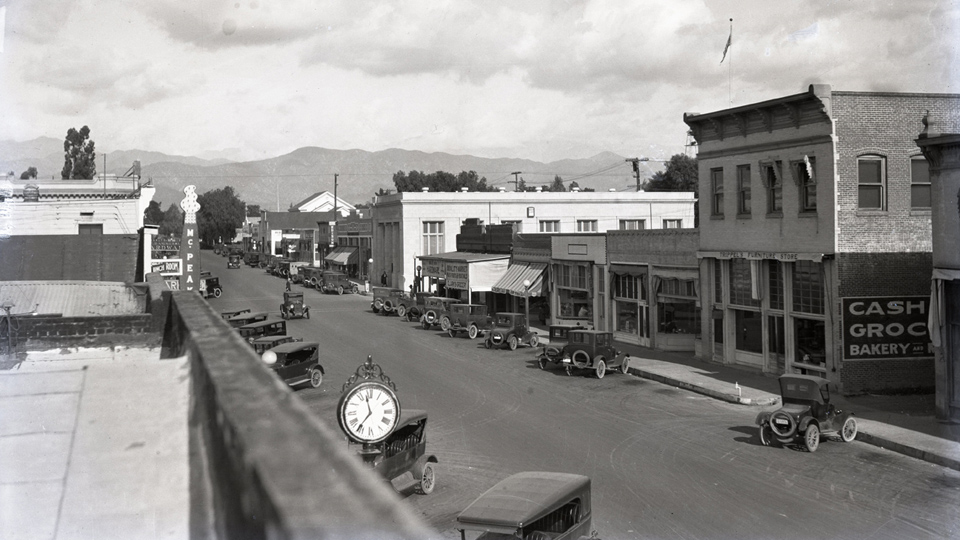
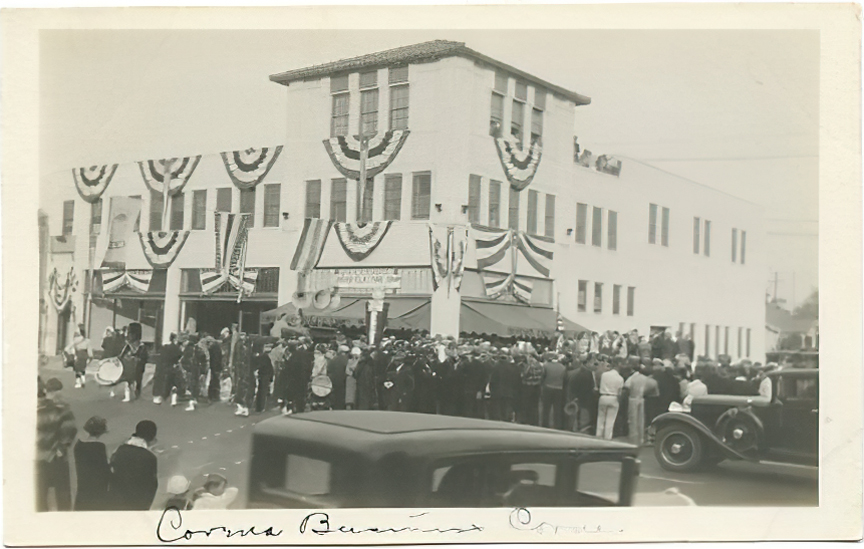
Although I've been interested in my home town's history for decades now, I still get confused sometimes about what happened when. So, I finally decided to make a list of as many significant events as I could think of, and put them all in chronological order. I must say, I wish I'd done this a long time ago! It makes things much easier to place in context and remember.
Much of the information presented here is gleaned from Donald H. Pflueger's "Covina: Sunflowers, Citrus, Subdivisions" (1964), and Dr. Barbara Ann Hall's "Images of America: Covina," (2007). Online resources include the Digital Archives of the Covina Public Library, Newspapers.com, the California Digital Newspaper Collection, the West Covina Historical Milestones webpage, and personal communications with fellow Covina-area historians Glenn Reed (to whose memory this work is dedicated), Randall Smith, Tom Armbruster, Jim Harris and Michael Schoenholtz. Other references are provided in links, and citations for specific entries are available upon request. Please bear in mind: this timeline is an ongoing work in progress. Corrections, additions, and their supporting documentation are always welcome.

July 30, 1769 – Explorers led by Gaspar de Portolá are the first Europeans to set foot in today's San Gabriel Valley. To cross a boggy creek, they construct a makeshift bridge ("Puente"), thus bestowing the first Spanish place name on their new discovery.
September 8, 1771 – Hispanic settlement of what will become Los Angeles County commences with the founding of Mission San Gabriel Arcángel in the province of Las Californias in New Spain. First built on the bank of the Rio Hondo near today's Whittier Narrows, the mission moves to its present location after a flood in 1776.
September 4, 1781 – The founding of El Pueblo de Nuestra Señora la Reina de los Ángeles.
1804 – Las Californias is divided into two new provinces: Alta California and Baja California.
1810 – The friars of Mission San Gabriel build a supply station and chapel 45 miles to the east. In the decades to come, a trail that connects the two Catholic outposts will become an important pioneer transportation link called the San Bernardino Road.
1821 – Mexico gains its independence from Spain.
November 26-27, 1826 – Jedediah Smith is the first U.S. citizen to venture by land into the valley of the San Gabriel. His party camps at the cienega of Mud Springs, now in San Dimas near the west end of today's Palomares Avenue.
November 5, 1841 – The Rowland-Workman Party arrives in Los Angeles from New Mexico via the Old Spanish Trail. The 65-member emigrant caravan comprises multiple nationalities, including Americans, Mexicans and Europeans.
March 9, 1842 – Alta California Governor Juan Bautista Alvarado grants Rancho La Puente to American-born Mexican citizen John A. Rowland. The initial grant holdings comprise 4 square leagues (approximately 23,000 acres) of prime range land east of the San Gabriel River and south of the San Bernardino Road.
1844 – British Crown subject Henry Dalton buys Rancho Azusa and a one-third interest in Rancho San José Adición from Luis Arenas for $7,000.
July 22, 1845 – Governor Pío Pico grants co-ownership of Rancho La Puente to Rowland's fellow settler and business partner, British-born Mexican citizen William Workman. By this decree, the rancho is also expanded in size to 48,790 acres: approximately 76-1/4 square miles.
April 24, 1846 – The beginning of the Mexican-American War. Rancho owners Rowland and Workman each participate in military actions in southwestern Alta California while skillfully straddling both sides of the conflict.
January 10, 1847 – Los Angeles falls to American forces following the Battle of Rio San Gabriel.
February 2, 1848 – The war ends with the signing of the Treaty of Guadalupe Hidalgo, which cedes Alta California to the United States. Under its terms, Rowland and Workman retain ownership of Rancho La Puente, and Rowland regains his U.S. citizenship.
c.1850 – Dalton sets aside a room on Rancho Azusa where the children of the upper valley's earliest settlers can learn their Three Rs.
September 9, 1850 – California becomes the 31st State in the Union.
1852 – The first American settlement in the San Gabriel Valley is founded at El Monte, on the Old Spanish Trail just east of the Rio Hondo.
1854 – The first orange trees are planted in Rancho La Puente.
1858 – The U.S. Government declares most of Henry Dalton's Rancho Azusa to be public land. During the following two decades, hundreds of American squatters/homesteaders will move into the area which today comprises the cities of Baldwin Park, Glendora, Irwindale, and the northern half of Covina. Dalton will spend the rest of his life appealing the dispossession of his property.
1861 – Dalton builds the first enclosed structure dedicated to classroom instruction on the lands east of the San Gabriel River. Called the Brush School because of the thatch used for its roofing, it is said to resemble "a covered corral." Seventeen pupils attend the first year.
1863-1864 – A severe drought decimates the region's cattle industry, and the ranchos of Los Angeles County turn increasingly to agriculture and land sales to survive.
1865 – The first general store and post office in the Lower Azusa Valley is built at "Four Corners" ("Las Cuatro Esquinas"), located at the northwest corner of the San Bernardino Road and Azusa Cañon Road. Orange trees are also planted there.
1866 – William Rubottom founds the town of Spadra: the first American settlement in Los Angeles County located east of the San Gabriel River.
1868 – Rowland and Workman agree to partition Rancho La Puente; Rowland becomes the sole owner of the land which will later become Covina.
c.1870 – A community center–Grange Hall–is erected on the south side of the San Bernardino Road about 500 feet west of today's Vincent Avenue. The gathering place is also used for church services and a school.
1872 – The Azusa Valley's first wood frame schoolhouse–Center School–is built at the southeast corner of today's intersection of Cerritos Avenue and Gladstone Street.
Fall, 1873 – Lower Azusa School–the first in what will become the Covina area–opens for classes south of the Azusa Cañon Road and west of San Dimas Wash (now the southwest corner of Cypress Street and Lark Ellen Avenue).
October 14, 1873 – "Don Juan" Rowland dies at the age of 82.
May 17, 1876 – "Don Julian" Workman kills himself following the failure of the Temple & Workman Bank and the subsequent forfeiture of his portion of Rancho La Puente to E. J. "Lucky" Baldwin.
September 2, 1876 – Costa Ricans Pedro Maria Badilla and Jose Julian Badilla purchase 5,563 acres of Rancho La Puente from Charlotte M. Rowland et al. for $45,000, intending to grow coffee. Julian and younger brother Pedro Antonio Badilla subsequently build houses on the south side of the San Bernardino Road west of today's Hollenbeck Avenue and work the land together. Pedro Maria, a Catholic priest, is an episcopal assistant to the Right Reverend Bishop Amat of Los Angeles.
September 5, 1876 – The Southern Pacific Railroad completes its new line connecting Los Angeles to San Francisco and the transcontinental railway system beyond. The S.P.R.'s right-of-way does pass through Rancho La Puente, but to the south of the San Jose Hills, bypassing the Azusa Valley.
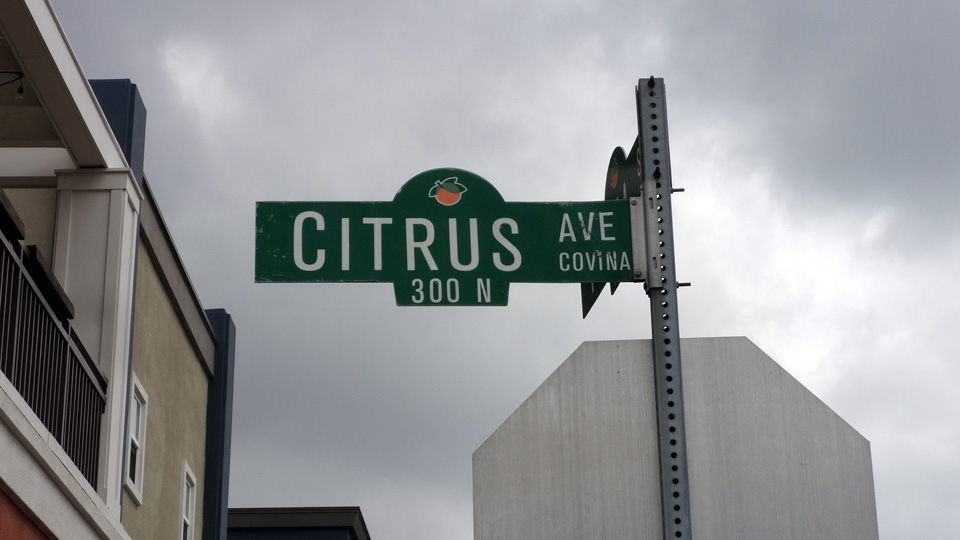
1877 – Eugene C. Griswold builds a general store and meeting hall at the northeast corner of Azusa Road No. 2 (today's Citrus Avenue) and Azusa Cañon Road (Cypress Street), which also becomes the Covina area's first post office. Griswold's pioneer settlement is named "Citrus." The store closes in 1879, but Griswold's Hall remains the local post office until 1887.
1877 – The "Badillo Brothers" successfully grow 500 coffee plants, but the experiment is abandoned due to water issues and high labor costs.
Summer, 1878 – "Badilla & Co." harvest a bumper wheat crop so well adapted to local conditions and resistant to blight that it is sold for seed rather than milled for flour.
Winter, 1878-1879 – Julian Badilla moves his family to Mexico.
June 3, 1879 – After buying the delinquent Badilla mortgage from the Rowlands, J. Edward Hollenbeck forecloses on the Badillas and acquires the entirety of their lands on June 27.
Late 1879 – Old San Bernardino Road becomes a county road and is widened and straightened to its current alignment.
1880s – The cultivation of wheat, barley, and grapes dominates agriculture in Rancho La Puente.
1881 – J. B. Beardslee plants the first navel orange trees in the valley on his north Citrus Avenue property.
September 7, 1881 – J. E. Hollenbeck deeds Antonio Badillo [sic] 100 acres of his elder brothers' former land for a consideration of $1. The deed is recorded on September 10, 1881, at 2:03 PM.
September 7, 1881 – Covina's genesis is set in motion when businessmen Joseph Swift Phillips contracts to buy 2,000 acres of former Badilla lands from J. E. Hollenbeck. The purchase price is $30,000 with 5 years to pay, and Phillips must plant the tract in grain and give Hollenbeck half of each harvest's proceeds. The agreement is recorded on September 13, 1881, at 12:41 PM.
Early 1882 – Joseph Phillips and family move into Julian Badilla's former house on San Bernardino Road.
June 6, 1882 – Incorporation of the Azusa Water Development and Irrigating Company. In November, 1883, J. S. Phillips acquires a controlling interest and begins construction of a 7-mile-long cement ditch to bring San Gabriel River water to his land.
November, 1883 – The first public building erected on the future site of Covina is a schoolhouse located on 2.85 acres at the southeast corner of San Bernardino Road and Citrus Avenue. J. S. Phillips and M. Baldridge partner in its construction, and Miss Sherman is the first teacher.
January 21, 1884 – "Don Enrique de Azusa" dies empoverished in Los Angeles.
April 3, 1884 – Joseph Moxley is the first to buy land in the Hollenbeck/Phillips Tract: 20 acres lying southwest of the intersection of San Bernardino Road and the quarter section line of Section 13, Township 1 South, Range 10 West, S.B.B.&M., soon to be known as Barranca Street. Sue Pollard and J. S. Eckles also buy parcels that month; the three sales combined now leaving 1,956.75 acres of the larger tract as yet unsold.
November, 1884 – A group of German Baptists express an interest in establishing a religious colony on Phillips' Azusa Valley land and sign a purchase agreement for the entire acreage. Various names suggested for their new settlement include "Pilgrims Home," "Los Covinas," and "Covena." However, Phillips is unable to secure enough water for their needs before the "Dunkards" abandon their plan.
December, 1884 – Future Los Angeles mayor Frederick Eaton completes surveying and subdividing the Phillips Tract into 10.1-acre lots. On his plat map, Eaton officially names the 120-acre town site "Covina."
December 12, 1884 – Newspaperman H. N. Short and associate J. R. Conlee arrive in Covina to start The Covina Independent, and soon after erect the new town site's first structure–their print shop–at the southwest corner of Citrus and Badillo. The same day, C. W. Potter opens his blacksmithing shop under a spreading pepper tree in the newborn business district.
Spring, 1885 – Samuel Allison builds the first residence in the Covina town site at 160 West Badillo Street. Newspaper editor Conlee's house goes up soon after at 202 West College Street.
January, 1885 – The Phillips Tract opens for land sales, The Covina Independent publishes its first edition, and Covina's first general store is built by F. E. Grover at the northeast corner of Citrus and Badillo. A butcher shop and grocery soon follow.
January 8, 1885 – Phillips borrows $40,000 from the Pacific Mutual Life Insurance Company to pay Hollenbeck in full. To secure the loan, Hollenbeck and Phillips jointly convey the 1,956.75-acre tract to trustee James F. Houghton, who is vested with legal title to the land until Phillips repays the loan.
January 20, 1885 – The first ad announcing land for sale in the Phillips Tract appears in the Los Angeles Daily Times.
March 13, 1885 – A roller skating rink built on the west side of Citrus Avenue in Covina opens with a grand ball attended by people from all over the valley. The town's first church services are also held at the rink.
September 2, 1885 – J. Edward Hollenbeck dies suddenly at 56 at his home in Boyle Heights, Los Angeles.
December 24, 1885 – The Covina Social Club opens a community center on East Badillo Street, appropriately named Covina Hall. It also hosts church services.
January 15, 1886 – Francisca Vicenta (aka "Francis") Badilla, a daughter of Antonio Badilla, files a $25,000 civil suit against J. S. Phillips alleging seduction resulting in pregnancy. Phillips publicly pronounces the charge to be "blackmail of the meanest type," and the plaintiff withdraws the complaint 18 days later.
February, 1886 – Antonio Badilla sells his 100 acres to Covina pioneer Daniel Houser for $12,000, then subsequently moves most of his family back to Costa Rica. Eldest sons Rafael and Vicente remain in California and are employed by Phillips.
April, 1886 – The "Phillips Ditch" is completed following construction of a 10,000,000-gallon irrigation reservoir located on the south side of San Bernardino Road west of Grand Avenue.
Fall, 1886 – J. R. Hodges builds Covina's first permanent structure out of concrete on the south side of Badillo Street east of the Pioneer Blacksmith Shop. The following year, the town's first telephone is installed in Hodges' "Concrete Block."
1887 – Covina's first post office opens in the B. F. Eastman store on the southeast corner of Citrus and Badillo. It moves to the Warner Bros. grocery on Citrus the following year and J. Moxley becomes postmaster.
1887 – Center School is expanded to 4 rooms and is the first in the valley to organize classes by grades.
June 1, 1887 – Transcontinental rail service comes to the Azusa Valley with the arrival of the Atchison, Topeka and Santa Fe Railway. The line directly connects the neighboring towns of Azusa, Glendora and Alosta to Los Angeles in the west and Chicago in the east.
June 1, 1889 – J. S. Phillips defaults on his 1885 loan and loses all of his unsold Covina acreage in a forced sale. He subsequently departs the town he fathered.
Early 1890s – Large orchards of deciduous and citrus fruit trees begin replacing the grain fields and grape orchards of the Eighties.
1890 – Dr. James Denny Reed becomes Covina's first resident physician.
1891 – Charles Homer Ruddock builds the largest mansion in the Azusa Valley–Mountain View–on former Badilla/Hollenbeck lands to the immediate east of the Phillips Tract.
July 14, 1891 – The Citrus Union High School District is formed to jointly serve the communities of Azusa, Covina and Glendora. Citrus High's first classes are held that September in an abandoned hotel in the defunct settlement of "Gladstone" north of Covina.
December 10-11, 1891 – A powerful wind storm destroys many buildings in the budding town, including Citrus High School and Covina's skating rink.
August, 1893 – Area orange growers form the Azusa-Covina-Glendora Citrus Association. Several small packing houses are opened along the Santa Fe rail line through Azusa and Glendora. Lemon growers form a similar association in 1895.
1894 – Two new 2-storey schoolhouses are constructed to replace the pioneer-era Phillips and Lower Azusa buildings. Charter Oak also opens its own schoolhouse at the southwest corner of Bonnie Cove and Cienega Avenues.
Late 1890s – Citrus cultivation steadily grows to become the dominant form of agriculture in the Covina area.
September 9, 1895 – Service begins on the new spur line of the Southern Pacific Railroad through Covina. (Today's Metrolink right-of-way.)
September 20, 1895 – Anticipating increased traffic to and from the new Southern Pacific station at the north end of Second Street, Mr. & Mrs. Benjamin F. Cook and Mr. & Mrs. Charles E. Bemis grant strips of their land to Los Angeles County allowing for the widening of Second from 50 to 100 feet.
October 10, 1895 – The town's first bank opens: a Covina branch of the Azusa Valley Bank.
October 14, 1895 – The Covina Citrus Association is incorporated.
December, 1895 – The Houser Bros. packing house–Covina's first large-scale citrus processing operation–is erected alongside the new Southern Pacific rail line.
March 26, 1896 – The Covina School District is formed.
1896 – The Pomona Road (today's Covina Hills Road) is completed over the eastern San Jose Hills.
1896-post WWII – With its own citrus industry, rail transportation links, schools and financial institutions now established, Covina's future is assured, and its first boom begins. The "Era of Citrus" will span the next half-century.
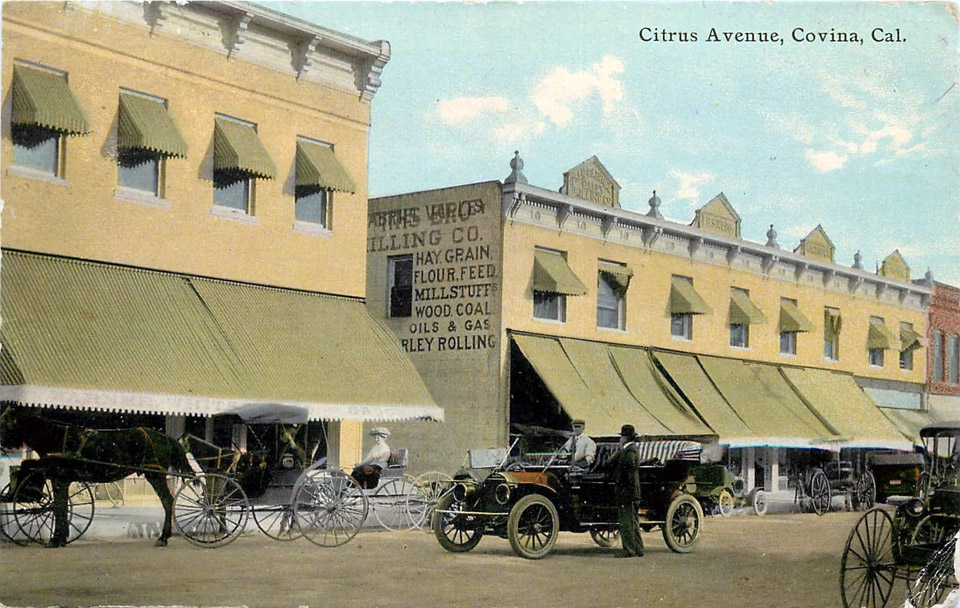
1897 – The Chapman/A.O.U.W. Block is erected at the northwest corner of Citrus Avenue and Badillo Street. It is known today as the Old Covina Bank Building.
May 10, 1897 – The Covina Reading Room and Library Association is formed. The first donation comprises 50 books.
April, 1898 – Local investors headed by C. H. Ruddock buy the Covina branch of the Azusa Valley Bank and re-name it the Covina Valley Bank.
June 6, 1898 – The Azusa Water Development and Irrigating Company changes its name to the Covina Irrigating Company, which today is the city's oldest business operating in the same location (146 E. College Street).
October 11, 1898 – Seventeen ladies gather in the home of Mrs. J. J. Morgan and organize the Monday Afternoon Club, which subsequently incorporates as the Covina Woman's Club.
1899, 1909 – The headquarters of the Covina Valley Bank—later the First National Bank of Covina—is constructed in stages at the northwest corner of Citrus Avenue and College Street.
August 28, 1899 – Covina High School opens, offering secondary-level education on the upper floor of the newly-expanded Grammar School. Lillie E. Harris is the first graduate of Covina High in Spring, 1900.
1900 – The landmark Reed Block is erected at the northeast corner of Citrus Avenue and Badillo Street.
August 11, 1900 – Covina's first hotel, The Vendome, opens at the northwest corner of Citrus and Cottage Drive. After changing its name to the Covina Hotel in 1916, it closes in 1928 and is torn down in 1935.
January 21, 1901 – The 20th century officially dawns in Covina with the arrival of electricity and electric lights.
March 27, 1901 – The Covina Valley Bank obtains a national charter and is reorganized as the First National Bank of Covina.
July 30, 1901 – Covinans vote 91-68 to incorporate. The California Secretary of State certifies the creation of the new city of the sixth class on August 6, and the final order for incorporation is entered by the County Board of Supervisors on August 14.
August 20, 1901 – Eri Gregg Clapp is sworn in as the first Chairman of the Board of City Trustees. The other Trustees are C. W. Potter, L. L. Ratekin, Thos. E. Finch and Joseph Moxley. F. M. Douglass is City Treasurer, E. B. Carrier is City Clerk, C. F. Parker is City Recorder and I. C. Fairly is City Marshal.
September 4, 1902 – The Covina Home Telephone Company is formed. By mid-1903, almost a hundred homes and businesses are connected to the network, and in October, 1903, long distance service to Los Angeles becomes available.
1902-1903 – Fifty electric street lights are installed in town. Forty-one more are added in 1908.
January 5, 1903 – Classes begin in the new Covina High School building located on San Bernardino Road behind the Grammar School and facing Park Avenue.
November 4, 1903 – The C. W. Tucker photographic studio opens for business. Through its direct successor—Powell Camera Shop—it would serve the Covina community for the next 123 years, finally closing in April, 2026.
November 5, 1903 – The first spike is driven for the Pacific Electric Railroad trolley line along Badillo Street. (Full interurban service in the P.E. network would not begin until June 5, 1907, however.)
1904 – Concrete sidewalks and curbs are installed along Citrus Avenue.
Fall, 1904 – Robert E. Dancer is the first to settle, drill for water and cultivate land in the area that will become West Covina. He plants English walnuts on his 34-acre property, others follow suit, and the area becomes known locally as "Walnut Center."
1904-1905 – Flood-prone Walnut Creek is channelized from Sunset Avenue west to the San Gabriel River.
December, 1904 – Lucky Baldwin commences subdividing his land south of Arroyo (later Garvey) Avenue.
April 26, 1905 – A new home for the Covina Woman's Club opens at the northwest corner of Citrus Avenue and Center Street.
May, 1905 – Mrs. I. I. Cook conveys to the city a 125' x 150' plot of land on the southeast corner of Second and Italia Streets for the construction of a library.
October 24, 1905 – Covina founder Joseph Phillips dies.
December 4, 1905 – Dedication of the new Carnegie Library. Henrietta M. Faulder—librarian since 1902—will serve continuously in her position there until her retirement in 1934.
April 14, 1906 – Dr. J. D. Reed establishes the Covina National Bank. Its first headquarters is in the Reed Block at the northeast corner of Citrus and Badillo.
1906-1907 – Baldwin's 4th and 5th Subdivisions in Rancho La Puente lay out the grid of streets of what will later become West Covina.
1907 – The Covina Union High School District is established to provide secondary education to the communities of Covina, Charter Oak, Lower Azusa/Vineland (Baldwin Park), and Walnut Center/Irwindale (West Covina).
1908 – Voters approve bonds to fund the purchase of land and construction of the larger high school.
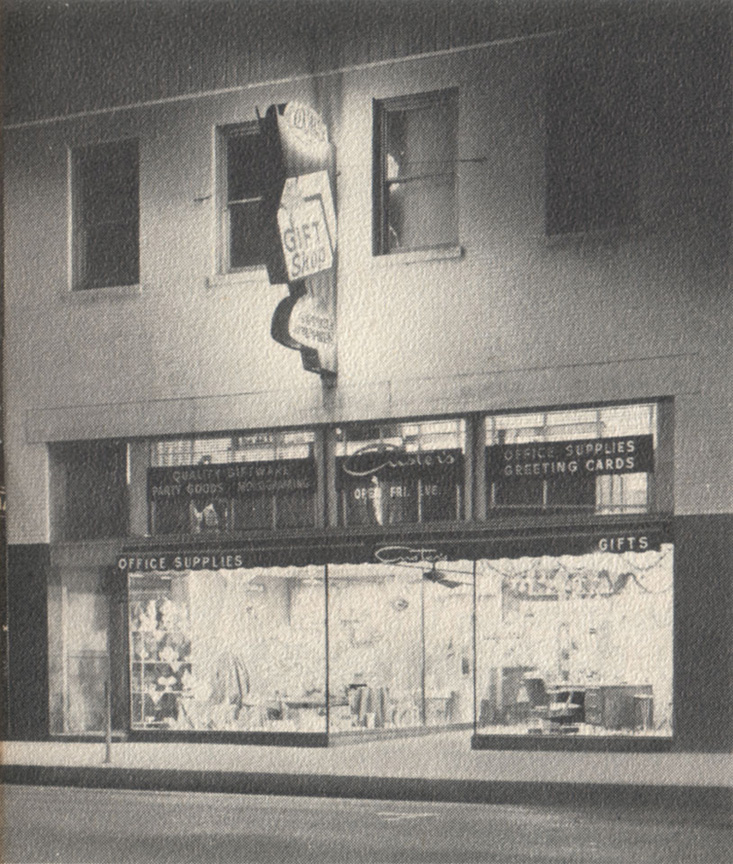
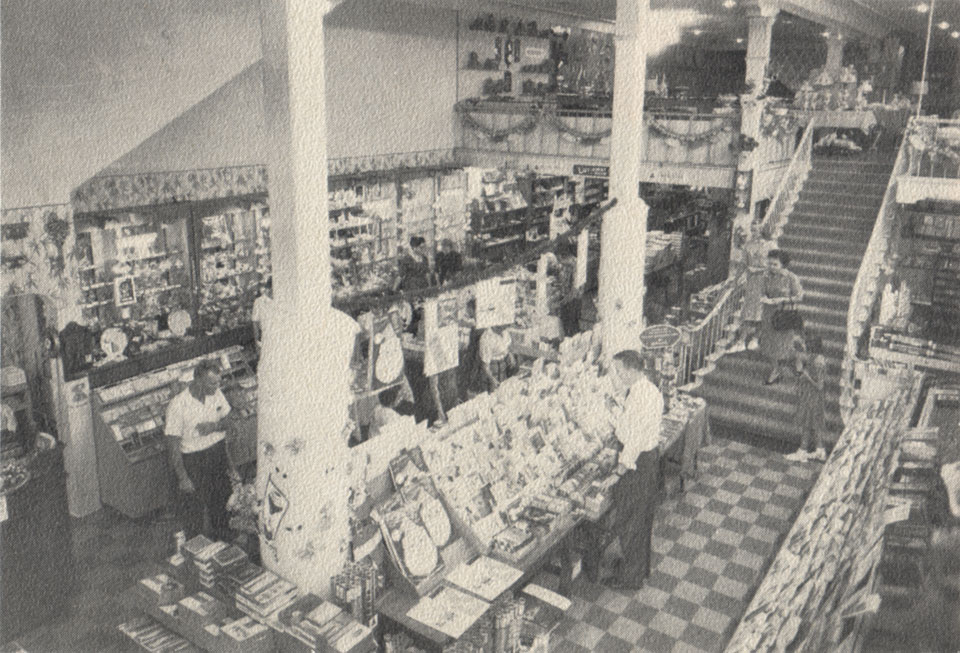
February 15, 1909 – Warner, Whitsel & Co. (est. 1891) open their new grocery store in the Buller Block at 126 N. Citrus Avenue. The building is known to later generations of Covinans as Custer's.
March 1, 1909 – The rancho period ends upon the death of Lucky Baldwin.
March 30, 1909 – Dedication ceremony of Covina Union High School. Located on the west side of Citrus Avenue between Puente and Dexter Streets, instruction at the new civic landmark begins on September 20.
August 7, 1909 – Covina Argus editor J. L. Matthews encourages adoption of the name "West Covina" for the farming community to the south and west of the city.
September, 1909 – Irwindale School opens south of Walnut Creek on the west side of today's Sunset Avenue halfway between Cameron and Merced. Eleven students are enrolled in its first year. In 1914, the name is changed to West Covina School, and to Sunset School in 1950.
1910 – The 1894 grammar school is renamed the Reed School for philanthropist Dr. James D. Reed, and Lower Azusa is renamed for famed singer "Lark" Ellen Beach Yaw.
March 7, 1910 – The major league Chicago White Sox come to Covina to play its celebrated champion town team. The pros defeat the local amateurs 5-3.
May, 1910 – Center is the first street in town to be paved. Citrus Avenue from Center to School Street is paved in April, 1911.
February 3, 1912 – The Covina Women's Christian Temperance Union install a sanitary drinking water fountain in front of the Chapman/A.O.U.W. Block at the southern entrance to downtown. The little landmark will stand until 1932.
1913 – Covina's first fire truck is placed in service.
Fall, 1915 – The Citrus Union High School District opens Citrus Junior College: the first public community college in Los Angeles County.
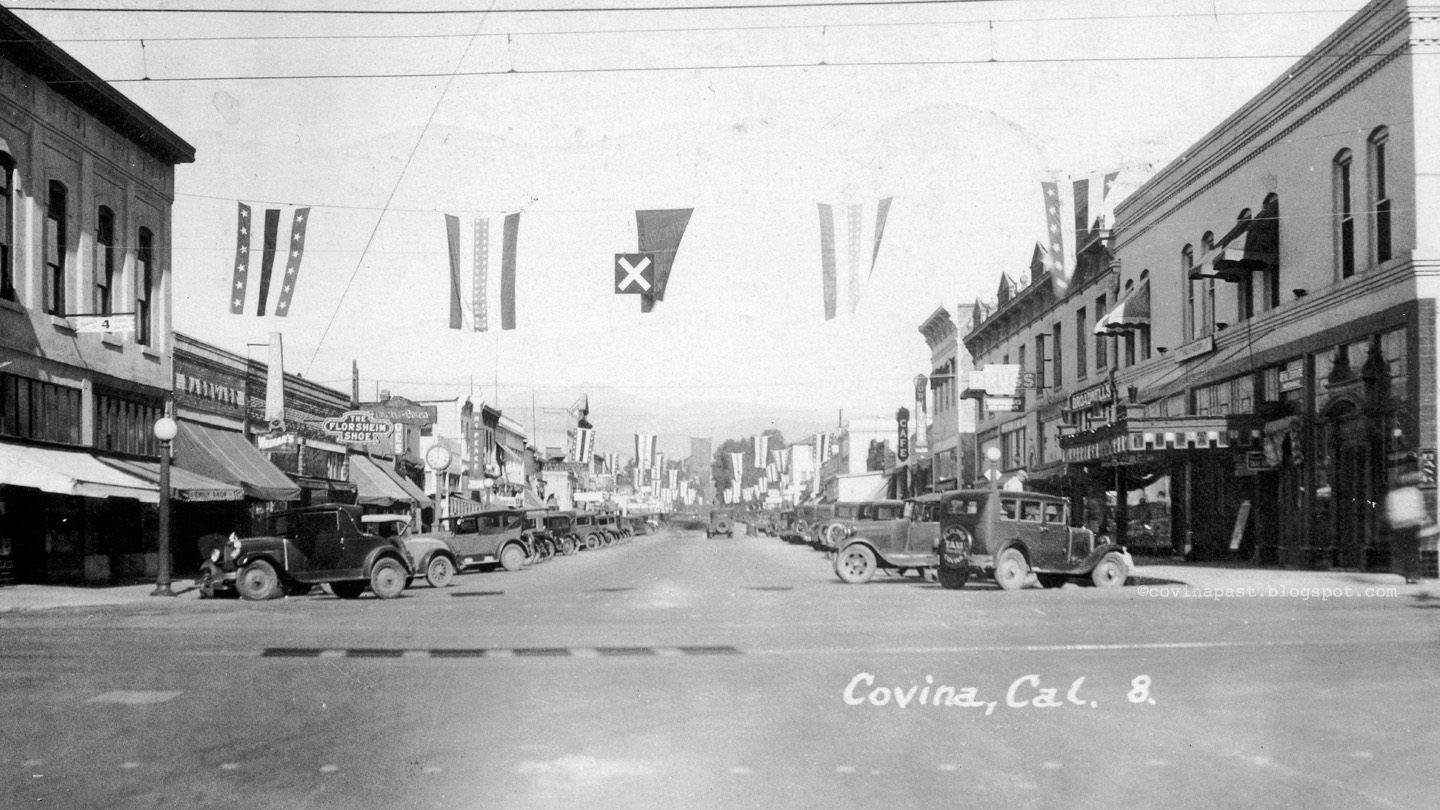
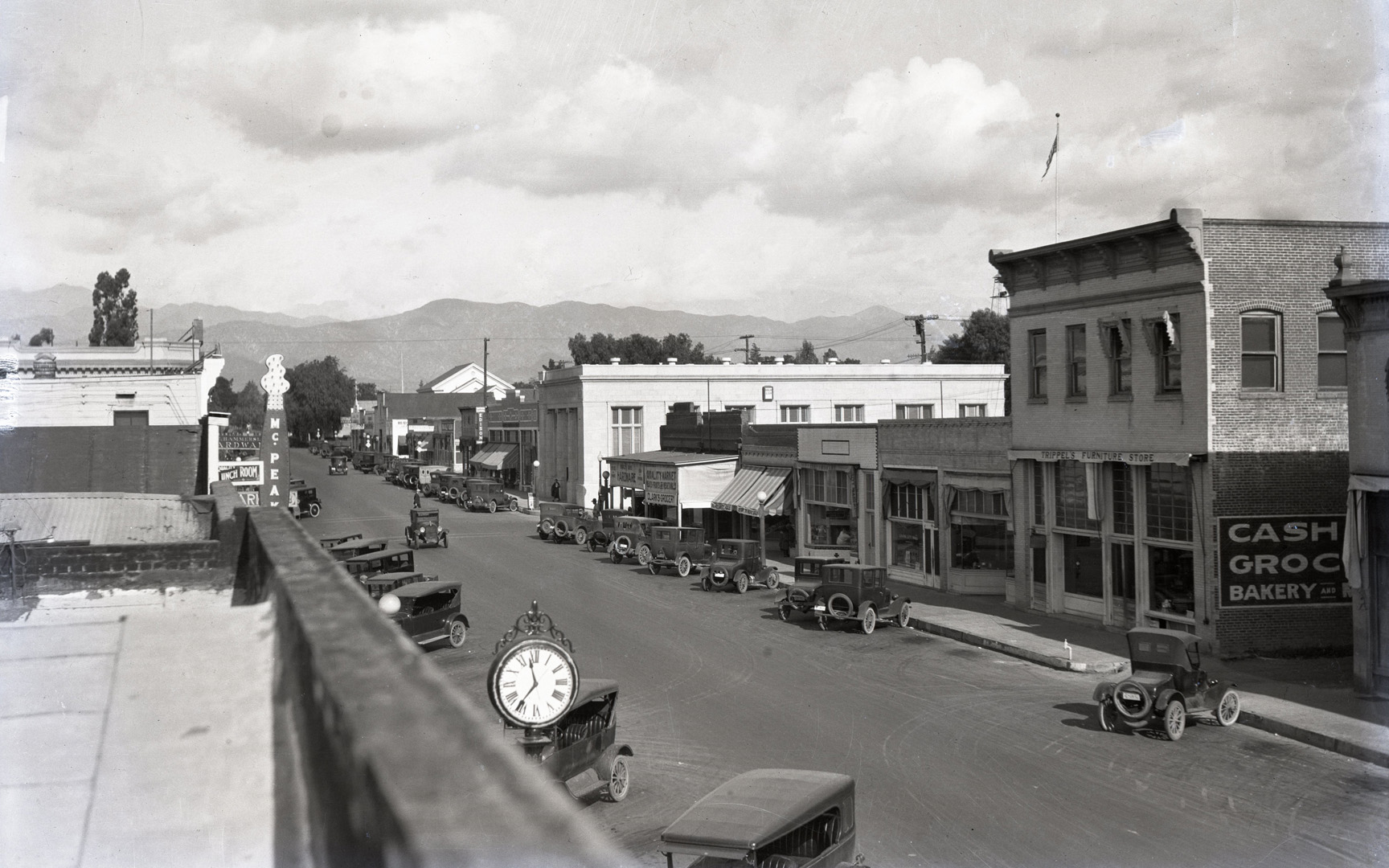
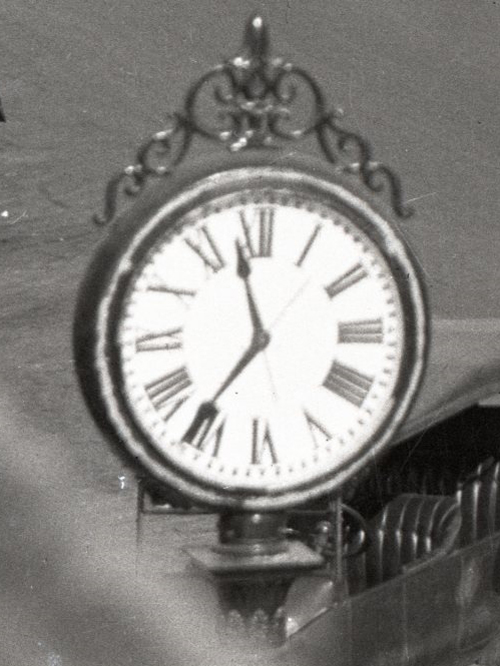
April, 1916 – The street clock in front of the Finch Brothers Jewelry Store on Citrus Avenue is installed. In 1925, it is upgraded to run on electricity.
September 8, 1917 – Dedication of the Masonic Home on East Badillo Street in Charter Oak.
1919 – The fourth and last Covina Grammar School is constructed at the southeast corner of Citrus Avenue and San Bernardino Road.
March, 1919 – Wellesley P. Magan, M.D., opens a surgical practice in Office 64 of the First National Bank Building at Citrus and College, establishing the foundation of what will later become the Magan Clinic. He is joined by his younger brother, Dr. Shaen S. Magan, in October, 1921.
1920 – A new Lark Ellen School opens, and the old high school building is moved to the southwest corner of Second and School Streets and dedicated as the Covina Masonic Temple.
May, 1921 – Ten acres of the Adams Tract west of Fourth Street are acquired for the development of Covina Park.
December 19, 1921 – Opening night of the Covina Theatre. "Bits of Life," starring Wesley Barry, Rockliffe Fellowes, and Lon Chaney, Sr., is the first film shown in the new motion picture venue.
March, 1922 – Mrs. F. E. Wolfarth wins a Chamber of Commerce prize for her suggestion for a new city motto: "One Mile Square and All There." (However, the slogan actually used by the C-of-C was "A Mile Square...")
Summer, 1922 – Graduate nurses Misses Melisse Wittler and Lavina Graham open the city's first hospital in the former Charles E. Bemis home at the northwest corner of Badillo and Second Street. Mary Wittler joins the partnership soon after.
February 3, 1923 – The 507 residents of West Covina vote over 3:1 in favor of incorporation. Two days later, it is officially declared a city of the sixth class by the Los Angeles County Board of Supervisors.
1924 – Arrow Highway is proposed as a major arterial boulevard connecting San Bernardino to Los Angeles. Disputes over routing through Covina, San Dimas and La Verne drag on for decades, however, and the project as originally envisioned is never completed.
1924 – San Jose Hills Road (roughly following today's South Grand Avenue) gives Covinans a direct route to the Walnut Valley and on to Orange County.
1924 – The First National Bank of Covina erects a new headquarters at 200 North Citrus. The landmark building constructed by Edward A. Hubbard will house a succession of major financial institutions in the decades to come.
August 11, 1924 – Ground is broken for a new Covina Hospital at the southeast corner of Cottage Drive and Fourth Street. That same year, the Magan Clinic moves to its own building at 155 West College Street.
May, 1925 – The high school's new Science Hall is completed and readied for occupancy the following Fall term.
January 2, 1926 – Construction begins on a new $300,000 campus for the California Preparatory School for Boys on the former H. M. Houser ranch in the Covina Hills, 1-1/2 miles southeast of town.
April 30, 1927 – The Covina swimming plunge officially opens at Covina Park.
January, 1928 – Puddingstone Dam is completed across Walnut Creek. It is 147 feet high and 825 feet long at its crest. Although construction began in July, 1927, a reservoir at this site had been proposed as early as 1888.
May, 1928 – The opening of the Holt Avenue bypass southeast of Covina eases motor travel over the hills between Pomona and points west.
October, 1929 – Covina Hospital completes its new 50-bed facility at 257-267 West College Street.
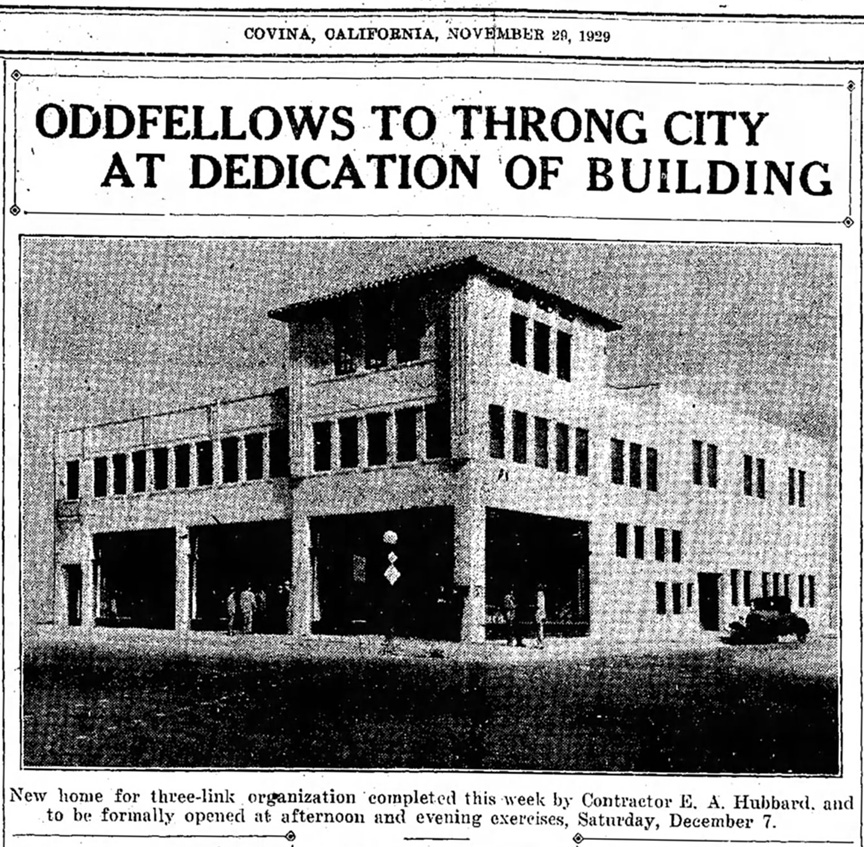
December 7, 1929 – Dedication of the Oddfellows Building on the northeast corner of Citrus and Italia: Covina's first 3-storey commercial structure.
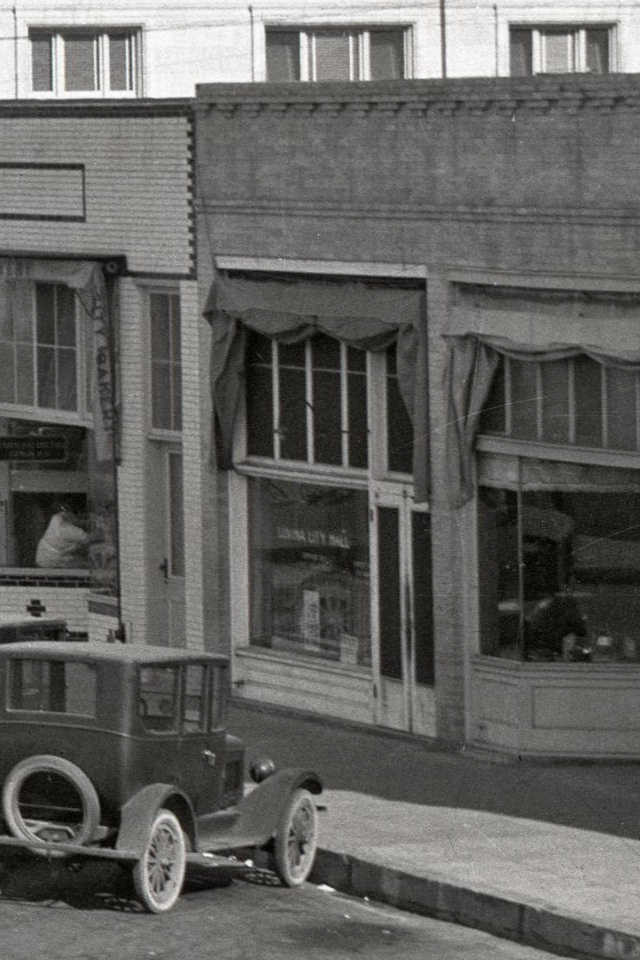
January 25, 1930 – Dedication of the new Covina City Hall on East College Street.
December, 1930 – The Covina Drive-In Market opens on the southwest corner of Citrus and San Bernardino Road.
September, 1931 – San Dimas Avenue now connects its namesake and neighboring cities to Holt Avenue in west Pomona and destinations further south.
May, 1933 – The new 3-lane Holt-Garvey Highway (CA-26, US-99-60-70) is completed over Kellogg Hill to Pomona. It is widened to 4 lanes in 1937.
October 13, 1934 – The city celebrates 50 years since its founding with a parade said to be its longest and largest ever.
April, 1937 – The First National Bank of Covina is purchased by Bank of America.
1938 – The Voorhis School for Boys (est. 1928)–located on South Valley Center Avenue in the Covina Hills–becomes the southern campus of the California Polytechnic School. In 1956, it relocates to the former W. K. Kellogg Arabian horse ranch, ultimately becoming today's Cal Poly Pomona.
May 4, 1940 – The new United States Post Office is dedicated at the southwest corner of College Street and Second Street.
1941 – George Meeker's "Sunkist Village" is West Covina's first suburban housing development.
May, 1942 – Cal Prep announces the sale of its Covina campus to the Theosophical Society Point Loma and moves to the former Foothills Hotel in Ojai.
1945-1946 – The "quick decline" virus spreads through the orange groves, killing thousands of trees. The devastating blight heralds the beginning of the end of Covina's Era of Citrus.
1945-1955 – High demand for new suburban housing after World War II results in a shifting of the local economy from agriculture to residential real estate and construction, ushering in Covina's second boom.
Fall, 1946 – Classes begin at Mount San Antonio College in Walnut, affording local high school graduates a stepping stone to higher education.
March 28, 1947 – Citing competition from private automobiles, Pacific Electric ends its trolley service to Covina.
April, 1947 – Known variously over the past half-century as the Pomona Road, the Pomona & Covina Road, Pomona Hill Road, and Holt Road, the curvy old pioneer-era route from Rowland Avenue to the summit of Kellogg Hill is officially re-named Covina Hills Road.
September 9, 1947 – "Lark" Ellen Beach Yaw passes away.
January 1, 1948 – Covina Hospital changes ownership and becomes Inter-Community Hospital.
December, 1948 – The Santa Fe Dam is completed north of Arrow Highway in Irwindale, ending the threat of flooding from the San Gabriel River. The river rock dam is 92 feet tall and almost 5 miles in length.
Fall, 1951 – The California Baptist Theological Seminary opens at its campus on Covina Hills Road, occupying the former buildings of the California Preparatory School and Theosophical Society. The seminary ordains its last ministers in 1974.
August 1, 1952 – The first stores of West Covina Center are opened on Garvey Boulevard just west of Glendora Avenue.
1953 – The Covina Grammar School on Citrus Avenue is closed, and in 1955, the building is sold to Aetron: a division of Aerojet-General Corporation.
August 10, 1953 – Alpha Beta opens a new, modern grocery store on the southeast corner of Citrus Avenue and Rowland Street.
December 2-4, 1954 – Shoppers Lane, adjoining the southeast corner of Citrus and Rowland, celebrates its grand opening.
1956-1957 – The San Bernardino Freeway (later Interstate 10) is extended through the West Covina area, and is completed over Kellogg Hill to Pomona on April 26, 1957.
February 11, 1956 – The Googie architecture jewel Covina Bowl opens at 1060 West San Bernardino Road.
Fall, 1956 – Covina High moves to its new campus on Hollenbeck Avenue, and West Covina High holds its first classes at the former CUHS campus. WCHS will move to its new site on Cameron Avenue in West Covina the following Fall. Edgewood Freshman High School is the last to occupy the grounds during the 1958-1959 school year.
October 25-December 20, 1956 – Grand openings of the anchor stores at the new West Covina Plaza shopping center on Garvey Boulevard west of Vincent Avenue.
April 11, 1957 – McCaiges of Covina–the first standalone department store in the eastern San Gabriel Valley–formally opens across from Covina Bowl on the southeast corner of San Bernardino Road and Rimsdale Avenue.
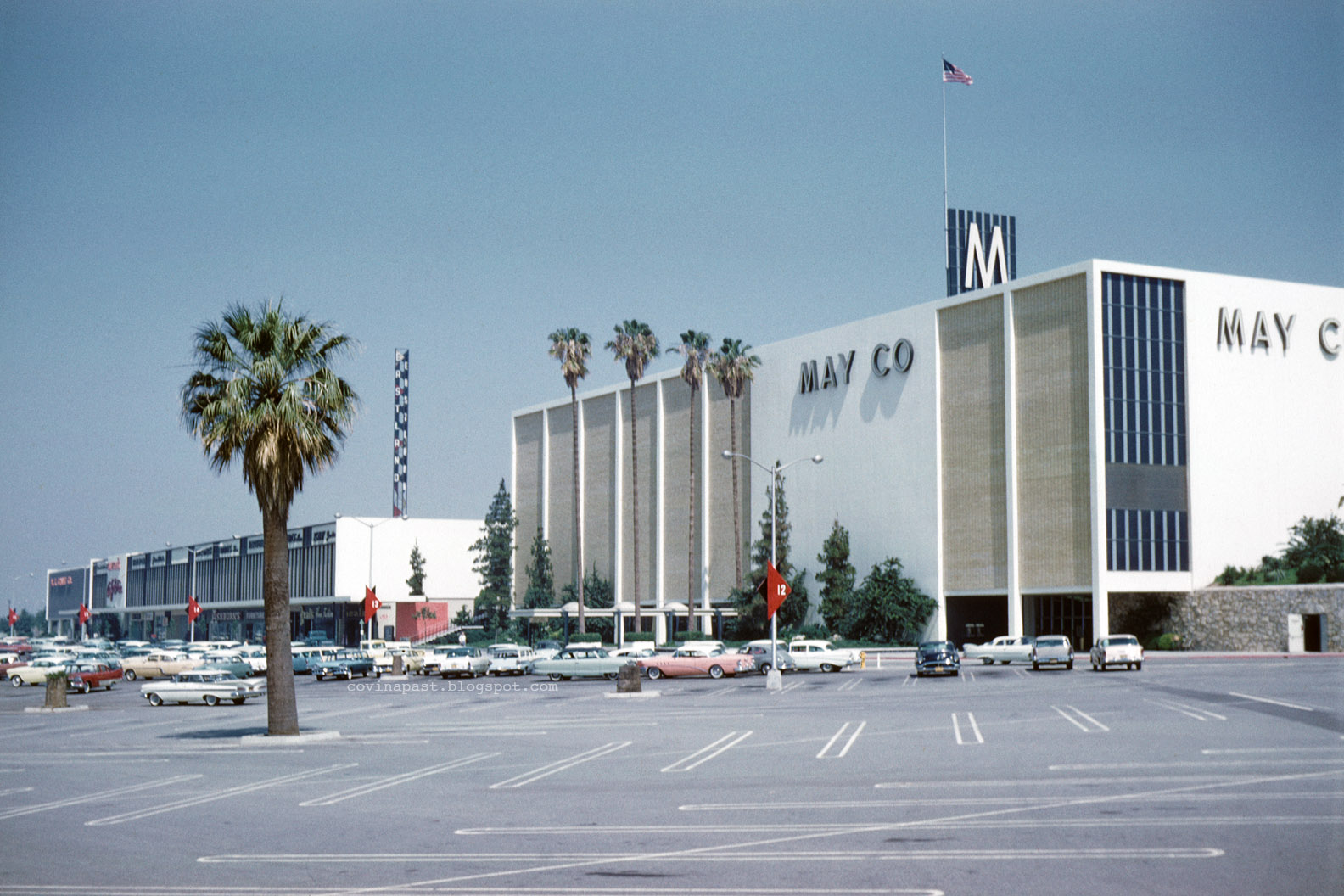
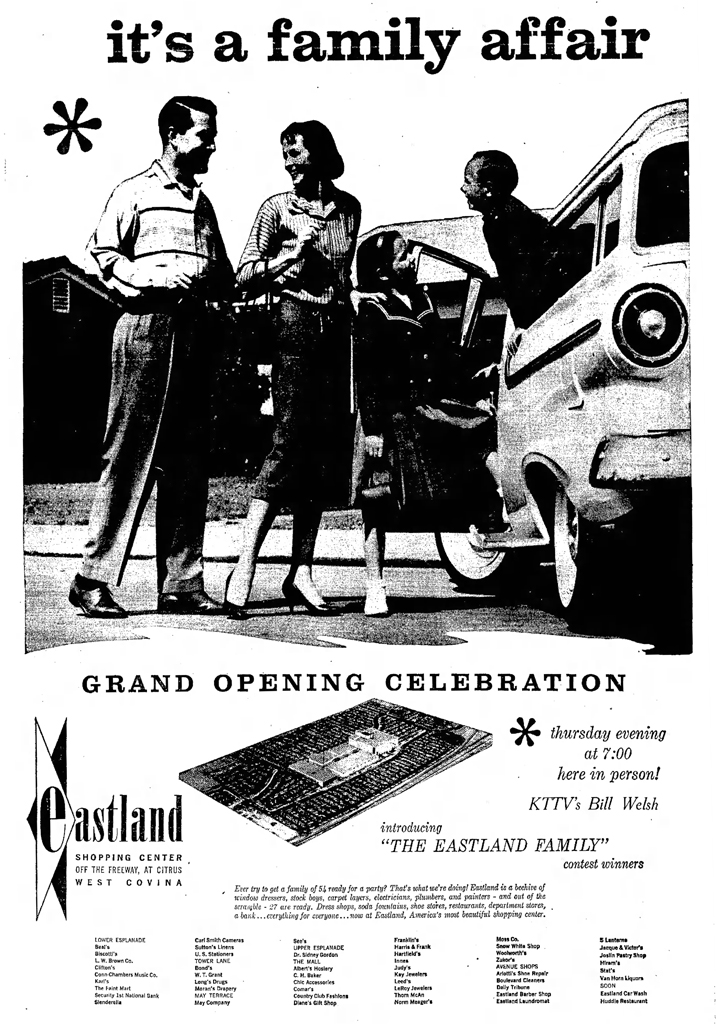
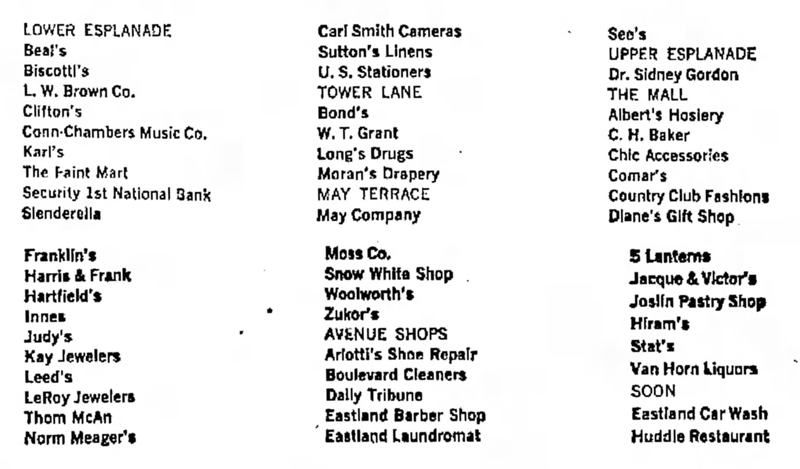
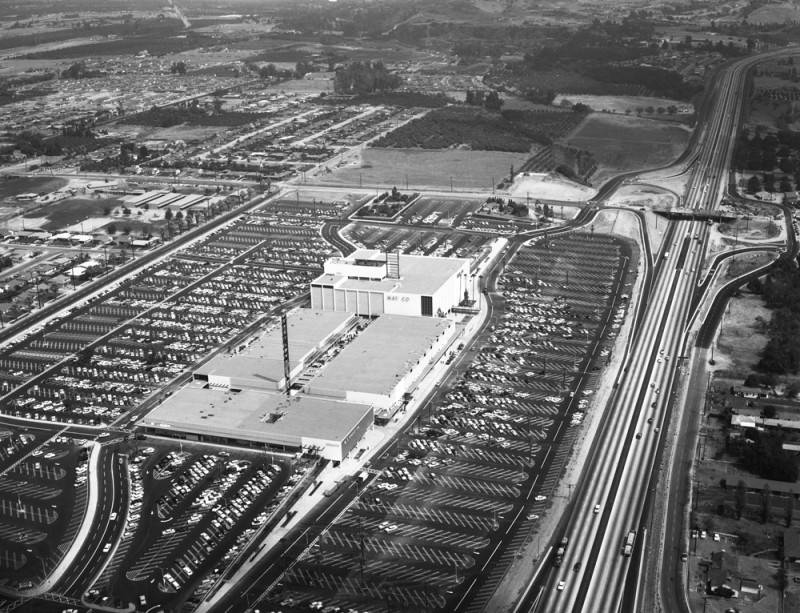
October 24-26, 1957 – Grand opening of the Eastland Shopping Center in West Covina. It is the sixth modern mall built in the Southland, and the first to be located adjacent to a freeway.
May 9, 1958 – Builders Emporium takes over the location of McCaiges department store becoming the area's first home improvement center.
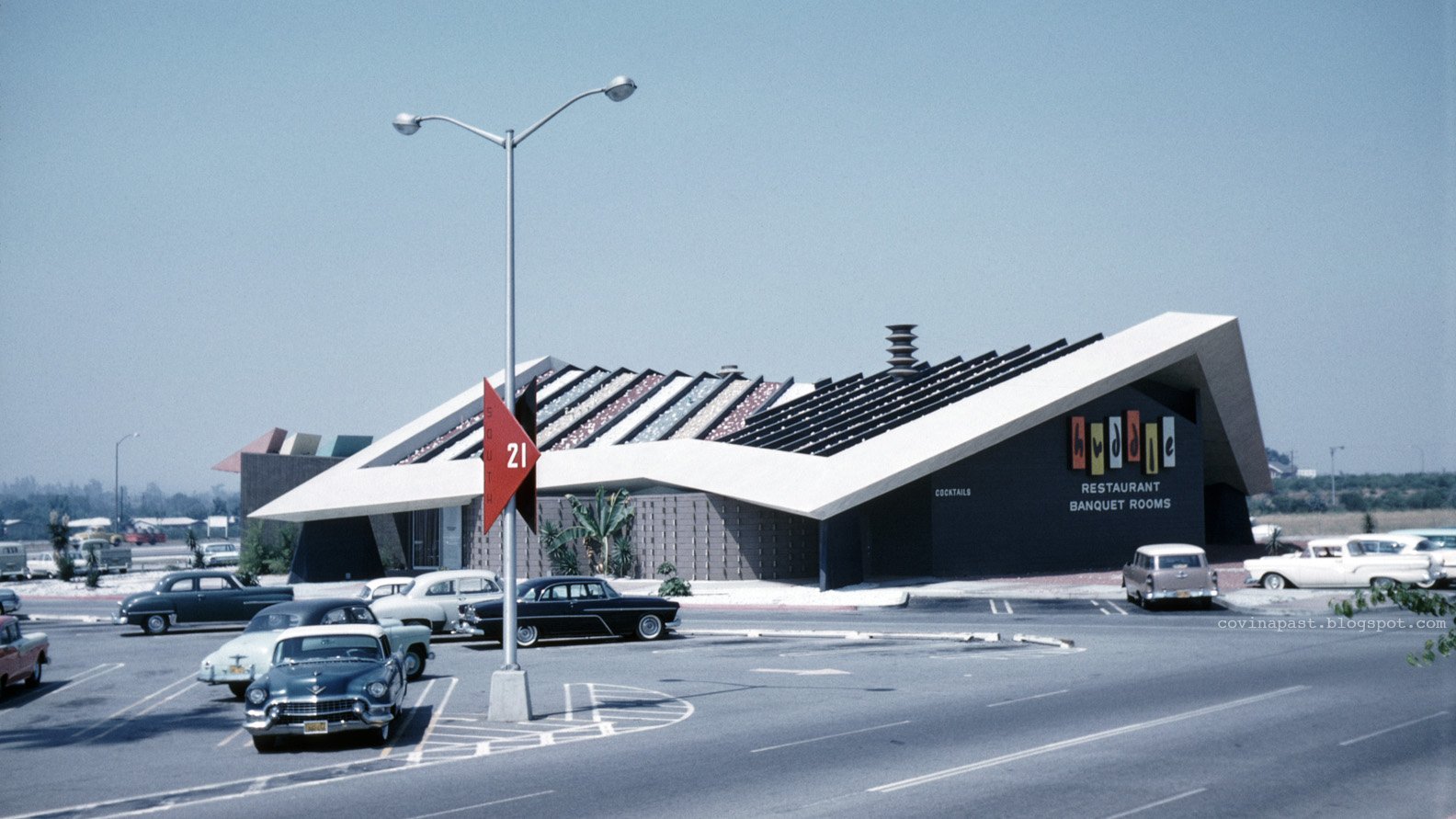
August 27, 1958 – The Huddle restaurant in the Eastland Shopping Center–another Googie classic–serves its first customers.
Fall, 1959 – Classes begin at the new Northview High on Cypress Avenue, Charter Oak High on East Covina Boulevard and at Edgewood High at Merced and Orange Avenues in West Covina.
December 18, 1959 – The Covina Drive-In Theatre shows its first outdoor double feature at Arrow Highway east of Grand: "Houseboat" starring Sophia Loren and Cary Grant, and "The Big Circus" with Victor Mature.
c.1960 – Suburban homes now greatly outnumber orange groves. Covina's Era of Citrus has ended.
1960 – The Covina Woman's Club breaks ground for its new clubhouse at 128 South San Jose Avenue.
October 14, 1960 – An estimated 30,000 people gather to hear Vice President Richard Nixon deliver a campaign speech at Eastland.
1961 – Controversy surrounds plans by Forest Lawn to open an 1,100-acre cemetery in the Covina Hills. The protest demonstrations attract national news coverage.
September 25, 1961 – Dedication of a new branch of the Los Angeles County Library at 1601 West Service Avenue in West Covina.
November, 1961 – The convenience of "big box" retail is introduced to local shoppers with the opening of the WonderFair department store on Barranca Street opposite Eastland and SCOA on West Cameron Avenue in West Covina. White Front on North Azusa Avenue in Covina opens soon after in March, 1962.
November 15, 1961 – The gala premiere of the Eastland Theatre at 2504 East Workman Avenue in West Covina. It is the first area movie theater to feature stereo sound.
1962 – Covina founder Joseph Phillips' house at San Bernardino Road and Hollenbeck Avenue is burned down in a fire department training exercise.
1962 – The Broadway and Desmond's are the first stores in the new West Covina Fashion Center just west of West Covina Plaza; Desmond's opens on April 30, Broadway on August 6. Barker Bros. opens October 24 on nearby Service Avenue.
March 21, 1962 – Opening of 4-lane Grand Avenue south from Rowland Street to Holt Avenue.
June 10, 1962 – The gymnasium of the old Covina Union High School's campus on Citrus Avenue is gutted in an arson fire.
October 6, 1962 – Dedication of the new Queen of the Valley Hospital on Sunset Avenue at Merced in West Covina.
June 18, 1963 – The Capri Theater opens at 444 South Glendora Avenue in West Covina. The first feature screened in the 1,000-seat house is "Bye Bye Birdie."
Summer, 1963 – The campus buildings of the old Covina Union High School are razed for redevelopment.
November 30, 1963 – A new $400,000 Covina Public Library opens on the southeast corner of Second and Italia Streets.
Fall, 1964 – Classes begin at the new South Hills High School at Barranca Street and Cameron Avenue in West Covina.
Fall, 1965 – Classes begin at the new Royal Oak High School at East Badillo Street and Glendora Avenue in Charter Oak.
August 31, 1965 – The Carousel Theatre opens at 3213 East Garvey Avenue in West Covina. Although it plays host to many big name musical acts and shows, its location and "theatre in the round" stage design prove to be unpopular. It closes only 3 years later in December, 1968, and is demolished in February-March, 1969.
November, 1965 – Montgomery Ward takes over the former WonderFair/ABC department store on Barranca Street in Covina.
November, 1966 – Covina has a new main post office on Rimsdale Avenue north of San Bernardino Road.
February, 1967 – Azusa Avenue is extended south through the San Jose Hills from Francisquito Avenue in West Covina to Amar Road in La Puente.
July, 1967-February, 1968 – A new alignment of Grand Avenue south from Cortez Street in West Covina is constructed to bypass meandering old San Jose Hills Road, offering drivers a much quicker and safer route to Mount San Antonio College.
October 1, 1967 – The Magan Clinic opens its new main office on West Rowland Street just east of Hollenbeck Avenue.
July 31, 1968 – Grand opening of the Sears store at the southeast corner of Azusa Avenue and Arrow Highway.
1969 – The former Covina Grammar School/Aetron building is razed to clear the site for a proposed Covina Town Center which is never built.
1969 – The Covina Valley Historical Society is formed.
June 6, 1969 – West Covina dedicates its new Civic Center on South Sunset Avenue at West Service Avenue. The 27-acre site includes a City Hall, Police Facility, an Emergency Operating Center, and an addition to the existing County Courts building.
June 27, 1969 – The Fox Covina Theatre opens at 221 North Azusa Avenue. "The Love Bug" is the first movie shown there.
August 20, 1969 – Opening of the Wescove Cinema 1 & 2 at 1450 West Service Avenue in West Covina: the first multi-screen indoor movie theater in the eastern San Gabriel Valley. Nine-hundred ticket holders watch the first screening of "True Grit" in Cinema 1 that night.
1969-1970 – Cameron Avenue from Barranca Street to Grand Avenue is improved and widened.
September 25, 1975 – Following the demolition of the old open-air West Covina Plaza in 1974, a greatly expanded West Covina Fashion Plaza re-opens as the area's first fully enclosed indoor shopping mall.
1979 – Most of the former Cal Prep/Baptist Seminary campus is torn down and subsequently redeveloped for housing and offices. The last school building, the gymnasium, is razed in 2005. (The headmaster's house, however, still stands.)
April 1, 1979 – Longs Drugs opens its new expanded store in Eastland's Avenue Shops.
November 2-4, 1979 – Eastland's grand re-opening as an indoor mall. A new Mervyn's anchors the west end.
April 8, 1986 – Covina celebrates its centennial on the 100th anniversary of the recording of the official map of the Phillips Tract with the County of Los Angeles.
November 6, 1988 – National politics returns to Covina when Vice President George H. W. Bush and U. S. Senator Pete Wilson address a campaign rally in Covina Park.
1989 – Construction is completed on the 13-storey Eastland Tower at 100 North Barranca Street in West Covina. Standing 158 feet above street level, it is the tallest building in the eastern San Gabriel Valley.
January, 1993 – The closure of May Co. at Eastland is the death blow to the mid-century incarnation of the landmark shopping center. The May Co. store itself is demolished in 1996.
November, 1996 – Sears moves to The Plaza at West Covina and subsequently closes its Covina store.
2001 – Covina celebrates its centennial as an incorporated city.
May 7, 2003 – IKEA opens its new Covina location on the former site of Montgomery Ward at the southeast corner of Barranca and Workman Streets.
April, 2005 – The historic Covina Theatre is demolished to begin construction of the Covina Center for the Performing Arts. The new theatre venue opens in October, 2007, and is sold to the City of Covina in December, 2022.
April, 2017 – The Covina-Valley Unified School District votes to close Lark Ellen Elementary, ending 144 continuous years of primary school education at that location.
May-June, 2021 – The landmark Covina Bowl is demolished for condominiums, however the signature entrance and sign are spared for preservation.

For a timeline history of Covina's schools, click here.