Showing posts with label new history. Show all posts

Saturday, August 1, 2026

Covina Farms

Formerly located at 731 North Grand Avenue on the northwest corner with Edna Place, Covina Farms was a shopping staple for many local families for over a quarter century. It began as an open-air produce and meat market in August, 1955,1 and expanded to a full-service grocery in September of 1956.2 Long-time owners Ray and Sumiko Okura bought the store in November, 1957.3

My mom loved Covina Farms. She got all our meats there. Not only did they have the best quality in town, their butcher shop had lockers you could rent, then buy meat in bulk and store it in their deep freeze. The fresh fruit and vegetables couldn't be beat, either. My favorite part was the big newsstand where I'd read a Mad magazine or comic book while Mom shopped.

Mr. Okura passed away in February, 1977,4 and although I'm speculating here, that could have been what set in motion the eventual end of Covina Farms in July, 1981.5 Only a few short months later, Blake Paper Co. took over at 731 N. Grand6 and ran a successful business out of that location for many more years. The old building was finally torn down in 2013.7 A new Circle K store, gas station and car wash were constructed on the site and opened in 2021.7


I wish I had a picture of Covina Farms, but the best I can do is show you this old shopping bag that I found when I was closing up my parents' house in Covina in 1988. (Mom was quite the packrat.) It's the only memento I have of the friendly little local market where we shopped probably more times than any other.

References:

1 Covina Argus-Citizen, August 11, 1955, p.3.
2 Covina Argus-Citizen, September 13, 1956, p.31.
3 Covina Argus-Citizen, October 31, 1957, p.28.
4 Los Angeles Times, February 18, 1977, p.24.
5 Los Angeles Times, July 16, 1981, p.207.
6 Los Angeles Times, April 25, 1982, p.617.
7 Posted comments by Covina residents in the "I Grew Up in Covina" Facebook group.


Thursday, July 23, 2026

Ira Stanton and Kin

The other day, Dave Armbruster of the Covina Valley Historical Society asked if I could help with info about this photo. The caption read, "Ira Stanton Hauling Oranges," and Dave wondered what I could find out about the gentleman.


Built in 1913, the Covina Heights Groves, Inc., packing house was located on the SPRR line just east of the northeast corner of Front and First Streets.
Ira Stanton's brother, Pliny (b.1877), was Manager,1 and also co-owner of the Stanton grove,2 so perhaps Pliny took this picture of his brother atop their wagon.


I discovered a lot about Ira and his kinfolk, but three things stood out as noteworthy:

Monday, June 22, 2026

Citizen Casad

If you've followed my blog for any significant length of time, you know I enjoy collecting old Covina postcards and learning about the people who wrote/received them. Well, this may not be a postcard, but in terms of discovering someone, I really hit the jackpot here!


To see the Hollywood received postmark on the verso, click here.

The first thing I noticed about this old envelope was its fine-grade Irwindale postmark. (Irwindale in this case being the original Irwindale, i.e. turn-of-the-last-century West Covina, not the modern-day incorporated city to our northwest.) Then I pondered the fancy cursive that closely resembled my grandmother's, and deciphered the addressee's last name as "Casad." Ahh, that's a street in Covina/WC! Could this maybe be the person it's named after? Then, only minutes later, a quick newspaper search introduced me to Mr R. C. Casad, who has turned out to be one of the more remarkable historical Covina personages I've ever had the pleasure to meet.

In our Civics class at South Hills, I remember Mr. Douglas telling us that the framers of the Constitution intended that Congress be comprised of regular citizens elected by the community who would then come to the nation's capital for a two-year term and represent their constituents. Sounded great on paper, but of course, the system we ended up with was career politicians representing their party and themselves over and above anything else. Not so great...

Covina's Roland C. Casad, however, was a throwback to the Founders' ideal, and much more—a common man who sought not only to stand for his district, but who sincerely desired to improve the lives of all the people and bring prosperity to the entire country. To that end, he tirelessly ran for national elected office 11 times from 1932-1948, including 4 times for president.

Monday, June 1, 2026

The Badilla Foreclosure

The story of the Badilla coffee venture in the 1870s is the genesis chapter of Covina history. The families of Julian and Antonio Badilla were the first to settle the north region of Rancho La Puente, and had they not lost their land to foreclosure in 1879, Covina as we know it today would not have been born. J. E. Hollenbeck's lawsuit changed the course of our history, but the passage of time has obscured the events and people involved. Long assumed lost, I recently found the official court records for Hollenbeck vs. Badilla et al., and what they reveal will significantly broaden our understanding of Covina's past.

The court case that set the stage for Covina's birth.
Source: Los Angeles area court records, 1850-1911, Call number: mssLAACR, Item number: 05091, The Huntington Library, San Marino, California.


Because this article is rather lengthy, I'm going to begin with some tl;dr bullets of my principal findings:

• Contrary to legend, the Badillas did grow coffee here, and wheat in abundance. Their only failure was financial.

• The old story also said Antonio Badillo was a debtor landowner whose mortgage was foreclosed, and that entire characterization was false.

• The Badillas did not use any of their own money to buy the land in Rancho La Puente. Instead, the Badillas and Rowlands arranged a seller-financed mortgage for the $45,000 purchase price.

     —The down payment of $15,000 was borrowed from the Commercial Bank of Los Angeles.

     —The $30,000 balance was financed with two one-year-term $15,000 promissory notes.

• Plaintiff Hollenbeck was not the original mortgage holder. Rather, he purchased the Badillas' delinquent mortgage from the Rowlands, then foreclosed.

• Hollenbeck did not buy the former Badilla land at the Sheriff's auction, he was granted title to it as payment-in-full for the court's decree.

• Two future California politicians were involved with this case. The judge was a member of the influential Sepúlveda family, and the Badillas' defense attorney went on to become a United States Senator.

The Badillo Legend

In my 2021 article about Hollenbeck and the Badillas, I presented proof that several elements of the familiar Badillo story were untrue. Now, after years of further research and studying these newly-discovered court records in particular, I'm more certain than ever that the narrative once considered historical fact long ago crossed over into the realm of fiction.

The most complete telling of the Badillo legend is found in Donald Pflueger's Covina (1964), and can be summarized as follows:

Julian and Antonio Badillo were wealthy Costa Rican plantation owners who met Hollenbeck when he lived in Central America. Hollenbeck convinced the Badillos to leave Costa Rica and grow coffee in southern California. About 1875, the brothers bought 5,500 acres of Rowland land in Rancho La Puente for $4 an acre. However, being unfamiliar with the area's semi-arid climate, the Badillos failed twice to grow coffee. Julian got discouraged and left, but Antonio stayed and borrowed large sums of money from the Los Angeles bank of which Hollenbeck was principal stockholder. Antonio tried growing other crops, but he failed at that as well and defaulted on his loan. The bank foreclosed on Antonio in 1879 and Hollenbeck purchased all the former Badillo land for $16,692. Then in 1880, Hollenbeck deeded 100 acres back to Antonio as a gift.1

For more than a half-century before and after Pflueger's book, this was considered settled history.

Real Facts Emerge

In 2011, however, descendants of Julian Badilla discovered their genealogical connection to his 1870s coffee experiment in Rancho La Puente, and new historical facts came to light.

Monday, May 18, 2026

The First Settler in West Covina, 1904

It may be difficult to believe, but a section of the East San Gabriel Valley that is now home to about a hundred thousand people was basically uninhabited until 1904. Before then, the land south of today's Interstate 10 between the San Gabriel River and Glendora Avenue in West Covina was not yet irrigable, so the area lagged behind Covina in terms of development by almost two decades. At the time, the land was still part of "Lucky" Baldwin's division of Rancho La Puente, and nothing much went on there except for a few cattle grazing on the wild wheat.

In 1904, though, Baldwin started subdividing this portion of his ranch, and the first tract was surveyed in March of that year.1 H. T. Cotton bought the 810-acre subdivision six months later for $121,5002 and named it "El Monte Walnut Place."3 Not because it was in El Monte (it wasn't—that was just the closest town then), and not because there were walnuts being grown there, either—there weren't any yet—but the soil and lay of the land seemed perfect for them, if only someone could find a way to water the trees.

Then, just three weeks after Coffin bought Walnut Place, he made his first sale to a gentleman from actual El Monte named Robert E. Dancer. The property was described in the newspaper as "thirty-three acres...about one-half mile north of Bassett Station."4 Mr. Dancer then drilled for water and found a gusher of it at a relatively shallow depth. Word got around, and before you knew it, a small land rush ensued, and the district known as "Walnut Center" was born.5 And since Walnut Center was the immediate forerunner of today's West Covina, local historians have long pointed to Robert Dancer as its first settler.

What nobody in later years really knew, though, was the precise location of Dancer's pioneering farmstead. (A "half mile north of Bassett Station" is a clue, but far from an exact one.) Over time, many plausible educated guesses have been put forth, but the actual location of Dancer's ranch has remained a mystery for decades.

Now because I've had really good luck lately finding old deeds with the legal descriptions of many pioneer lands in Covina, I thought I might try to find Robert Dancer's, too. Fortunately, copies of those deeds are relatively easy to obtain from the Los Angeles County Registrar-Recorder's Office in Norwalk. (Also fortunately, even someone who lives 700 miles away like me can place an order online and get them, too.)

Well, just today, I got the deed, and now we can tell exactly where Robert Dancer's ranch was! The legal description is as follows...1,6

Friday, May 8, 2026

Compromise Line Road

I hope my dozen or so regular readers will pardon me if I write about someplace other than Covina just once. ;-)

Although I was born and raised in Covina, I lived my first five years on East Foothill Boulevard in Glendora, so consequently, the history of our neighbor to the north is a natural area of interest to me.

The subject is not far out of bounds geographically, either, as both Covina and Glendora share partial origins in a historical Mexican land grant called Rancho San José Adición (aka Rancho Addition to San Jose) which just happens to be the broader topic of this article. Most of Covina's Charter Oak neighborhood lies within Adición's borders, so I'm not really straying too far afield here.

Anyway, even as a child, I had a keen interest in roads and maps which really took off after I discovered my dad's Renie Atlas around age 12 (same time as my interest in Covina history, hmm!). Probably not long after that, the name of one street in particular from my Glendora years aroused my curiosity: "Compromise Line Road." Always wondered what that meant. Somewhere in my early readings of local history, I did learn that it involved a dispute over a northern boundary of Rancho Addition to San Jose, but I never could find out much more than that.


Compromise Line Road in Glendora. Source: Renie Atlas of Los Angeles City and County, 1965 edition.


Recently I was contacted by an old classmate who asked about Compromise Line, and desiring to know more than the basics I'd heard long ago, I decided to do a deep-dive into the subject. Obvious first stop reference-wise was Donald Pflueger's Glendora (1951), but unfortunately his mention of Compromise Line Road was so nonspecific as to be no help at all. Then I searched the newspaper archive, and that was a similar dead-end.

Wednesday, April 1, 2026

Two Home Towns

Here's something I never thought I'd see: a postcard sent from McKinleyville—my home town of the last quarter-century—to the home town of my birth, Covina, back when both burgs were basically backwoods backwaters that no one ever heard of.


"Ethel" mailed this postcard to "Elvin Gilmore Esq." in Covina in 1909. The somewhat cringe novelty side can be viewed by clicking here.


Let's see if we can figure out the connection between these two home towns of mine!

Saturday, March 7, 2026

The Hollenbeck Palms

Recently, I added this very early C. W. Tucker photo postcard to my Covina ephemera collection.


Click on the image above to view a clean enlargement.

Although the view looks very different today, and the palms are way taller now, I doubt someone who grew up in Covina would have too much difficulty recognizing where this picture was taken.

But, just in case not, we are looking north on Hollenbeck Avenue from only a few feet north of its intersection with Badillo Street.

And the year? Well, let's play history detective and see what we can come up with!

Sunday, March 1, 2026

Covina Past at 100

For this blog's 100th post, I thought a little retrospective might be in order. There've been quite a few changes here at Covina Past since I created this account in 2012. Suffice it to say, it's a very different site now versus what it used to be.

Friday, January 16, 2026

Lysle Writes Home

Once upon a time, a young man named Lysle C. Ummel1 visited Covina, and while he was here, he bought four picture postcards of the place and sent them back to relatives in Fremont, Nebraska.

Lysle must have mailed them all together in an envelope, because they have no postmarks and thus are not readily datable. However, various clues in the photo of Citrus Avenue made it possible for me to determine that particular picture was taken in 1919.

The familiar view below looking north on Citrus from Badillo. Lysle went on to become an electrical engineer,2 so that perhaps explains his pointing out the precise location of the Edison office at the time.


Click on the image to view an enlargement (and click here to view Lysle's message on the verso).

So how did I figure out the year? Let's start out with that blade sign on the Chapman-Workmen building at left. Turns out that "Winder & Jones" were in business at that location from 1919 to 1926,3 so that narrowed the range of possible dates right away. The Covina Theatre isn't there across the street yet, so that narrows things even further to 1919-1921.4 But the clincher was the license plates, as 1919 was the last year between 1919 and 1921 that California plates were white.5

Here are the other two postcards with white borders, which I feel safe in assuming are also from 1919.

Tuesday, January 13, 2026

Italia

You're about to make the acquaintance of a remarkable woman who, as you'll see, merits a far more prominent place in Covina history than the mere footnotes she's been relegated to in the past...

As has often been the case, my initial inspiration for an article was a postcard. This particular specimen first attracted my interest because of the handwritten inscription indicating the house owned by Mr. Clapp, the druggist, from whose store came this antique medicine bottle: the subject of one of my earliest posts here.


View looking southwest along the west side of the 200 block of North Second Street, Covina, c.1908. "Rose" mailed this hand-colored M. Rieder postcard from Lordsburg (La Verne) on January 2, 1908. Click image to view an enlargement.


The Clapps were an important family in early Covina, and I'll have more to say about them later, but the actual main character in my present story is Mrs. Clapp's mother—Mrs. Italia Cook—who lived in the big house at far right.

The published histories barely mention Italia, but she was easily the most propertied and most philanthropic woman in Covina at the turn of the last century, and now here, at long last, this pioneer-era force of nature is going to get the full recognition she's due.

Friday, December 12, 2025

"The Man Who Built Covina"

He died the same day as the famous singer Lark Ellen, and his death announcement was set right next to hers headlining the front page of the town paper. In his time, he was lauded as "the man who built Covina,"1 but his name—and most of his life's work—was subsequently lost to history.

Edward Aaron Hubbard was born in Fairfield, Illinois, on June 2, 1880. He initially plied his building trade in Lyons, Kansas, before coming to Covina in 1922.1 Not long after setting up shop here, he was commissioned to construct his first and most enduring commercial edifice: the bank building on the northeast corner of Citrus and College that's been a downtown landmark for many generations of Covinans.


The new home of the First National Bank of Covina opened for business in March, 1924.2
Photo courtesy Covina Valley Historical Society.

Friday, November 7, 2025

The Squatter Era

In 1859, long before the Badilla brothers or J. S. Phillips arrived on the scene, that northern section of Covina that today lies between San Bernardino Road and Arrow Highway began being settled by enterprising American and immigrant pioneers. Featured in this article is a recently discovered telling of those settlers' story that was written in 1887, when all the events described were still in the living memory of those who witnessed them.

The land that is the subject of this newfound contemporary account was originally part of Henry ("Don Enrique") Dalton's Rancho Azusa, which the Englishman had purchased from Don Luis Arenas in 1844. At that time, Dalton's ranch encompassed most of the territory east of the San Gabriel River and south from the foothills of the San Gabriel Mountains to the old San Bernardino stage road.


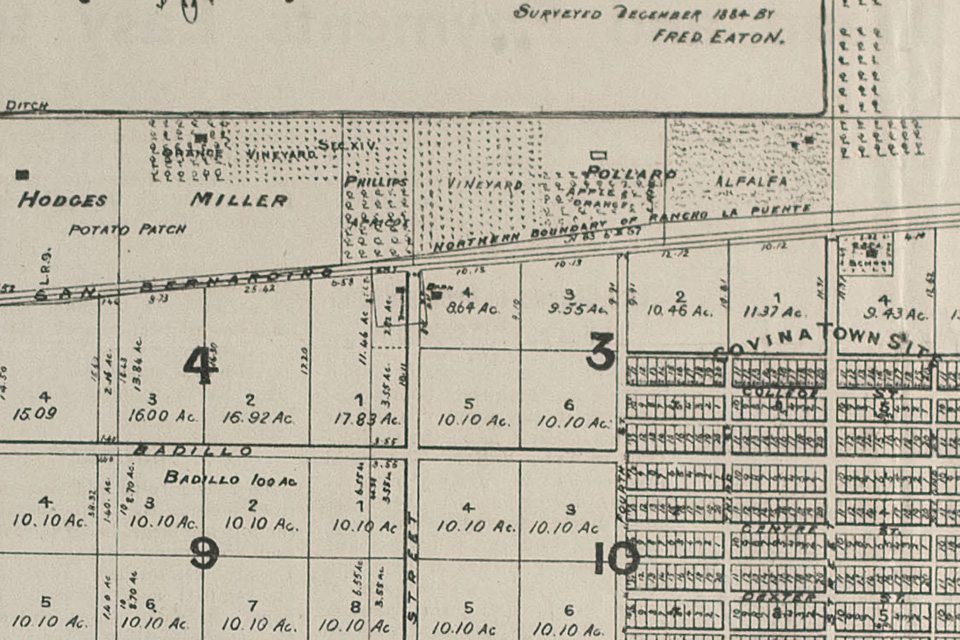
Rancho Azusa de Dalton originally extended south to the northern boundary of Rancho La Puente. Alignments of selected section and quarter-section roads of today are labeled for reference.
Source: U.S. Dept. of the Interior, Bureau of Land Management, General Land Office Records. (Click on the image to view an enlargement.)

As the article below will recount, in 1858 the U. S. Government ordered a new survey of Dalton's holdings, the result of which was the invalidation of Rancho Azusa's southern and eastern boundaries. Surveyor Henry Hancock drew a new southern line for Dalton's rancho (today's Gladstone Street), thus creating 2,428.25a acres of new public land that thereupon became available for preemption, and later, homesteading.

While Pflueger (1964) gave an admirably thorough account of Covina's squatter era, this article from the January 23, 1887, edition of the Los Angeles Timesb tells the story from a unique perspective I hadn't seen in print before. So, without further ado...

Tuesday, September 23, 2025

Original Covina Landowners

While digging into old real estate records earlier this month, I decided to make a map showing the names of the first owners of every parcel in the Phillips Tract. Whenever I found an original title conveyance by trustee James F. Houghton, I made a note of the grantee and the date in the corresponding square on Eaton's survey.


Earliest owners of lots in the Phillips Tract. Click image to view an enlargement. A legend for the colors displayed can be found there.


Why would I go to the trouble of doing that, you might ask? Well, it was primarily to fact-check a similar cartographic record in the collection of the Covina Valley Historical Society, the accuracy of which I have since come to question.

Sunday, September 14, 2025

The Tract, Trials and Tribulations of Joseph Phillips


J. Edward Hollenbeck and Joseph Phillips: the two men without whom Covina would not have existed.


These past six weeks I've been doing a deep dive into Covina founder Joseph Swift Phillips, and I've uncovered many surprising new facts. The subjects are fairly complicated and make for a long, dry read, however, so I thought I'd approach this article differently and start off with a list of my main points and then delve into the particulars afterwards.

I should perhaps note here at the outset that none of the following findings have been described in any previous published history of Covina. This is all new stuff here, especially the legal blockbuster near the end!

tl;dr summary:

• As I stated in a previous article, the real estate deal between Phillips and Hollenbeck for the tract of land which would become Covina took place in 1881, not 1882.

• The 1881 deal was only a contract for deed, not an outright sale, and Phillips may have used real estate instead of cash for his down payment.

• In 1885, Phillips had to borrow $40,000 to pay off Hollenbeck, and the loan was secured by a deed of trust that conveyed legal title from Hollenbeck directly to trustee James F. Houghton. Phillips himself never actually held marketable title to the tract which bore his name.

• Although Phillips was empowered to arrange and negotiate sales, all of the original land purchases and title conveyances in the Phillips Tract from 1885-1889 were brokered and closed by Houghton.

• Phillips ultimately failed to repay his 1885 loan, so in 1889, Houghton foreclosed and Phillips forfeited all of his Covina properties.

• Hollenbeck and Houghton both made big bank on the Phillips Tract, while Phillips himself lost everything.

• In 1894, Phillips sued almost everyone who had been involved with his past land dealings in a last ditch effort to recoup his financial losses.

• In sum, litigation expense was likely a significant contributor to Phillips's financial downfall.

Details and references below.

Saturday, July 12, 2025

Badillo Mystery Solved?

For some time there's been much speculation about the name of Badillo Street in Covina and why it differs from the pioneer family's hereditary Spanish name, Badilla. Now, after years of study, I believe I can finally provide an answer to the "Badillo" question that's backed up by objective, verifiable facts.


Covina's main east/west street was named "Badillo" on the original Phillips Tract survey map in 1884.
Courtesy Covina Valley Historical Society.


I briefly mentioned my own theory about the spelling difference at the end of the article about Hollenbeck and the Badillas that I posted back in 2021. I noted that the family themselves appeared to use a terminal –o in their surname on occasion, and theorized that the street was named "Badillo" because that was the name the farming brothers were best known by.

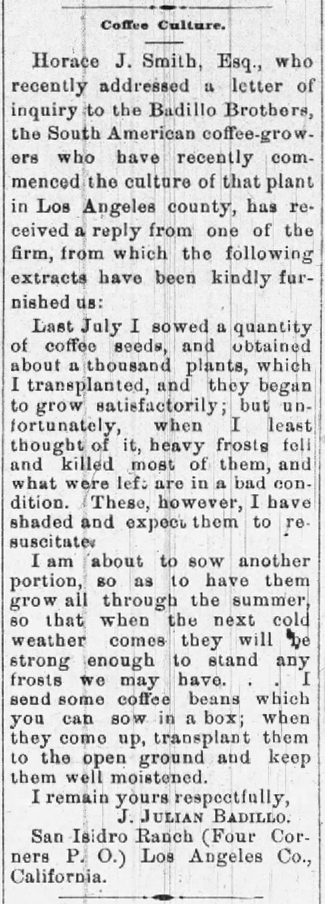
I didn't have sufficient supporting evidence for either claim, though, until I recently found this letter published in a newspaper in 18771 that was signed "J. Julian Badillo." This was the first time I'd seen one of the famous coffee-growing brothers using the Badillo spelling himself (and also the first I've seen the name of their coffee plantation was "San Isidro Ranch.")


Santa Barbara Daily Press, February 7, 1877.
(See also Los Angeles Evening Express, February 10, 1877.)


With that revelation, I did more specific searches on the newspaper archive website to manually tally the number of times the two surname spellings were used, and the contexts in which they appeared.

The results:

Sunday, July 6, 2025

The Issei Fathers of West Covina

Relatively few valley residents today are aware that people of Japanese ancestry played a significant role in the early history of West Covina. During the first two decades of the 20th century, dozens of farmers emigrated from Japan to settle here, owning and working the land, raising families and becoming productive members of the local community.

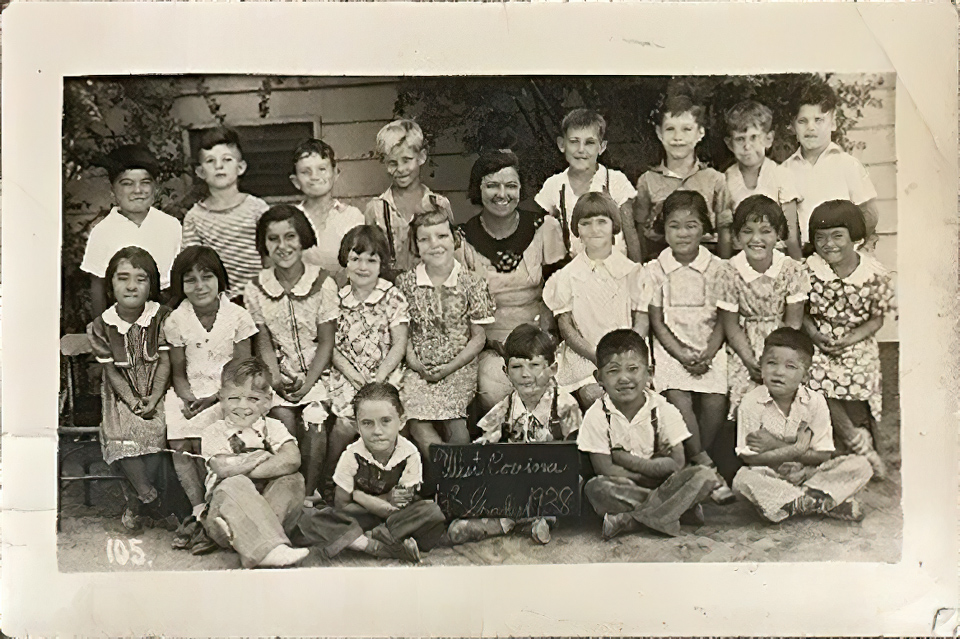
And what a community it was! Early West Covina was a remarkable assemblage of nationalities. No previous author has stated this specifically, but unlike the parent city,1 there was no racial separation to speak of in pre-war West Covina. Americans, Europeans, and first-generation immigrants from Japan (termed "Issei") all lived, farmed and participated in society with full freedom of association. There's perhaps no better visual evidence of this societal integration than this photo of Grades 1-3 at West Covina School in 1938. Look at all those happy faces!


Teacher Frances Maxson Sanchez (1900-1999) was the daughter of West Covina's first mayor, Benjamin Franklin Maxson, Jr., and her husband, Juan C. Sanchez, was a great-grandson of founding pioneer John Rowland.2

Thursday, June 26, 2025

Post-War Postcard

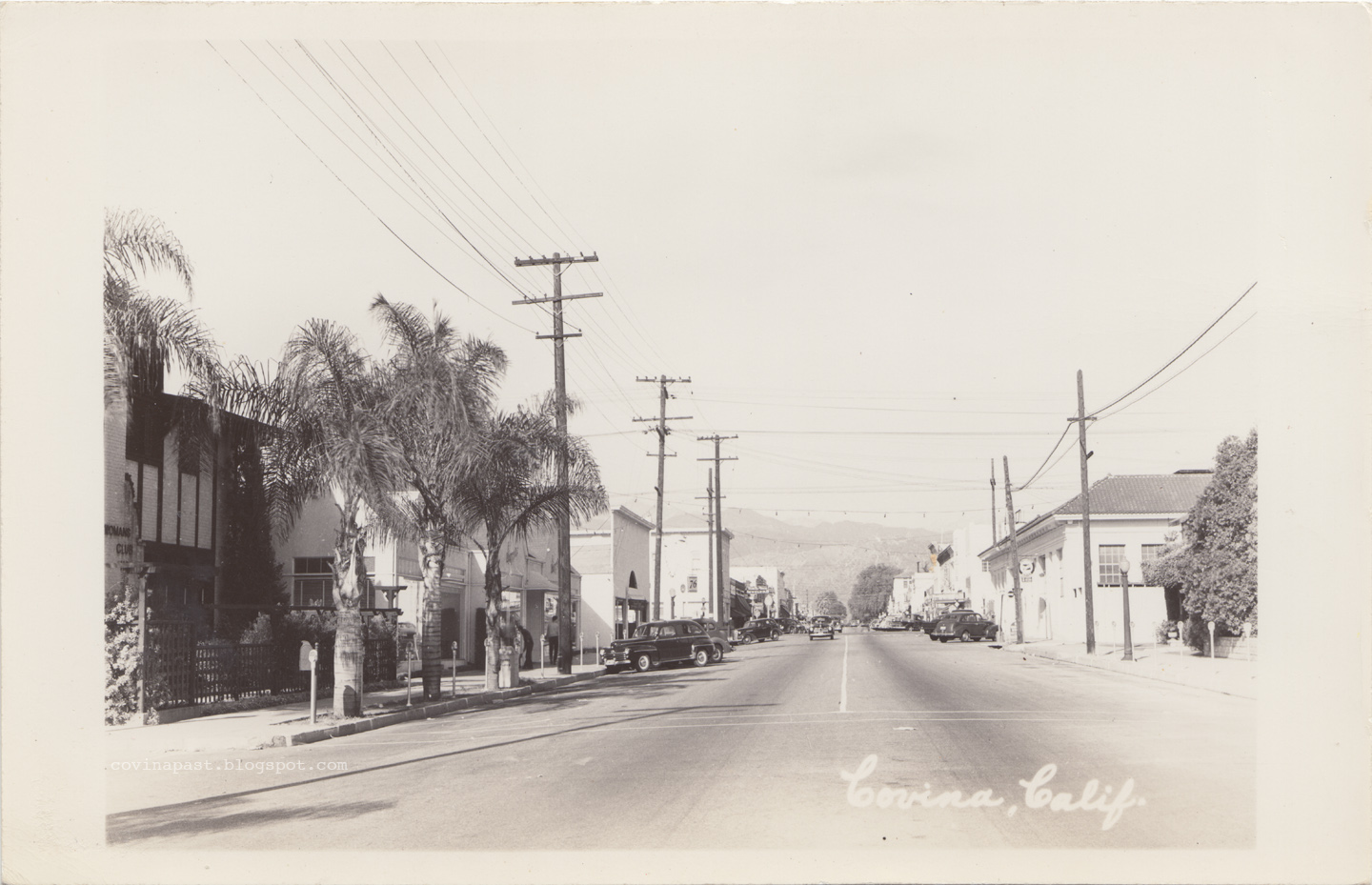
Time for another episode of vintage Covina photo sleuthing! Got ahold of another uncommon postcard of Citrus Avenue recently for which I hoped to pinpoint a date.


Post-war view north on Citrus Avenue from its intersection with Center Street.
Click on image for a larger view.


It's unused, so there's no postmark to give us a ballpark estimate. Just eyeballing the cars, though, I could tell it was from the Forties, but when, exactly?

Wednesday, June 18, 2025

When Was Covina Founded?

For people born in centuries past, it was not uncommon to not know one's precise birthday, and the same applies to historical places, even Covina!


Covina's founder, Joseph Swift Phillips (1840-1905).


Various sources have claimed with authority that Covina's origin date was 1882, 1884, 1885 and 1886. So, which of these is correct? Perhaps unsurprisingly, the answer is... complicated.

Monday, June 16, 2025

The City Motto

In January, 1922,1 the Covina Chamber of Commerce held a contest for a slogan to represent the city to the broader world. Two months and dozens of submissions later, it was announced that a Mrs. F. E. Wolfarth won the $20 prize with her entry, "One Mile Square And All There."2 The official motto as subsequently adopted by the CCoC would change the "One" to an "A,"3,4 however, thus becoming the saying that a lot of us young latter-day Covinans were taught in school: "A Mile Square And All There."

But let's pause a moment for a fact check. Was Covina actually "a mile square?" Turns out not quite.