Showing posts with label 19th century. Show all posts

Saturday, August 22, 2026

Covina High History

If I were to give a one-sentence description of what I do here, it'd be "Fact-checking Covina history." Typically that involves the distant past, but recently I read a post on the Covina High Facebook page that said the school began "its 130th year" when classes opened this past week. I posted a comment suggesting the math didn't look right and someone replied with this graphic of the school's official logo. Sure enough, right there it says, "EST. 1897," and I know for certain that's incorrect. So a-fact-checking we must go!


To be precise, the stated date is two years too early. Pflueger (1964), the newspaper record, and even the school district itself agree: Covina High opened in 1899.1,2,3,4 But why stop there? Might as well cover all the other important CHS dates while I'm at it. So the following is mostly a copy/paste of my Covina Past FB post of yesterday, though this time with footnote references and discussion.

Thursday, July 23, 2026

Ira Stanton and Kin

The other day, Dave Armbruster of the Covina Valley Historical Society asked if I could help with info about this photo. The caption read, "Ira Stanton Hauling Oranges," and Dave wondered what I could find out about the gentleman.


Built in 1913, the Covina Heights Groves, Inc., packing house was located on the SPRR line just east of the northeast corner of Front and First Streets.
Ira Stanton's brother, Pliny (b.1877), was Manager,1 and also co-owner of the Stanton grove,2 so perhaps Pliny took this picture of his brother atop their wagon.


I discovered a lot about Ira and his kinfolk, but three things stood out as noteworthy:

Monday, June 1, 2026

The Badilla Foreclosure

The story of the Badilla coffee venture in the 1870s is the genesis chapter of Covina history. The families of Julian and Antonio Badilla were the first to settle the north region of Rancho La Puente, and had they not lost their land to foreclosure in 1879, Covina as we know it today would not have been born. J. E. Hollenbeck's lawsuit changed the course of our history, but the passage of time has obscured the events and people involved. Long assumed lost, I recently found the official court records for Hollenbeck vs. Badilla et al., and what they reveal will significantly broaden our understanding of Covina's past.

The court case that set the stage for Covina's birth.
Source: Los Angeles area court records, 1850-1911, Call number: mssLAACR, Item number: 05091, The Huntington Library, San Marino, California.


Because this article is rather lengthy, I'm going to begin with some tl;dr bullets of my principal findings:

• Contrary to legend, the Badillas did grow coffee here, and wheat in abundance. Their only failure was financial.

• The old story also said Antonio Badillo was a debtor landowner whose mortgage was foreclosed, and that entire characterization was false.

• The Badillas did not use any of their own money to buy the land in Rancho La Puente. Instead, the Badillas and Rowlands arranged a seller-financed mortgage for the $45,000 purchase price.

     —The down payment of $15,000 was borrowed from the Commercial Bank of Los Angeles.

     —The $30,000 balance was financed with two one-year-term $15,000 promissory notes.

• Plaintiff Hollenbeck was not the original mortgage holder. Rather, he purchased the Badillas' delinquent mortgage from the Rowlands, then foreclosed.

• Hollenbeck did not buy the former Badilla land at the Sheriff's auction, he was granted title to it as payment-in-full for the court's decree.

• Two future California politicians were involved with this case. The judge was a member of the influential Sepúlveda family, and the Badillas' defense attorney went on to become a United States Senator.

The Badillo Legend

In my 2021 article about Hollenbeck and the Badillas, I presented proof that several elements of the familiar Badillo story were untrue. Now, after years of further research and studying these newly-discovered court records in particular, I'm more certain than ever that the narrative once considered historical fact long ago crossed over into the realm of fiction.

The most complete telling of the Badillo legend is found in Donald Pflueger's Covina (1964), and can be summarized as follows:

Julian and Antonio Badillo were wealthy Costa Rican plantation owners who met Hollenbeck when he lived in Central America. Hollenbeck convinced the Badillos to leave Costa Rica and grow coffee in southern California. About 1875, the brothers bought 5,500 acres of Rowland land in Rancho La Puente for $4 an acre. However, being unfamiliar with the area's semi-arid climate, the Badillos failed twice to grow coffee. Julian got discouraged and left, but Antonio stayed and borrowed large sums of money from the Los Angeles bank of which Hollenbeck was principal stockholder. Antonio tried growing other crops, but he failed at that as well and defaulted on his loan. The bank foreclosed on Antonio in 1879 and Hollenbeck purchased all the former Badillo land for $16,692. Then in 1880, Hollenbeck deeded 100 acres back to Antonio as a gift.1

For more than a half-century before and after Pflueger's book, this was considered settled history.

Real Facts Emerge

In 2011, however, descendants of Julian Badilla discovered their genealogical connection to his 1870s coffee experiment in Rancho La Puente, and new historical facts came to light.

Friday, May 8, 2026

Compromise Line Road

I hope my dozen or so regular readers will pardon me if I write about someplace other than Covina just once. ;-)

Although I was born and raised in Covina, I lived my first five years on East Foothill Boulevard in Glendora, so consequently, the history of our neighbor to the north is a natural area of interest to me.

The subject is not far out of bounds geographically, either, as both Covina and Glendora share partial origins in a historical Mexican land grant called Rancho San José Adición (aka Rancho Addition to San Jose) which just happens to be the broader topic of this article. Most of Covina's Charter Oak neighborhood lies within Adición's borders, so I'm not really straying too far afield here.

Anyway, even as a child, I had a keen interest in roads and maps which really took off after I discovered my dad's Renie Atlas around age 12 (same time as my interest in Covina history, hmm!). Probably not long after that, the name of one street in particular from my Glendora years aroused my curiosity: "Compromise Line Road." Always wondered what that meant. Somewhere in my early readings of local history, I did learn that it involved a dispute over a northern boundary of Rancho Addition to San Jose, but I never could find out much more than that.


Compromise Line Road in Glendora. Source: Renie Atlas of Los Angeles City and County, 1965 edition.


Recently I was contacted by an old classmate who asked about Compromise Line, and desiring to know more than the basics I'd heard long ago, I decided to do a deep-dive into the subject. Obvious first stop reference-wise was Donald Pflueger's Glendora (1951), but unfortunately his mention of Compromise Line Road was so nonspecific as to be no help at all. Then I searched the newspaper archive, and that was a similar dead-end.

Wednesday, April 22, 2026

Packing House Ladies, c.1900

Also found these pictures on the Huntington Digital Library site last night. Actually I've seen thumbnails of these pics many times before, but I never took a real close look at them until now. I was more than a little surprised by what I saw...

I knew it was common for women to work in these fruit packing houses, but I did not know they did so dressed in such fancy, fashionable finery!


Workers in the A.C.G. Packing House, Covina, c.1900. C. C. Pierce Photography Collection.
Courtesy of The Huntington Digital Library, San Marino, CA. Link to full-res image.

Saturday, March 21, 2026

Old Neighbor Remembers

I'll be frank—I don't generally care for oral histories. Reason being, people's memories of past events tend to be embellished or even just plain mistaken; my own being no exception. However, every once in a while, I chance upon an oral account that's really interesting and even compelling in its particulars, and this one—published for the city's 51st anniversary commemoration—is one I believe worthy of historical preservation, in spite of its anonymous authorship. So, with no further ado...

From the Covina Argus of October 18, 1935:

Tuesday, January 13, 2026

Italia

You're about to make the acquaintance of a remarkable woman who, as you'll see, merits a far more prominent place in Covina history than the mere footnotes she's been relegated to in the past...

As has often been the case, my initial inspiration for an article was a postcard. This particular specimen first attracted my interest because of the handwritten inscription indicating the house owned by Mr. Clapp, the druggist, from whose store came this antique medicine bottle: the subject of one of my earliest posts here.


View looking southwest along the west side of the 200 block of North Second Street, Covina, c.1908. "Rose" mailed this hand-colored M. Rieder postcard from Lordsburg (La Verne) on January 2, 1908. Click image to view an enlargement.


The Clapps were an important family in early Covina, and I'll have more to say about them later, but the actual main character in my present story is Mrs. Clapp's mother—Mrs. Italia Cook—who lived in the big house at far right.

The published histories barely mention Italia, but she was easily the most propertied and most philanthropic woman in Covina at the turn of the last century, and now here, at long last, this pioneer-era force of nature is going to get the full recognition she's due.

Friday, November 7, 2025

The Squatter Era

In 1859, long before the Badilla brothers or J. S. Phillips arrived on the scene, that northern section of Covina that today lies between San Bernardino Road and Arrow Highway began being settled by enterprising American and immigrant pioneers. Featured in this article is a recently discovered telling of those settlers' story that was written in 1887, when all the events described were still in the living memory of those who witnessed them.

The land that is the subject of this newfound contemporary account was originally part of Henry ("Don Enrique") Dalton's Rancho Azusa, which the Englishman had purchased from Don Luis Arenas in 1844. At that time, Dalton's ranch encompassed most of the territory east of the San Gabriel River and south from the foothills of the San Gabriel Mountains to the old San Bernardino stage road.


Rancho Azusa de Dalton originally extended south to the northern boundary of Rancho La Puente. Alignments of selected section and quarter-section roads of today are labeled for reference.
Source: U.S. Dept. of the Interior, Bureau of Land Management, General Land Office Records. (Click on the image to view an enlargement.)

As the article below will recount, in 1858 the U. S. Government ordered a new survey of Dalton's holdings, the result of which was the invalidation of Rancho Azusa's southern and eastern boundaries. Surveyor Henry Hancock drew a new southern line for Dalton's rancho (today's Gladstone Street), thus creating 2,428.25a acres of new public land that thereupon became available for preemption, and later, homesteading.

While Pflueger (1964) gave an admirably thorough account of Covina's squatter era, this article from the January 23, 1887, edition of the Los Angeles Timesb tells the story from a unique perspective I hadn't seen in print before. So, without further ado...

Tuesday, September 23, 2025

Original Covina Landowners

While digging into old real estate records earlier this month, I decided to make a map showing the names of the first owners of every parcel in the Phillips Tract. Whenever I found an original title conveyance by trustee James F. Houghton, I made a note of the grantee and the date in the corresponding square on Eaton's survey.


Earliest owners of lots in the Phillips Tract. Click image to view an enlargement. A legend for the colors displayed can be found there.


Why would I go to the trouble of doing that, you might ask? Well, it was primarily to fact-check a similar cartographic record in the collection of the Covina Valley Historical Society, the accuracy of which I have since come to question.

Sunday, September 14, 2025

The Tract, Trials and Tribulations of Joseph Phillips


J. Edward Hollenbeck and Joseph Phillips: the two men without whom Covina would not have existed.


These past six weeks I've been doing a deep dive into Covina founder Joseph Swift Phillips, and I've uncovered many surprising new facts. The subjects are fairly complicated and make for a long, dry read, however, so I thought I'd approach this article differently and start off with a list of my main points and then delve into the particulars afterwards.

I should perhaps note here at the outset that none of the following findings have been described in any previous published history of Covina. This is all new stuff here, especially the legal blockbuster near the end!

tl;dr summary:

• As I stated in a previous article, the real estate deal between Phillips and Hollenbeck for the tract of land which would become Covina took place in 1881, not 1882.

• The 1881 deal was only a contract for deed, not an outright sale, and Phillips may have used real estate instead of cash for his down payment.

• In 1885, Phillips had to borrow $40,000 to pay off Hollenbeck, and the loan was secured by a deed of trust that conveyed legal title from Hollenbeck directly to trustee James F. Houghton. Phillips himself never actually held marketable title to the tract which bore his name.

• Although Phillips was empowered to arrange and negotiate sales, all of the original land purchases and title conveyances in the Phillips Tract from 1885-1889 were brokered and closed by Houghton.

• Phillips ultimately failed to repay his 1885 loan, so in 1889, Houghton foreclosed and Phillips forfeited all of his Covina properties.

• Hollenbeck and Houghton both made big bank on the Phillips Tract, while Phillips himself lost everything.

• In 1894, Phillips sued almost everyone who had been involved with his past land dealings in a last ditch effort to recoup his financial losses.

• In sum, litigation expense was likely a significant contributor to Phillips's financial downfall.

Details and references below.

Saturday, July 12, 2025

Badillo Mystery Solved?

There's been all kinds of speculation in recent years about the name of Badillo Street in Covina and why it differs from the pioneer family's hereditary Spanish name, Badilla.


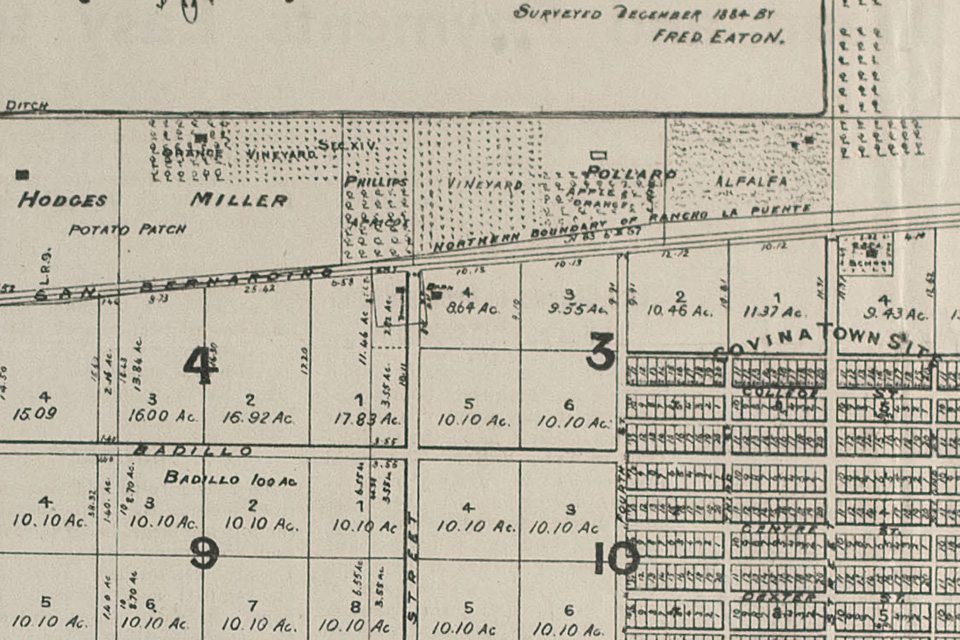
Covina's main east/west street was named "Badillo" on the original Phillips Tract survey map in 1884.
Courtesy Covina Valley Historical Society.


I briefly mentioned my own ideas about this controversy at the end of the article about Hollenbeck and the Badillas that I posted back in 2021. I noted that the family themselves appeared to use a terminal –o in their surname on occasion, and theorized that the street was named "Badillo" because that was the name the farming brothers were best known by.

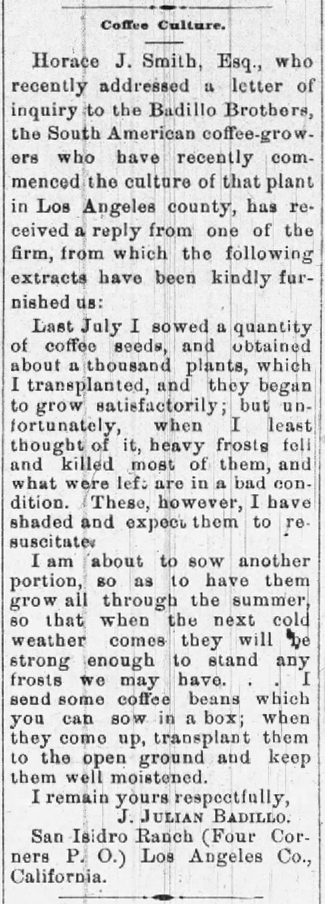
I didn't have direct evidence for either claim until just yesterday, though, when I found this letter published in a newspaper in 18771 that was signed, "J. Julian Badillo." This was the first time I'd seen one of the famous coffee-growing brothers apparently using the Badillo spelling himself (and the first I've seen the name of their coffee plantation was "San Isidro Ranch.")


Santa Barbara Daily Press, February 7, 1877.
(See also Los Angeles Evening Express, February 10, 1877.)


With that revelation, I did more specific searches on the newspaper archive website to manually tally the number of times the two surname spellings were used, and in which contexts they appeared.

This is what I found:

Wednesday, June 18, 2025

When Was Covina Founded?

For people born in centuries past, it was not uncommon to not know one's precise birthday, and the same applies to historical places, even Covina!


Covina's founder, Joseph Swift Phillips (1840-1905).


Various sources have claimed with authority that Covina's origin date was 1882, 1884, 1885 and 1886. So, which of these is correct? Perhaps unsurprisingly, the answer is... complicated.

Sunday, May 18, 2025

Coffee Ranch Days

When I first read Donald Pflueger's "Covina" at age 12, I thought the most interesting parts were the author's descriptions of the valley before and during its settlement. One statement in particular captivated me: how, in the early 1880s, when the Methodist Church in the foothills at the top of Citrus Avenue rang its bell on Sunday mornings, "its clear notes could be heard all over the valley."1 That same valley when I first knew it was already home to a quarter-million people, so a stillness of that sort was almost incomprehensible to me. Like another world, it seemed... and indeed it was...

Perhaps the best-known settlers from those early times were the families of José Julian and Pedro Antonio Badilla (aka Badillo), who emigrated from Costa Rica to America in 1876. The brothers had high ambitions. They wanted a coffee plantation big enough to supply the whole United States!2 So what was their new land like when they arrived here?


Wheat harvest on Baldwin land in Rancho La Puente. Although best known for their coffee venture, the Badillas were famously successful raising wheat in 1878.3
Photo courtesy Covina Valley Historical Society and Powell Camera Shop.


Saturday, November 2, 2024

Founder Finds

I have a peculiar trait that I call "detritophilia." Whenever I find myself in a place with a long history of human habitation, I will visually scan disturbed pieces of ground looking for discarded bits of everyday life from times past. It's a kind of urban archeology except I don't do any digging. I simply look for objects that are lying on the surface, waiting in plain sight for my trained eye to spot.

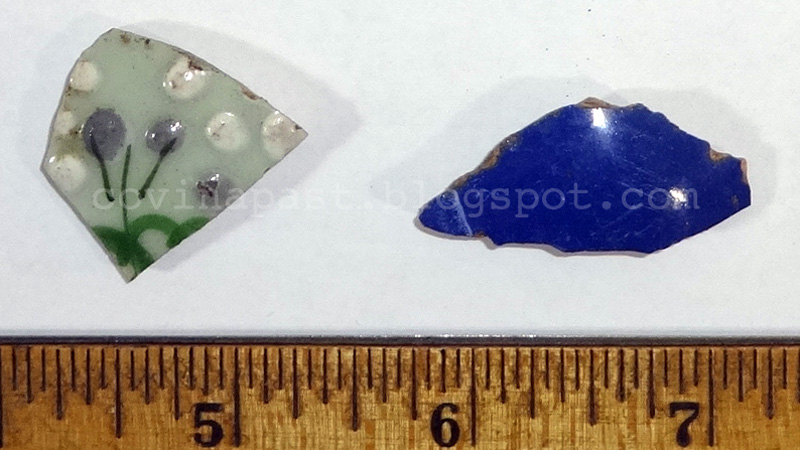
Anyway, in 1988, I made multiple trips to Covina to clean out our family home and prepare it for sale. One day while returning from Azusa with packing materials, I decided to kill some time and explore the vacant lot at San Bernardino Road and Hollenbeck where the Phillips House once stood (and the Julian Badilla house before that). Here are the four pieces of historical detritus that I collected that day.


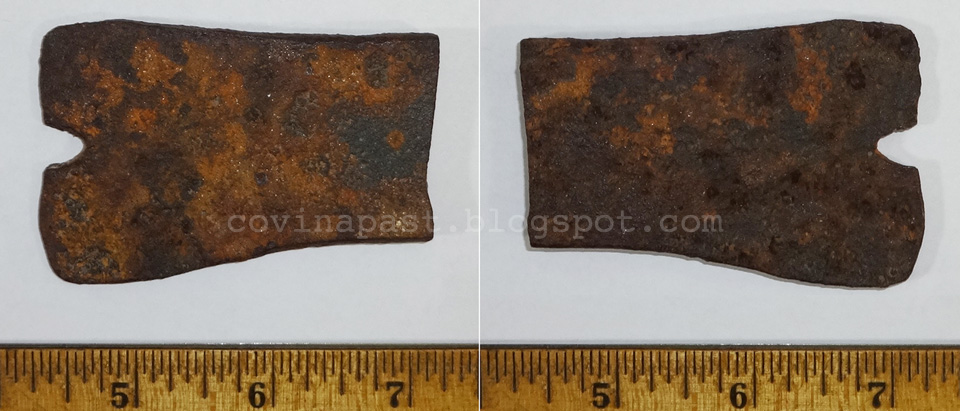
Photo by J Scott Shannon. Scale in inches.

This was pretty easy to identify as the broken off end of an iron prying bar. Upon closer inspection, though, I noticed its shape was distinctly asymmetrical, which suggested to me that it was forged by hand.


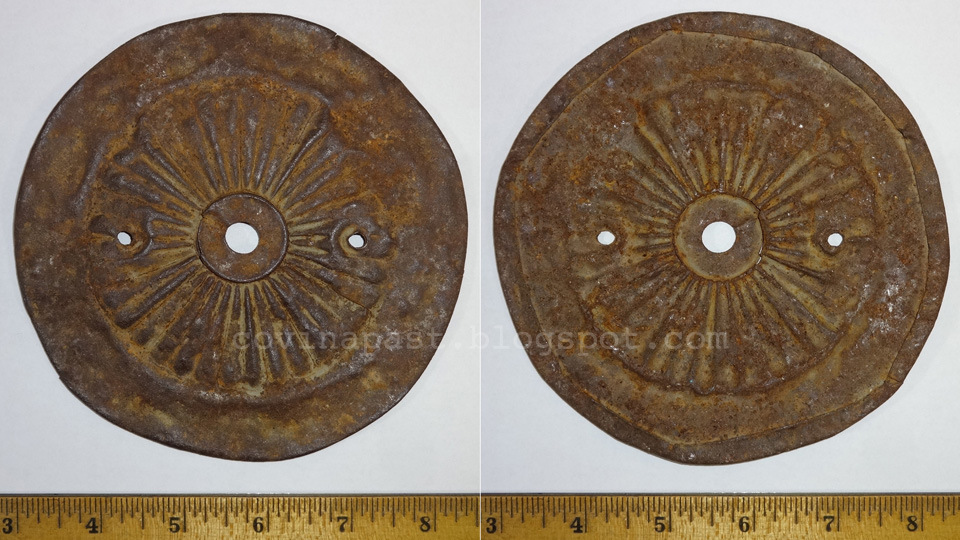
Photo by J Scott Shannon. Scale in inches.

This object baffled me for the longest time. My best guess was some sort of wall or ceiling fixture. It wasn't until recently that Michael Schoenholtz suggested that it might be the reflective portion of a candle sconce, and I now think he's exactly right. This, too, appears to be quite old, and hand-hammered. Note in particular how crudely the edges on the reverse side are formed.


Photo by J Scott Shannon. Scale in inches.

Two pottery fragments: the one on the left apparently of glazed porcelain, and the other, glazed red clay pottery. Not much to say about them, except that they're almost certainly pieces of some sort of tableware, and that one's fancy in design and the other is plain.

So, how old are these objects? Obviously they can't be dated precisely, but because the plot of land where they were found was not built upon until 1876, that gives us their earliest likely origin date.

Additionally, the apparent hand-made quality of the metal items makes it reasonable to assume that they are from a time when tools and other hardware were made by and purchased from local blacksmiths rather than being mass-manufactured and sold in stores. Store-bought goods probably became more common after 1890, so that's my best guess for the upper end of the age range.

So, if these items date from the period 1876-1890, they could have belonged to either Julian Badilla or Joseph Phillips. However, I tend to think the cruder-made metal objects are from the Badilla era. That candle sconce, in particular, looks more like a fixture on the wall of a simple farmhouse than the imported mahogany paneling of a mansion.

These finds are all to be donated to the Covina Valley Historical Society.


Sunday, October 6, 2024

The Founder's House

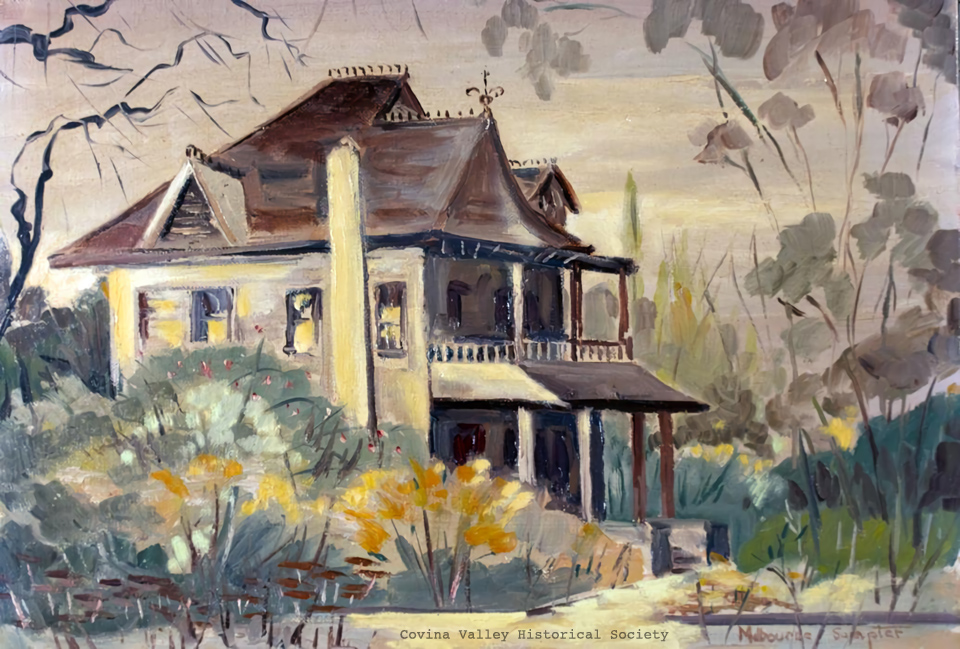
In the early 20th century, the citizens of Covina all recognized this ornate manse formerly standing at the southwest corner of San Bernardino Road and Hollenbeck Street as the house of the city's founder: Joseph S. Phillips (1840-1905). Despite its past status as a local landmark, over time its origins became obscured, and confusion has arisen in recent years about exactly whose house this was.


Painting by Melbourne Sumpter, image courtesy Glenn Reed/Covina Valley Historical Society.


Two specific facts about the place are undisputed:

• The first house on that site was built by pioneer José Julian Badilla after he and his elder brother Pedro bought the land in 1876.1,2,3

• In 1882, after Joseph Phillips agreed to buy 2,000 acres of then ex-Badilla land from J. Edward Hollenbeck (1829-1885), Phillips moved into Julian Badilla's former home.1,3,4

Most latter-day historians have also presumed that this two-storey Queen Anne Victorian is the same house built by Julian Badilla.1,4 However, could it be that Phillips replaced the original structure with a home of his own? Fact is, we don't know for certain one way or another, because there is no surviving record of who actually built the old landmark, or when.

In this article, I will attempt to answer the "who and when" with information that is now available, specifically maps that were published in the 1870s and 1880s, modern-day photographic and descriptive evidence, logical deduction and parsimony.

Sunday, June 16, 2024

Covina Schools Timeline

When I compiled the Covina History Timeline almost ten years ago, I included several entries that pertained to local educational institutions, but the number and scope of those mentions was necessarily limited. This new timeline delves into the history of Covina's schools in much greater detail. Most of the information presented here concerning schools of the postwar era was drawn from a book published in 1996 by the Covina-Valley Unified School District entitled "Centennial 1896-1996." Other references include Donald Pflueger's histories of Glendora (1951) and Covina (1964), Dr. Barbara Ann Hall's Covina (2007), and newspaper articles of the day found in the online archive Newspapers.com. Citations for specific entries are available upon request. Please bear in mind: this timeline is an ongoing work in progress. Corrections, additions, and their supporting documentation are always welcome.

Circa 1850"Don Enrique" Dalton sets aside a room on his Rancho Azusa where the children of the upper valley's earliest settlers can learn their Three Rs.

Saturday, May 4, 2024

Covina's Old Neighbors

The localities described below would have been household names to Covinans during the the town's first half-century, but most are unfamiliar today.


USGS map from 1908 showing Covina and environs in the early 20th century. (Note the original alignments of roads in the area of present-day West Covina.)
Click on the image for an enlargement.

Tuesday, December 12, 2023

Who Really Named Covina?

Back in 2018, the late Glenn Reed told of finding new information about how Covina originally got its name: a previously unknown contemporary account that the elder historian believed credible enough to make the following statement:

I think that is a better story for the naming of Covina than any that I have heard, and besides, it is an account from someone alive at the time; I am accepting it.1

And now, it just so happens that I've found corroborative evidence for that alternate take on Covina history.

First, though, let me quote the traditional story that's been retold in virtually every recounting of the city's past: that it was Joseph Phillips' surveyor Fred Eaton who authored the name.

...Mr. Eaton observed that because of the embracing mountains and hills the subdivision seemed to lie in a cove. He noted, too, the productive vineyards that had been planted by the settlers. From cove and vine he formed the word "Covina," cove of vineyards, and it struck him that this would be a good name for the new town.2


Frederick S. Eaton in the mid-1880s when the Phillips Tract was surveyed. He was elected City Surveyor of Los Angeles in 1885.3,4
Image source: Hal Eaton on Find a Grave.


It is factually true that the first time the word "Covina" ever saw print was on the original plat map of the Phillips Tract. But is there actual documentary proof that Eaton was the true author of the name? Or could this be a case of a tale that's been told so many times that people simply assume it's a historical fact?

It turns out, however, that there are other long-forgotten stories of how Covina was christened, and one of those is backed with documentary evidence: that the name originated with a group of German Baptist Brethren, and that their original spelling was "Covena"5...

Tuesday, November 2, 2021

Covina Hills Road

Looking back, I realize that Covina Hills Road was the likely origin of my fascination with olden times. We moved to the Ranchos when I was 5, and even at that young age, I noticed that, taking Rowland towards home, the instant we passed Grand onto Covina Hills Road, the scene changed from modern suburbia to cowboy days. Along almost its whole length were sights to behold that looked frankly ancient to me. Maybe this had been a stagecoach road, or an old indian trail, but no matter who I asked or what library books I read, no one could ever tell me anything about Covina Hills Road that came even close to answering all the questions I had about it. A lifetime would pass before I was able to discover the road's forgotten story myself...


Corner of CHR and Via Verde, San Dimas, June 26, 2010. Photo © J Scott Shannon.

Known by a variety of names over the years, today's Covina Hills Road began its existence in early 1895 as a mile-long access road to the headquarter buildings of the McCarthy Company's Hollenbeck Ranch partition southeast of town.1


Survey map from August, 1895,1 showing the new Hollenbeck Ranch road (yellow) as an extension of Rowland Avenue in the Phillips Tract.
Courtesy Los Angeles Dept. of Public Works.


The year previous, however, a committee of the Pomona Board of Trade together with officials and supervisors of Los Angeles County had already recommended creation of a road extending all the way over the San Jose Hills to give Pomona a more direct route to the San Gabriel Valley and points west.2 At the time, travelers from Pomona wanting to go to Covina had to divert around the hills: either north via Lordsburg (La Verne) and San Dimas, or west via the Old Spanish Trail (today's Valley Blvd.) then north on Pass and Covina Road. If they could cross directly over the hills, though, it would take at least five miles off the trip,3 which in the days before automobiles could mean an hour of time saved.

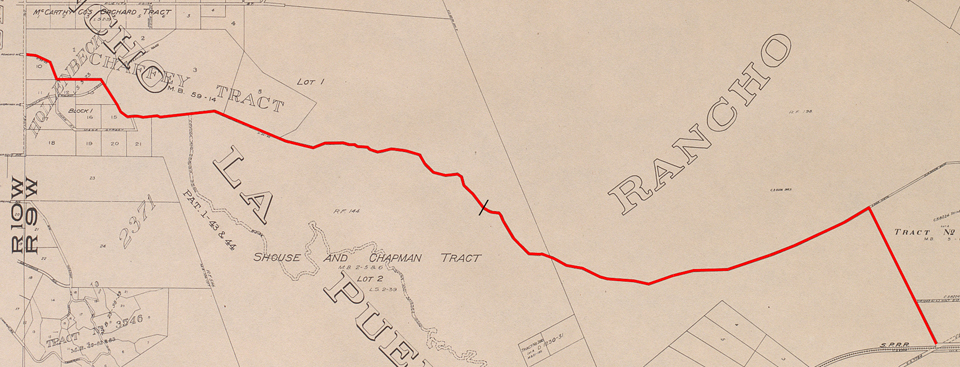
The route as surveyed in the summer of 1895 passed through the Phillips Ranch4 on the east over what we now call Kellogg Hill, then through Hollenbeck Ranch lands on the Covina side.3 After the rights-of-way were obtained and obstacles to construction overcome, work on the Pomona County Road was completed in four months in early 1896 for a total cost of $1,100.5


The original as-built alignment of the Pomona Road (red). Since 1933, the road has ended at the point indicated by the black slash.


Monday, September 20, 2021

Old Phillips Tract Ads

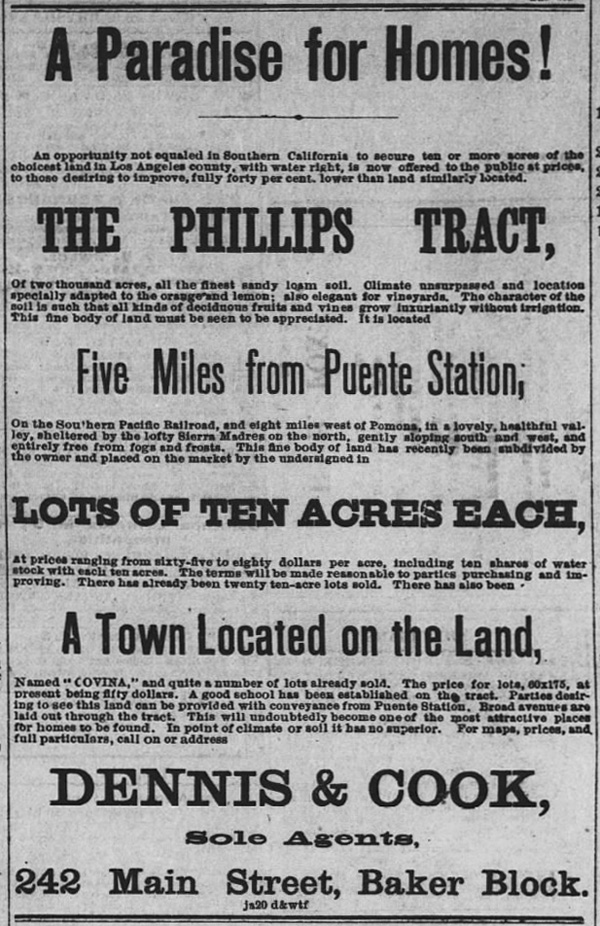
A lot of advertisements for the Phillips Tract were run in local papers during the first couple of years of land sales.

This was the first ad ever, printed only days after the official opening of the new development. Like almost all real estate ads of the time, it tells some untruths, especially when it says "A Town Located on the Land." In that first month, all that comprised Covina was J. S. Phillips' own house, a one-room schoolhouse, a small general store "downtown," and a simple shack across Badillo Street which housed a newspaper that basically had no readers yet.1 Civilization, Ho!


Los Angeles Times, Wednesday, January 21, 1885.2