Monday, September 20, 2021

Old Phillips Tract Ads

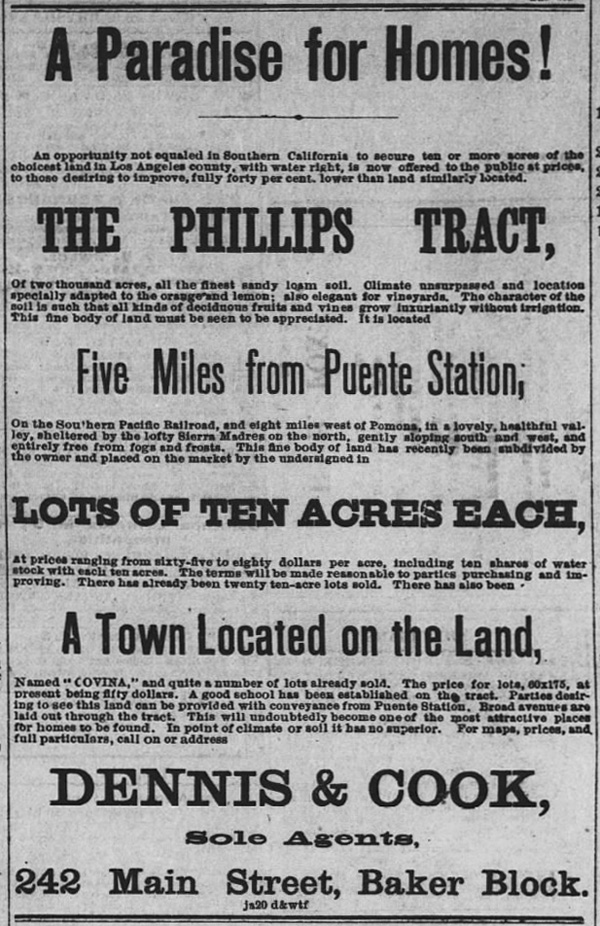
A lot of advertisements for the Phillips Tract were run in local papers during the first couple of years of land sales.

This was the first ad ever, printed only days after the official opening of the new development. Like almost all real estate ads of the time, it tells some untruths, especially when it says "A Town Located on the Land." In that first month, all that comprised Covina was J. S. Phillips' own house, a one-room schoolhouse, a small general store "downtown," and a simple shack across Badillo Street which housed a newspaper that basically had no readers yet.1 Civilization, Ho!


Los Angeles Times, Wednesday, January 21, 1885.2


Thursday, September 16, 2021

Untold Stories of Hollenbeck and Phillips

One of the "facts" you'll find in every history of Covina is that in 1882, J. E. Hollenbeck sold 2,000 acres of his land in Rancho La Puente to J. S. Phillips for $30,000 where the latter founded Covina in 1885.1 It turns out that's not historically accurate, as you'll soon learn.

Just recently I found this conveyance involving Hollenbeck and Phillips, but it wasn't at all what I was expecting. In fact, when I saw it, it made my jaw drop, because if the accepted origin story of Covina is correct, it shouldn't exist.


Los Angeles Times, January 14, 1885.2


As you can see, in eighteen-eighty FIVE, Hollenbeck and Phillips jointly conveyed 195-3/4 acres in Rancho La Puente to James F. Houghton–trustee of the Pacific Mutual Life Insurance Co. of California–to secure a loan to J. S. Phillips in the amount of $40,000. (Put a pin in that for future reference.)

What's significant is that Hollenbeck couldn't convey title in real property he didn't own, so this a clear indication he didn't sell his land to Phillips outright. It appears he only entered into an agreement to sell, and retained ownership until the terms of the agreement were fulfilled. If true, that means Hollenbeck actually remained a "silent partner" in the Phillips Tract all along (or at least until Phillips putatively used that $40,000 to satisfy his indebtedness to Hollenbeck after he obtained the loan in January, 1885.)

It took me a while to find proof of the above claim, but here it is in black-and-white (and yellow!):
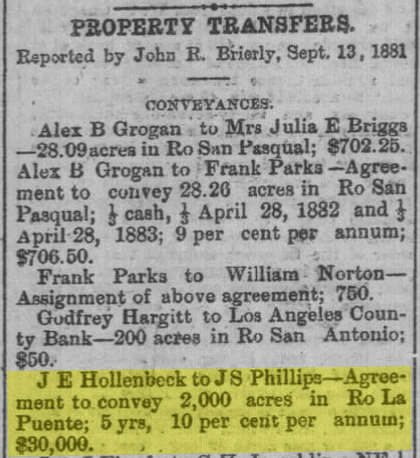

The Daily Commercial, September 15, 1881.3

So Phillips not only didn't purchase the land outright, Pflueger and other historians got the year wrong, too. We now know for certain that Hollenbeck was still technically an owner of the "Phillips" Tract, even after he made his deal with Phillips in 1881.

I also recently discovered something else that never made it into the history books. Pflueger1 chronicles the events in J. S. Phillips' life from 1882-1889 in often meticulous detail, but unless one attends carefully, a reader can easily skim past what ultimately happened to the founder of Covina, and even the single sentence devoted to the subject turns out to be a soft-pedaled vaguery of the actual turn of events that Phillips fell victim to in the end.

Quoting from page 204, this is all Pflueger has to say about the cessation of Joseph S. Phillips' association with the town he fathered:

He lost a large segment of his fortune in an investment in a northern California mine and was forced to sell his holdings in Covina and move elsewhere to regain his fortune.1

Well, as Paul Harvey used to say, you're about to find out "the rest of the story."
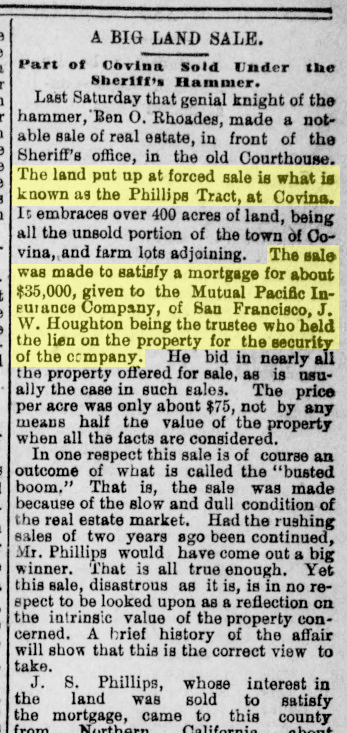

It was front page news in the June 3, 1889, edition of the Los Angeles Herald.4


First of all, notice there's Houghton and that life insurance company again: the same one that loaned Phillips $40,000 four years before. And apparently, judging by the remaining value of the mortgage, as mentioned in the newspaper article, Phillips had only managed to reduce his debt by $5,000 in all that time.

I suppose technically it was not inaccurate for Pflueger to say Phillips was "forced to sell his holdings," but the legal term "forced sale" is a synonym for foreclosure, which conveys a distinctly more negative connotation. With his equivocal phrasing, Pflueger almost made it sound like Phillips simply sold off his assets and moved on, but the hard fact of the matter was that Phillips had taken out a loan, he defaulted on repayment, and his remaining Covina properties were declared forfeit and seized. (A denouement interestingly similar to the Badillas before him.)

Heretofore, I would wager that not a single student of Covina history alive today was aware of Phillips' actual financial fate, or that Hollenbeck had retained a share of ownership in the Phillips Tract past 1882. (Both were certainly news to me!)

The full text of the newspaper article is transcribed below.

Tuesday, September 7, 2021

Hollenbeck and the Badillas

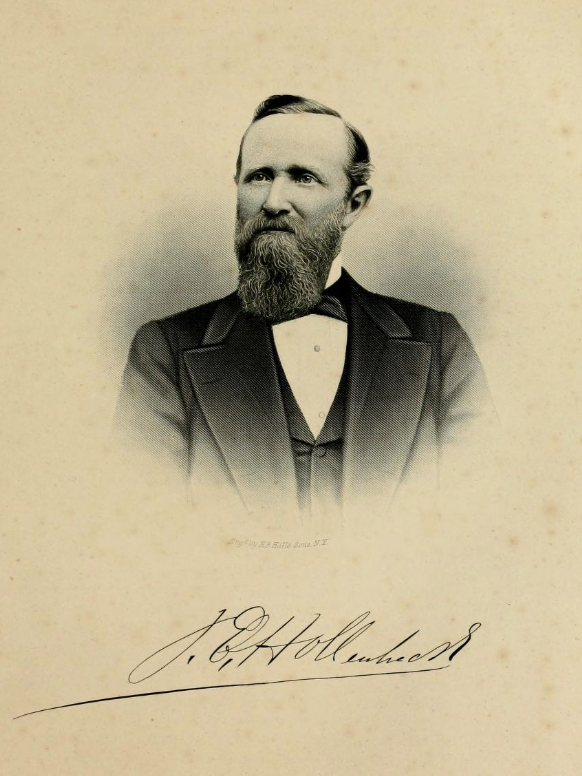
Everybody who grew up in Covina is familiar with the name Hollenbeck, but few know the historical figure's actual connection to the city. Turns out Covina as we know it wouldn't have existed without John Edward Hollenbeck and his business dealings and personal associations in Central America from 1849-1876.


J. Edward Hollenbeck (1829-1885). Source: An Illustrated History of Los Angeles County, California, 1889, at archive.org.


Hollenbeck engaged in several commercial enterprises during his 27 years spent mostly in Nicaragua, but the most salient with regard to Covina is the period after the American Civil War when he was an export agent for the Royal Mail.1 Hollenbeck oversaw international transactions of a wide variety of trade goods, and it was likely then that he crossed paths with the wealthy coffee-growing family of José de Jesús Badilla of Heredia, Costa Rica. José Badilla died in 1875,2 but by way of inheritance, and Hollenbeck, it would be his sons who ended up becoming the first settlers on the land which would one day become Covina.

In his notable history of Covina,3 Donald Pflueger wrote that it was Hollenbeck's suggestion that the Badillos emigrate to California to grow coffee. [N.b., for the purpose of this article, the two spellings (Badilla/Badillo) are considered to be interchangeable and of equally valid historicity.] Quoting:

The Costa Rica Ranch had been acquired by the Badillo brothers when they came into the valley at the instigation of John E. Hollenbeck, a prominent resident of Los Angeles who owned a magnificent home in Boyle Heights. Mr. Hollenbeck had spent many years in Costa Rica and Nicaragua, and while in Costa Rica he became acquainted with Julian and Antonio Badillo, well-to-do owners of coffee plantations. Although Mr. Hollenbeck did not understand the cultivation of coffee, he conceived the idea of establishing a coffee plantation in the San Gabriel Valley and approached the Badillo brothers on the matter.3

This has always been the accepted story, however, the deeper I have delved into the lives of Hollenbeck and the Badillas–examining in particular the actual historical sequence of events–the less likely it seems this was the American's idea. It's problematic to Pflueger's account that Hollenbeck didn't come to live in Los Angeles until March, 1876,1,4 only two months before the Badillos first arrived there.5 It seems improbable to me that a family that had been growing coffee successfully in Costa Rica for generations would completely uproot itself and move to a foreign country based solely upon the speculation of one man who had no experience growing their crop, and who up to that point had never himself lived in California.

What makes more logical sense is that the Badillas came up with the idea of moving to the United States themselves, and subsequently sought out the locally famous American expatriate, Hollenbeck, to help facilitate their plan. Apparently, he was known to be a ready ally to people who wanted to improve their lot in life. In an old biography, Hollenbeck was described as being noted for his "...large-hearted generosity, always assisting every worthy enterprise, and ever willing to help those who showed a disposition to help themselves."1 For the Badillas, J. E. Hollenbeck would seem to have been the right man in the right place at the right time to help them relocate to America.

Although I admit the above scenario is speculation, I have found indirect support for it in a memoir written by Covina pioneer Clara Eckles (1874-1966), who knew the (Antonio) Badillo family personally when she was a girl. Miss Eckles wrote that Mr. Badillo himself explained why they came to this country: they wanted "...a coffee plantation, yielding enough coffee for the whole United States!"6 Even Hollenbeck couldn't credibly pitch an idea that grandly ambitious. A big dream like that would also help explain why the family bought such a huge area of land, and were willing to pay such a high price for it.


Detail of 1877 map of Los Angeles County showing the original boundaries of the 5,563-acre Badilla Tract (yellow), and the 2,100-acre partition (olive) which ultimately became Covina. Source: Library of Congress


Once they made their plans to come to California, the Badillas apparently wasted no time. The first newspaper articles I found mentioning them here was a ship manifest published in the May 18, 1876 edition of the Los Angeles Daily Star,5 and the registry of the Lafayette Hotel in the Los Angeles Evening Express on May 20, 1876.7 The two eldest brothers subsequently bought their land from John Rowland's widow Charlotte M. Rowland, her son Albert Rowland and daughter Victoria Rowland on September 2, 1876.8,9


Saturday, August 21, 2021

The Case of Badilla vs Phillips

...by guest author Randall Smith

The name Badilla is synonymous with the early Covina area, both before and after the town’s founding. As most already know, the Badilla brothers owned the land upon which the Covina Tract would later be founded by Joseph S. Phillips. Among the legacies left behind is the street called Badillo, named in homage to the three Badilla brothers, who successfully grew wheat and barley on their land holdings. They also attempted to establish a coffee plantation on a portion of the property. Although they were successful in developing the trees, it was reported that the associated costs made its growing and cultivation an unprofitable enterprise, which ultimately led to the failure of their business enterprise.

Two sons of Pedro Antonio Badilla would remain in the area after their father’s return to Costa Rica, and assisted Joseph Phillips in building a portion of the infrastructure of the early township. Yet, it’s a different episode involving the Badilla name, and Covina’s early history, which is the focus of this post.

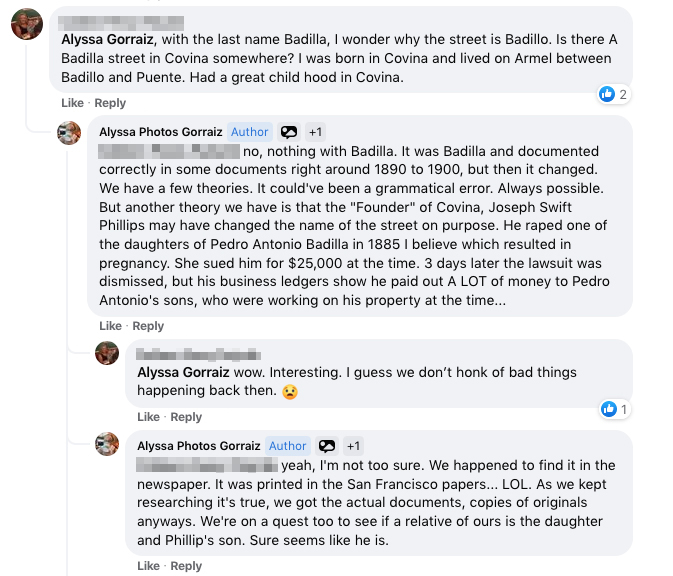
On June 18, 2021, a Badilla descendant posted an allegation on the Facebook group "I Grew Up in Covina" stating that Joseph S. Phillips raped a daughter of Pedro Antonio Badilla, resulting in pregnancy. The author offered no proof that such an event happened, only stating that it was printed in a San Francisco newspaper. The poster goes on to say, “We're on a quest too to see if a relative of ours is the daughter and Phillip's (sic) son. Sure seems like he is.”

In researching the allegation, I can state, unequivocally, that there is no record in any San Francisco newspaper, or any other newspaper, of any rape charge being brought against Joseph S. Phillips.


Saturday, August 14, 2021

Before Glendora Avenue

When I was a kid starting to get curious about local history, the story I heard about West Covina's Glendora Avenue was that it was called that because in olden days it went to Glendora. It did seem to point in that general direction, so I always assumed the tale was true.

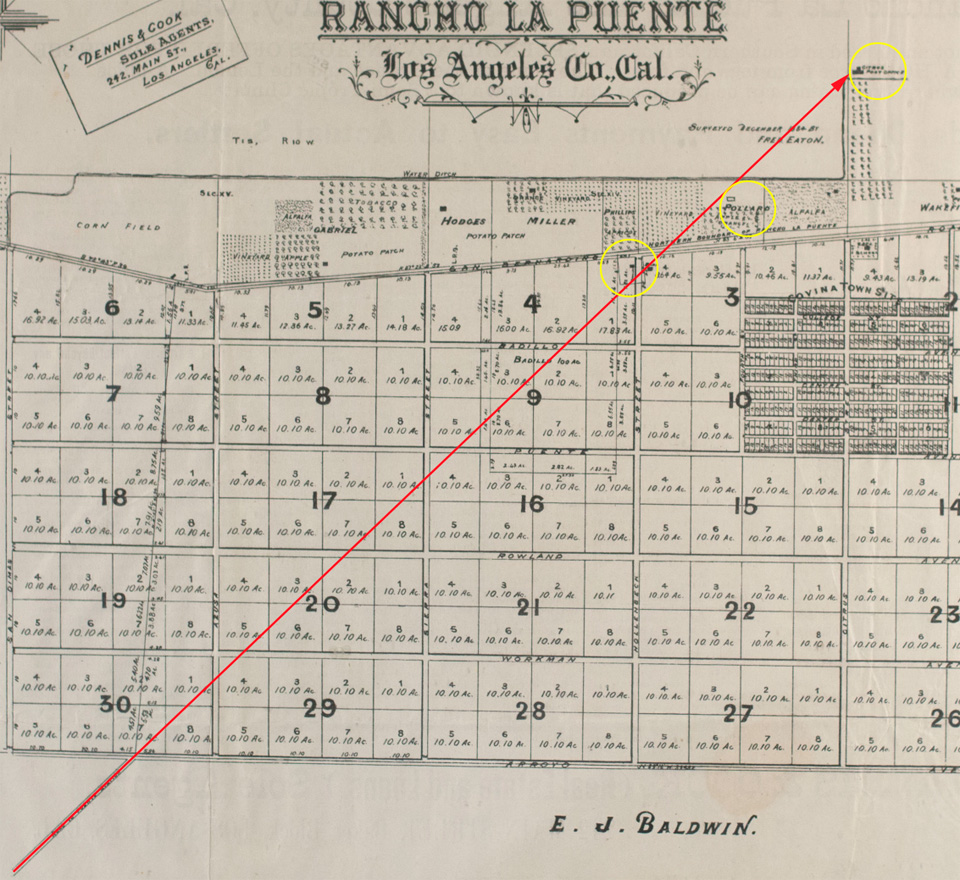
But where did Glendora Avenue actually go in historical times? I didn't think to figure that out until just the other day. Turns out if I take the original 1885 survey map of Covina and precisely extend the line of today's Glendora Avenue, it very conveniently connects three important historical sites: the Julian Badilla home (1876), Eugene Griswold's 1877 Citrus Post Office and general store, and the homestead of Robert J. Pollard, who I have recently come to believe may have been the Covina area's first settler of European descent.


Detail of Phillips Tract map (1885) showing a proposed historical northward extension of Glendora Avenue/Puente Depot Road (red arrow).
Yellow circles indicate the Badilla, Pollard and Griswold properties respectively. Map courtesy Covina Valley Historical Society.


No maps from the 1870s show that such a road existed through the future Covina area, but it would make sense that one did, because if you were Mr. Pollard or Mr. Griswold or the Sres. Badilla, you would need a wagon road in that exact location and orientation to get you to Puente, which was not only the headquarters town of Rancho La Puente, it was also the location of the then-new Southern Pacific Railroad depot, which at the time would have been your main transportation link to the greater world beyond.

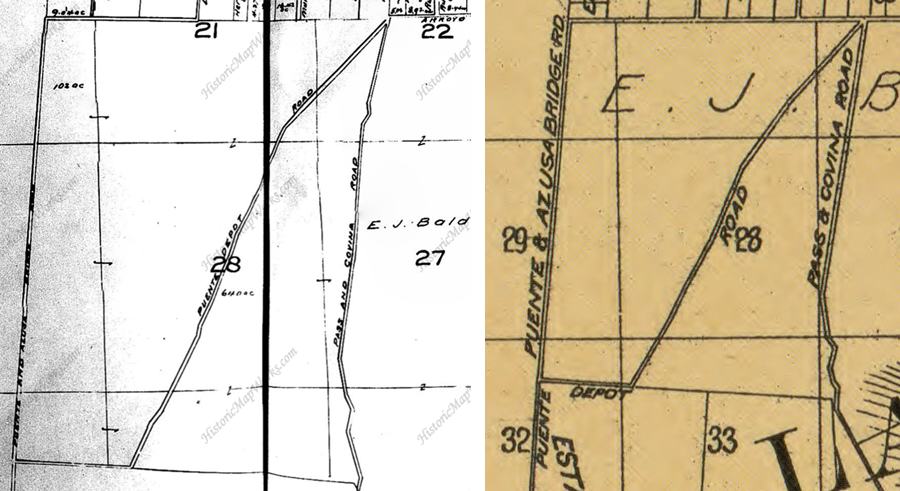
But there are maps from turn of the 20th century that do show a "Puente Depot Road" roughly tracing the path of today's Glendora Avenue. To realize my scenario, we need only imagine that the depot road went further north before the grid of streets for Covina was laid out in 1883-1884.


Maps from c.1900 showing "Puente Depot Road." Courtesy HistoricMapWorks.com and Library of Congress.


I don't think the diagonal Glendora Avenue we know today necessarily followed that same alignment all the way north, though. All it had to do was go as far as Citrus Avenue–a main thoroughfare named "Azusa Road #2" in the 1870s–and from there, you could have taken it up to Azusa or the foothills, where it ended at Fairmount Cemetery. In any case, Glendora wasn't founded until 1886, so the road we now call Glendora Avenue never went to such a place to begin with. The story behind the name turns out to be only the stuff of legend, after all.

One more thing: let's say the depot road did extend north to Citrus Avenue, that would finally answer a nagging question I've had for a long time, which was, why did the Badillas choose to build their HQ exactly where they did? That particular spot always seemed less than ideal to me. However, if we assume that in 1876, it was the intersection of the most crucial local roads at the time: San Bernardino Road (the most direct route to Los Angeles), the Puente Depot Road, and from there, the road north to Azusa, then the Badillas' chosen location makes perfect logistical sense.

This makes me think that the depot road existed before the Badillas arrived. So who first blazed the old wagon track to Puente? No way of knowing for certain at this point, but my guess would be R. J. Pollard, who may have been there before anybody else, but that I have yet to establish.

Much speculation here, I acknowledge, but a lot of history is informed speculation based on previously-known facts. And it's fun stuff to think about, anyway! I mean a historian's gotta have fun once in a while, right? Right!

Grateful thanks to Michael Schoenholtz and Randall Smith for research and discussion.


Friday, August 6, 2021

Two Twin Schools

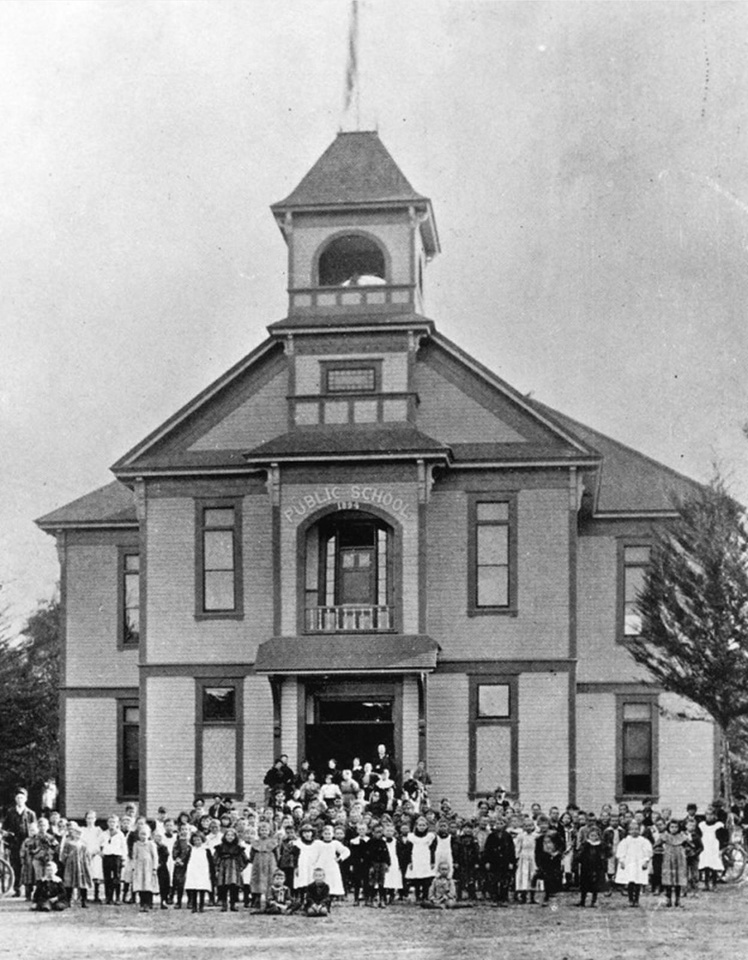
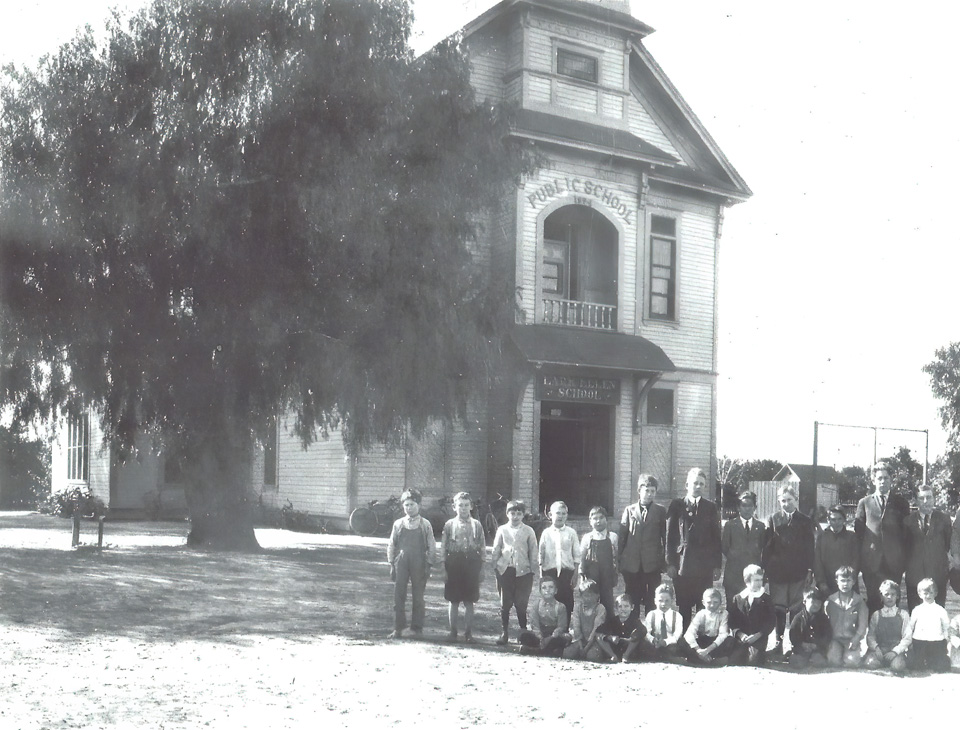
In 1894, two new almost-identical two-story schoolhouses were built in Covina. One replaced the pioneer Phillips School (1883) at Citrus and San Bernardino Road, and the other new building—initially named the Foley-Brown School—replaced the even older Lower Azusa School (1876), which was the very first dedicated schoolhouse in what would later be known as Covina.


The 1894 Covina Grammar School soon after it opened. The building was expanded to include the high school in 1899.
Photo courtesy Covina Valley Historical Society/Glenn Reed.


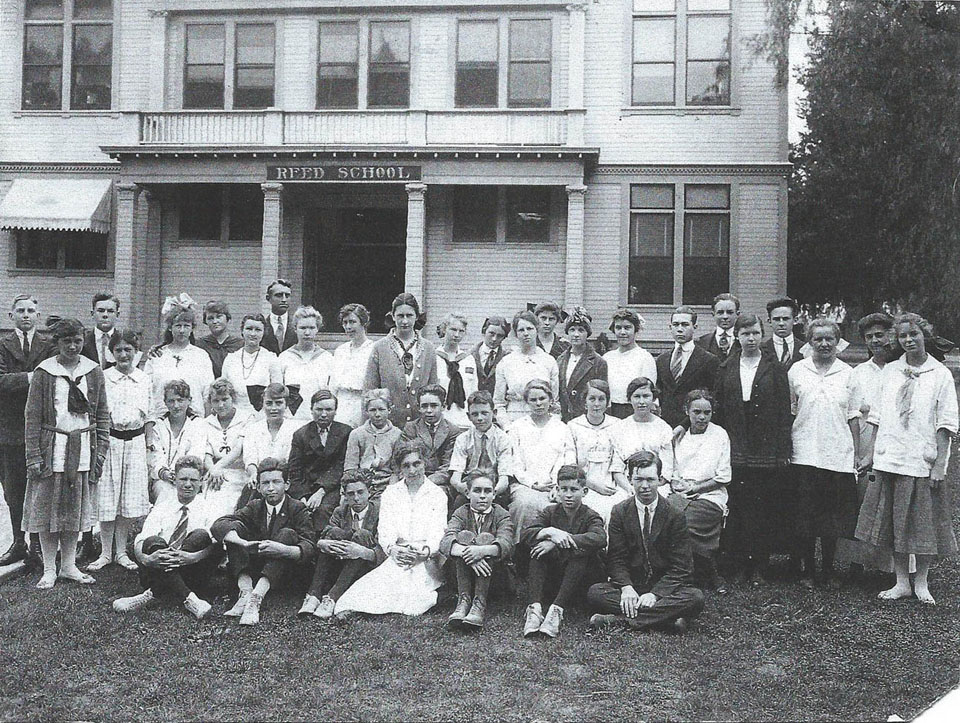
In 1910, both of Covina's grade schools were given new names. Lower Azusa was renamed Lark Ellen School after Covina's famous opera singer "Lark" Ellen Beach Yaw (1869-1947), and the one downtown was called Reed School, after local physician and philanthropist Dr. James Denny Reed.


Lark Ellen School, c.1910, located on the southwest corner of Cypress Street and Lark Ellen Avenue.
Photo courtesy Covina Valley Historical Society/Glenn Reed.


The Reed School in the Nineteen-teens. Photo courtesy Glenn Reed.


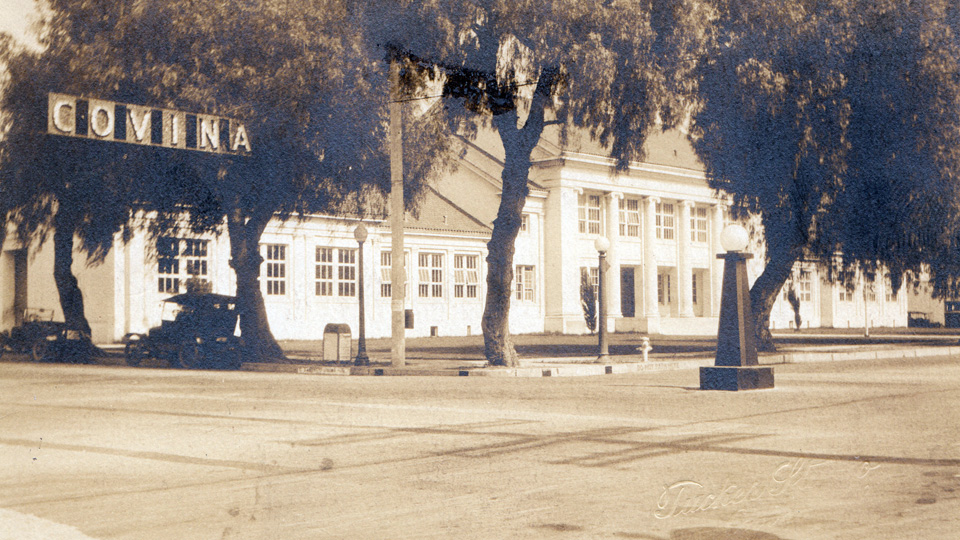
Covina's 1894 schoolhouses were demolished in 1918 and 1920 respectively to make way for newer buildings. Both were designed by John C. Austin, who later became the architect for the iconic 1928 Los Angeles City Hall.


Covina Grammar School, dedicated 1919, closed 1953. It was demolished in 1969 for a new Civic Center which was never built.


The second Lark Ellen School, circa 1940. It was replaced by the current campus buildings starting in 1953.
Courtesy Covina-Valley Unified School District.