Thursday, November 12, 2020

Mayors of Covina

A list of the mayors of the City of Covina in the 20th century, courtesy of Glenn Reed.


Eri Garfield Clapp          1901-1904
E. H. Lahee                 1904-1910
Lambert L. Ratekin          1910-1912
C. S. Beardsley             1912-1916
J. N. Wilson                1916-1918
R. A. Welch                 1918-1920
J. Minter Stanton           1920-1922
J. P. Overholtzer           1922-1924
George H. Maxfield          1924-1926
J. N. Wilson                1926-1928
George H. Maxfield          1928-1940
Seth I. Colver              1940-1948
Paul H. Chapman             1948-1950
Howard H. Hawkins           1950-1956
Paul Welch                  1956-1958
Donald A. Leggett           1958-1959
Maurice M. Upton            1959-1960
Howard H. Hawkins           1960-1962
Seth I. Colver              1962-1964
Oscar G. Yeager             1964-1968
Frank Haven                 1968-1972
Howard H. Hawkins           1972-1974
Louis Brutocao              1974-1976
Elaine Donaldson            1976-1978
Karl Jaeger                 1978-1980
Charles G. Colver           1980-1982
Henry Morgan                1982-1984
Charles G. Colver           1984-1986
Larry Straight              1986-1988
Robert G. Low               1988-1990
Christopher Lancaster       1990-1992
Henry Morgan (recalled)     1992-1993
Thomas O'Leary              1993-1996
Linda D. Sarver             1996-1997
Thomas O'Leary              1997-1998
Kevin Stapleton             1998-1999


Thursday, September 10, 2020

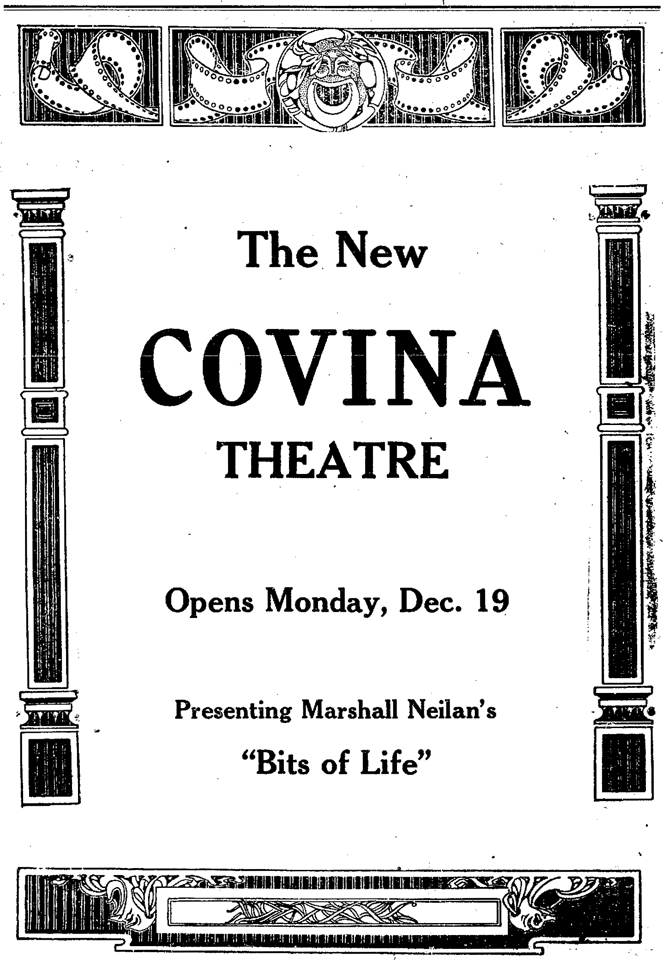
Covina Theatre Opens, 1921

Ad announcing the Grand Opening of the Covina Theatre, which appeared in the Covina Argus newspaper on December 16, 1921.


Image courtesy: Digital Archives of the Covina Public Library, and NewspaperARCHIVE.com.


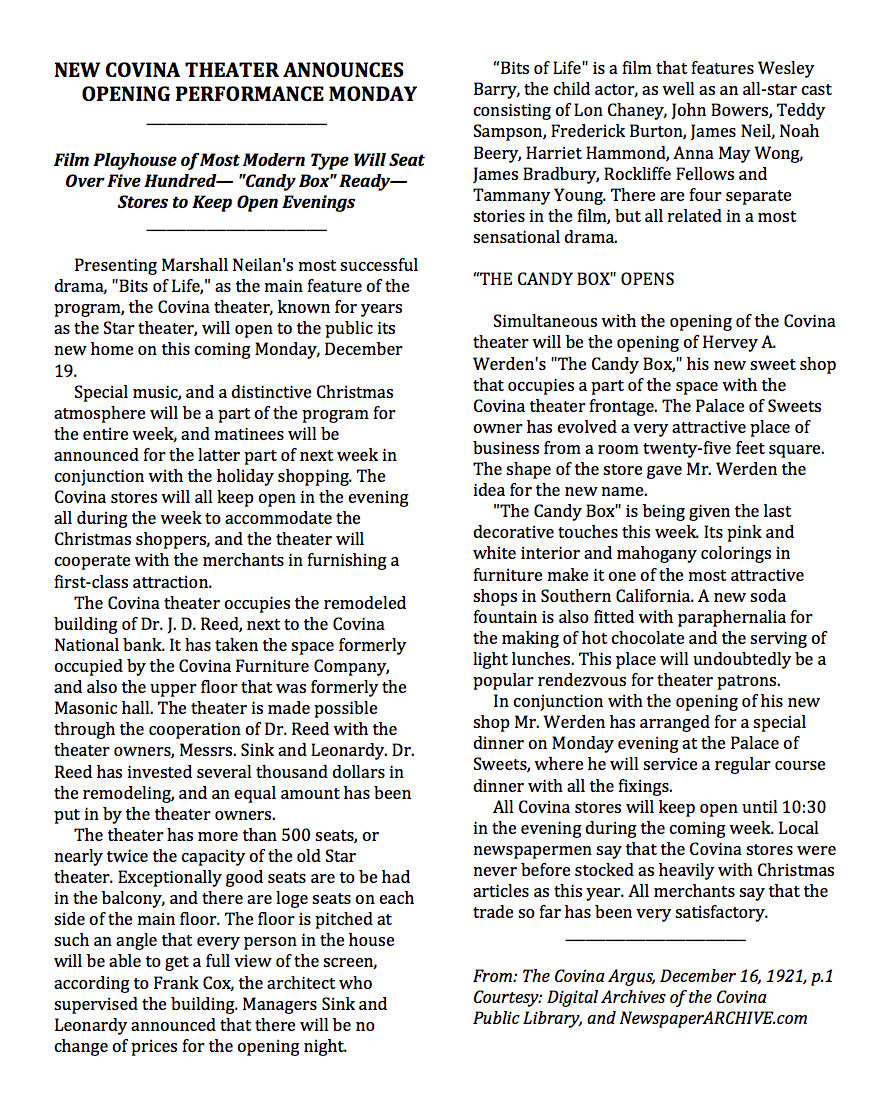
Transcription of the accompanying news article:

NEW COVINA THEATER ANNOUNCES OPENING PERFORMANCE MONDAY Film Playhouse of Most Modern Type Will Seat Over Five Hundred — Candy Box Ready — Stores to Keep Open Evenings, Presenting Marshall Neilan's most successful drama, Bits of Life, as the main feature of the program, the Covina theater, known for years as the Star theater, will open to the public its new home on this coming Monday, December 19. Special music, and a distinctive Christmas atmosphere will be a part of the program for the entire week, and matinees will be announced for the latter part of next week in conjunction with the holiday shopping. The Covina stores will all keep open in the evening all during the week to accommodate the Christmas shoppers, and the theater will cooperate with the merchants in furnishing a first-class attraction. The Covina theater occupies the remodeled building of Dr. J. D. Reed, next to the Covina National bank. It has taken the space formerly occupied by the Covina Furniture Company, and also the upper floor that was formerly the Masonic hall. The theater is made possible through the cooperation of Dr. Reed with the theater owners, Messrs. Sink and Leonardy. Dr. Reed has invested several thousand dollars in the remodeling, and an equal amount has been put in by the theater owners. The theater has more than 500 seats, or nearly twice the capacity of the old Star theater. Exceptionally good seats are to be had in the balcony, and there are loge seats on each side of the main floor. The floor is pitched at such an angle that every person in the house will be able to get a full view of the screen, according to Frank Cox, the architect who supervised the building. Managers Sink and Leonardy announced that there will be no change of prices for the opening night. Bits of Life is a film that features Wesley Barry, the child actor, as well as an all-star cast consisting of Lon Chaney, John Bowers, Teddy Sampson, Frederick Burton, James Neil, Noah Beery, Harriet Hammond, Anna May Wong, James Bradbury, Rockliffe Fellows and Tammany Young. There are four separate stories in the film, but all related in a most sensational drama. THE CANDY BOX OPENS Simultaneous with the opening of the Covina theater will be the opening of Hervey A. Werden's The Candy Box, his new sweet shop that occupies a part of the space with the Covina theater frontage. The Palace of Sweets owner has evolved a very attractive place of business from a room twenty-five feet square. The shape of the store gave Mr. Werden the idea for the new name. The Candy Box is being given the last decorative touches this week. Its pink and white interior and mahogany colorings in furniture make it one of the most attractive shops in Southern California. A new soda fountain is also fitted with paraphernalia for the making of hot chocolate and the serving of light lunches. This place will undoubtedly be a popular rendezvous for theater patrons. In conjunction with the opening of his new shop Mr. Werden has arranged for a special dinner on Monday evening at the Palace of Sweets, where he will service a regular course dinner with all the fixings. All Covina stores will keep open until 10:30 in the evening during the coming week. Local newspapermen say that the Covina stores were never before stocked as heavily with Christmas articles as this year. All merchants say that the trade so far has been very satisfactory. From: The Covina Argus, December 16, 1921, p.1 Courtesy: Digital Archives of the Covina Public Library, and NewspaperARCHIVE.com


Ad for "The Candy Box" concession stand at the front of the new theater.
Image courtesy: Digital Archives of the Covina Public Library, and NewspaperARCHIVE.com.


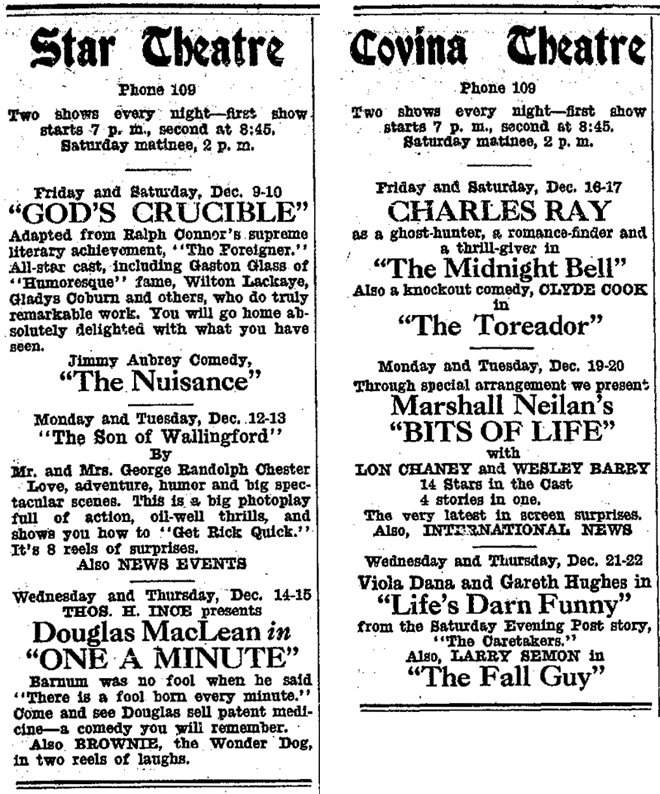
Out with the old and in with the new! Looks like the old Star Theatre had its last showing on Thursday, December 15th, and the new Covina Theatre opened unofficially the next day. Also, it appears "[A] Midnight Bell" was actually the very first feature shown in the brand new venue; "Bits of Life" being the Grand Opening bill-topper.


Image courtesy: Digital Archives of the Covina Public Library, and NewspaperARCHIVE.com.


I've not yet been able to find a good photo of the Covina Theatre in the 1920s, so I guess, like so many other things these days, all you get to see is ads. :-)

The Covina Theatre was demolished completely in 2005. Nothing of it remains today. The performing arts center there now is an entirely new building from the ground up.


Saturday, May 23, 2020

Covina On the Cusp

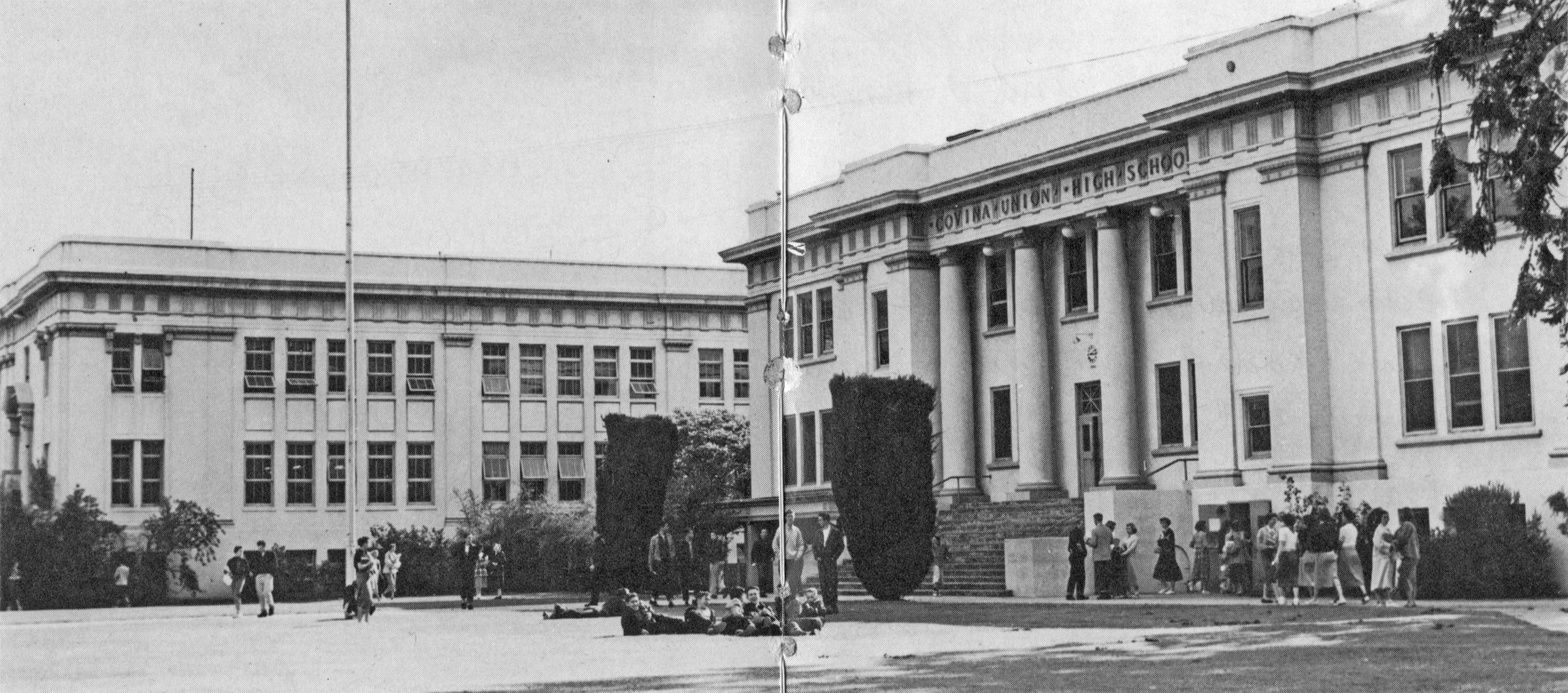
Title page of the CHS Cardinal yearbook from 1954: the year I was born in Covina. It shows my home town on the cusp of its transition from citrus-growing capital to suburban residential community.


Click for full-res image.

Still more groves than subdivisions at this point, but that wouldn't be the case for much longer.

The old high school would soon be no more, as well. CHS began transitioning to a new location on Puente at Hollenbeck starting in Fall, 1956. That same year, students from West Covina attended classes at the old campus until their own new high school would be ready in 1957. In 1958-1959, it became an all-freshman high school, where students from all over the area waited for Northview, Charter Oak, and Edgewood to be completed. After closing completely in 1961, the main building was repeatedly vandalized, and in June, 1962, the gymnasium was destroyed by arson. The entire complex was subsequently demolished.


Covina High quad, 1954. Science Hall annex at left. Click for full-res image.


Saturday, April 25, 2020

"75 Years of Covina"

Excellent video summarizing the history of our home town, originally presented in 1977 by the Rotary Club of Covina, and released on DVD in 2006 by the Covina Valley Historical Society. Historical materials compiled and presented by Vernon Jobe with narration by William B. Temple, and supervised by William Stone.

Among the topics covered are the history of irrigation, the citrus industry, rail transportation, schools, social organizations, postal service, the fire department, early telephone service, civic improvements, and a series of very interesting "before and after" views of Covina and environs over the years. Some of the statements made by the narrator are not historically accurate, however. For example, at the beginning, Mr. Temple states that Covina founder Phillips "subdivided one square mile of the Rancho La Puente," which vastly understates the actual acreage of the Phillips Tract, and he then incorrectly describes the tract's original boundaries. Overall, however, the video is highly informative and is well worth a watch!


Thursday, November 14, 2019

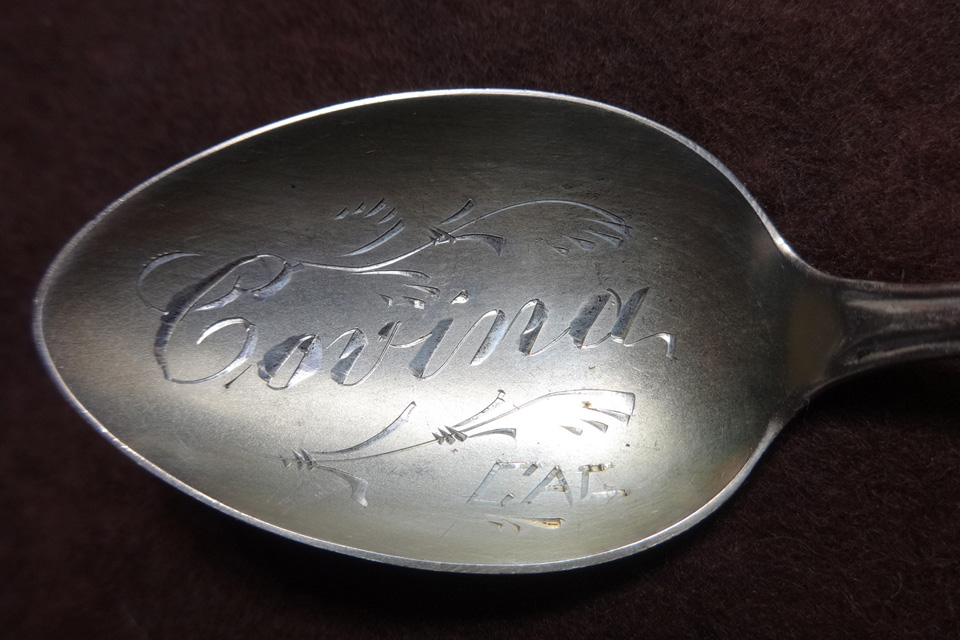
Covina Souvenir Spoon

I recently acquired this Sterling silver souvenir spoon, hand-engraved with 'Covina CAL' on the bowl. I'm told it dates to the 1910s.


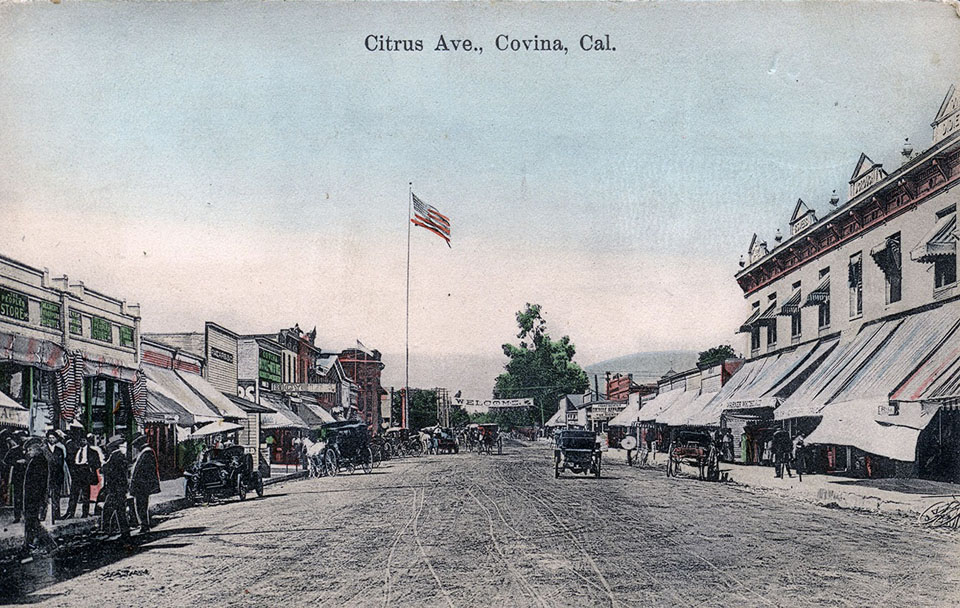
If it is from that period, it might very well have been bought at The Peoples Store on Citrus. This is exactly the kind of knickknack they sold. Clapp's Pharmacy is another possibility. Both carried souvenirs and curios in addition to their regular goods.


"The Peoples Store" can be seen over at the far left edge.

I was really happy to find the spoon. I saw one just like it 10+ years ago but failed to score it. I think my Covina antique collection is complete now. This was kind of the Holy Grail for me.


Tuesday, April 2, 2019

The San Bernardino Road

San Bernardino Road is one of Los Angeles County's oldest historical highways. An important transportation link in pioneer times, today's city of Covina would not have come into existence without it.

In 1810, when California was still part of the Spanish Empire, the friars of Mission San Gabriel built a chapel and supply station 45 miles to the east. The chapel was dedicated to San Bernardino de Siena, which, in the decades to come, would lend its name to a new city, and to the mission trail that originally connected the inland estancia to the mother church and to Los Angeles beyond.
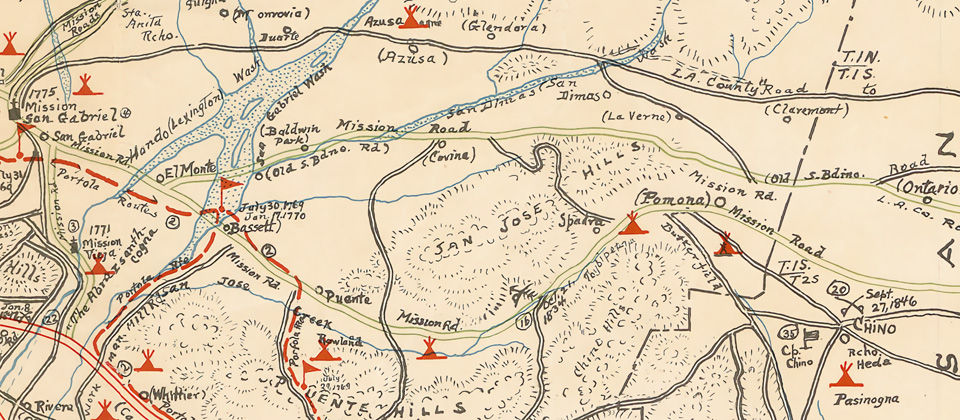

Detail from the Kirkman Map (1937) of historical sites in Los Angeles County, showing the future location of Covina (center) on the "Old S.Bdino. Rd."


It seems likely, however, that the trace which became known as the San Bernardino Road existed even before Mission San Gabriel was founded. The Gabrielinos which populated the valley prior to European settlement were said to have used it to transport logs from the San Bernardino Mountains to build the mission. The Anza expedition is known to have traversed the trail in 1774, as did Jedediah Smith and his party in 1826 and 1827.1

By 1842, when the San Bernardino Road was established as the northern boundary of Rancho La Puente,2 it was already the main east-west travel and freighting route between Los Angeles and what was then called the Azusa Valley.1 The old thoroughfare was upgraded to a county road in 1879,3 when it was widened and straightened to its current alignment.

In 1882, recognizing it as an ideal location for a townsite, Joseph S. Phillips bought 2,000 acres of land on the south side of the stage road and founded Covina there three years later.2,4

Many early "firsts" in the Covina area took place along the much-traveled track.2

  • The first general store: Goldsmith's "Four Corners" mercantile, just west of today's Orange Avenue, 1865.
  • The first community center and church: Grange Hall, on the south side, 500 feet west of today's Vincent Avenue, 1870s.
  • Covina's first schoolhouse, corner of Citrus Avenue, 1883.
  • First irrigation reservoir–foundational to Covina's citrus industry–west of Grand Avenue, 1886.
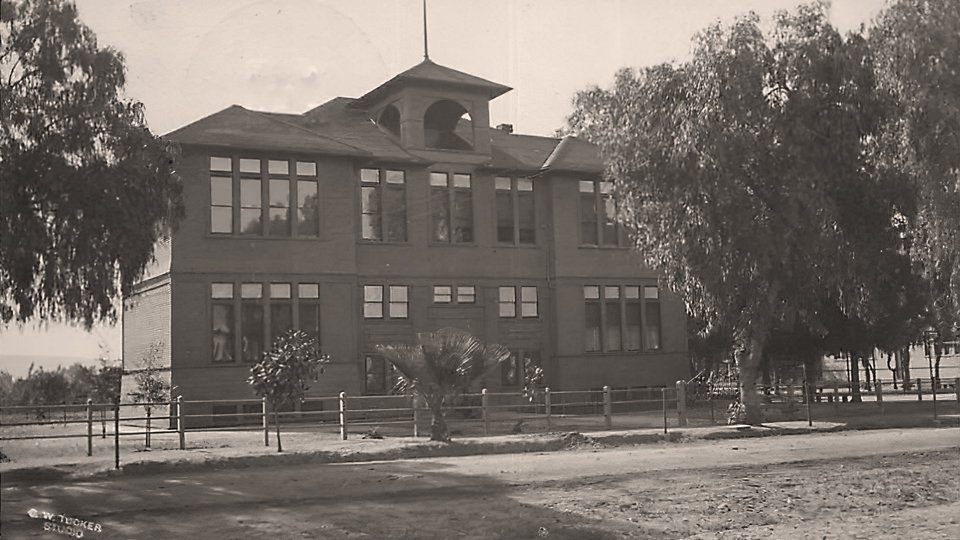
  • The city's first high school (pictured below): on San Bernardino Road behind the grammar school, 1903.

Some of the earliest houses in the lower Azusa Valley were built along San Bernardino Road. The most historically notable were the two homes built by the Badilla brothers in 1876,5 just west of today's Hollenbeck Avenue, and Thomas S. Ruddock's Mountain View (1891) at San Bernardino Road's intersection with Grand Avenue.4
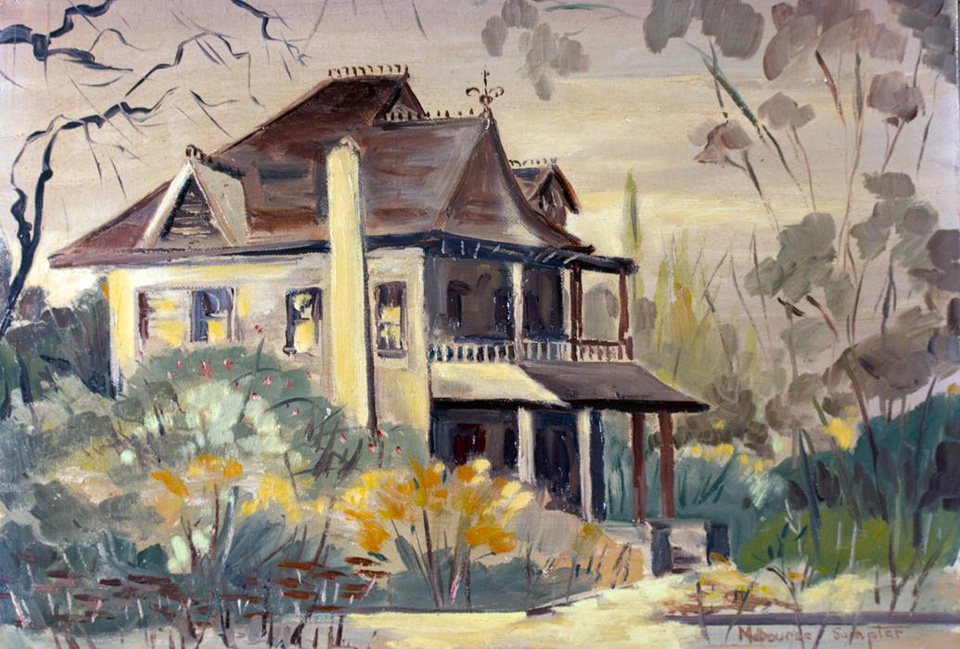

Covina's founder–J. S. Phillips–lived in this Queen Anne manse on the southwest corner of San Bernadino Road and Hollenbeck.
Painting by Melbourne Sumpter, image courtesy Glenn Reed/Covina Valley Historical Society.
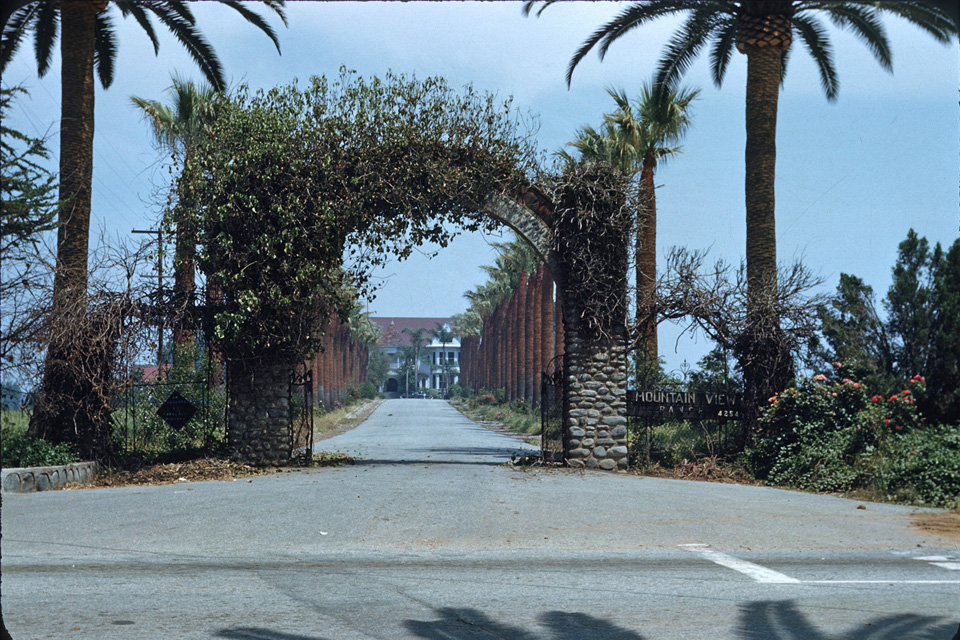


The entrance to Mountain View at the eastern end of San Bernardino Road, 1952. This driveway is now the palm-lined stretch of Wingate Street in Charter Oak.
Photo by Bruce Ward Macy, courtesy Marilee Johnson.


Before the establishment of Mountain View, the San Bernardino Road continued east in a meandering diagonal line up to Mud Springs south of San Dimas, then down past the Casa Primera de Rancho San José in Pomona on its way to its namesake destination.
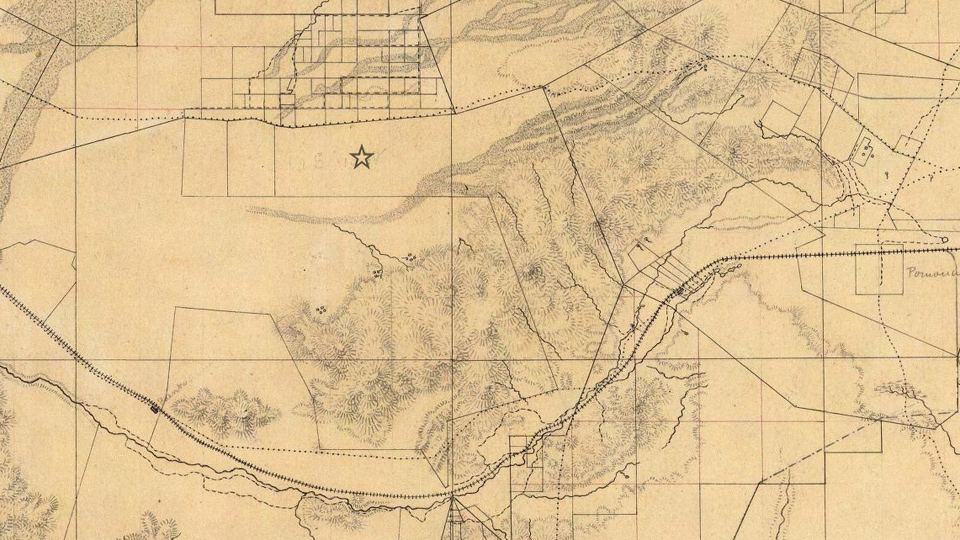

This topographical map from 1880 shows the original track of old San Bernardino Road (upper dotted line). The star shows the future location of Covina.
The dotted line to the south is another mission road, later to become Valley Blvd. Source: David Rumsey Map Collection.
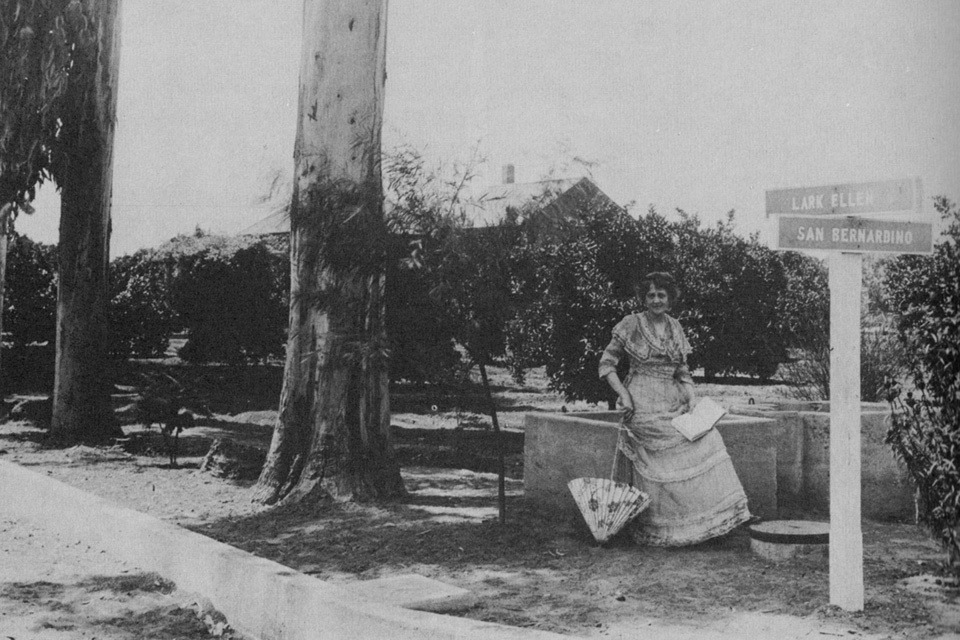


Opera singer "Lark Ellen" Beach Yaw also lived on San Bernardino Road, at the intersection of the street that still bears her name.
Image source: Covina, by Donald Pflueger, 1964.
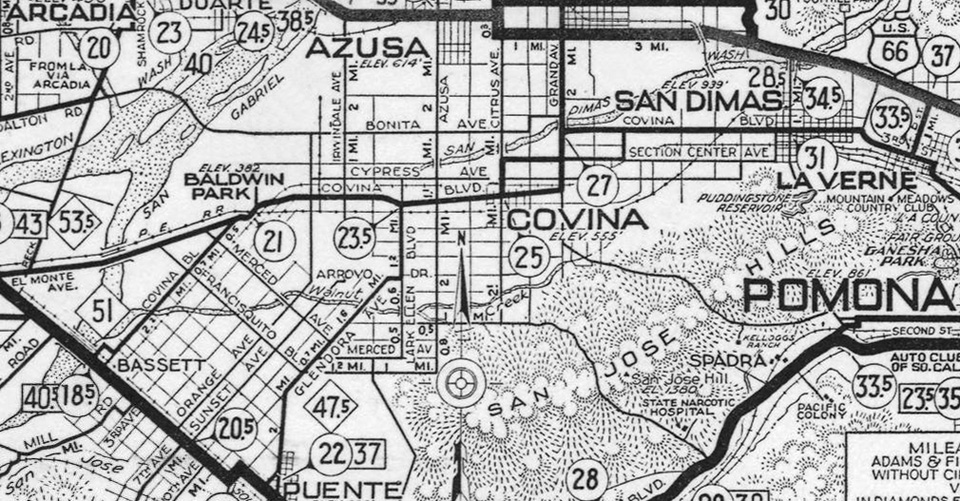


From 1911-1933, San Bernardino Road was part of a 14-mile-long thoroughfare called Covina Boulevard which ran from Bassett to San Dimas,
as shown on this AAA strip map from 1931. (Today's Covina Blvd. was called Section Center Ave. during this period.)
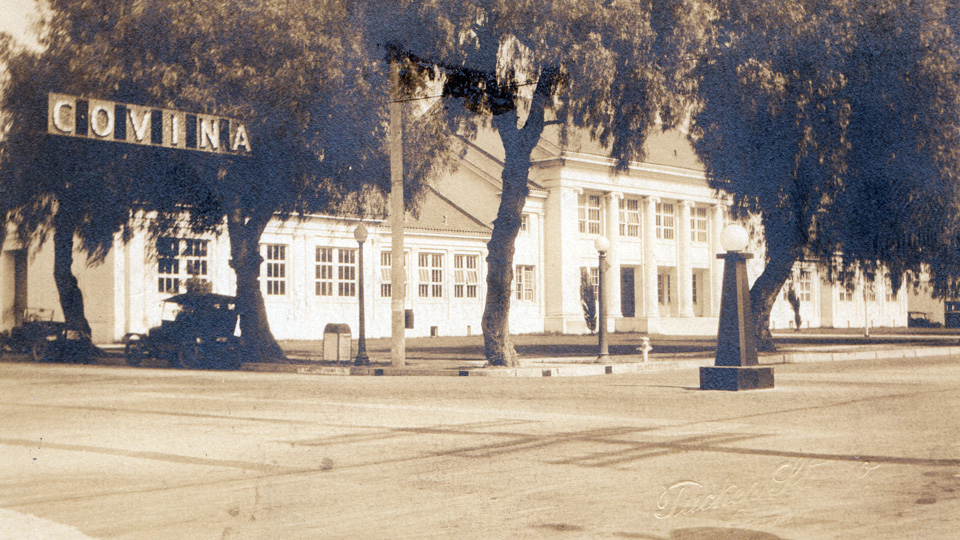


The Covina Grammar School at the southeast corner of San Bernardino Road (then named Covina Boulevard) and Citrus Avenue, mid-1920s. Tucker Studio photo.


Now well over 200 years old, almost all traces of the original San Bernardino Road have been erased, however the portion of it that passes through Covina today is one of the few remaining stretches that preserves the 1879 alignment of the historic Spanish mission trail.
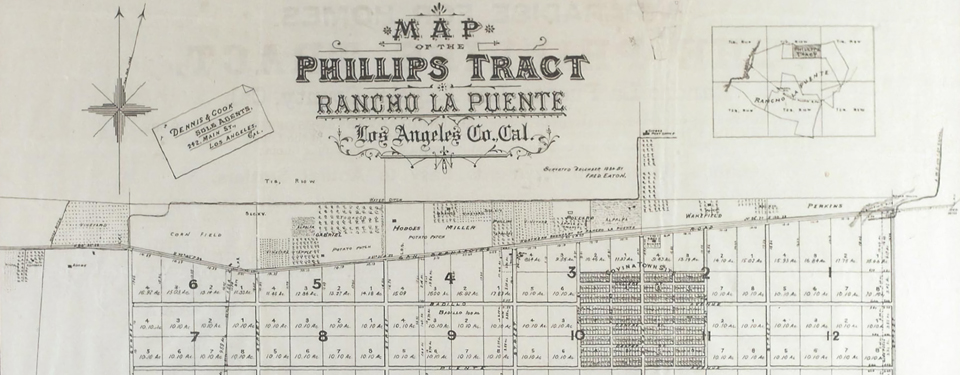

The familiar odd angles of old San Bernardino Road are easily recognized in this detail of the first map of Covina, 1885.
Courtesy Glenn Reed/Covina Valley Historical Society.

References:

1 Head, Harriett R., San Bernardino Road Linked with Southern California History. Covina Argus, January 31, 1930, p.2.
2 Pflueger, D. H. 1964. Covina: Sunflowers, Citrus, Subdivisions. Castle Press, Pasadena, California, 372pp.
3 Los Angeles Herald, June 4, 1879.
4 Hall, B. A. 2007. Images of America – Covina. Arcadia Publishing, San Francisco, California, 127pp.
5 _______. 2012. Covina History Changes. The Citrus Peal, Covina Valley Historical Society, p.9.