For some time there's been much speculation about the name of Badillo Street in Covina and why it differs from the pioneer family's hereditary Spanish name, Badilla. Now, after years of study, I believe I can finally provide an answer to the "Badillo" question that's backed up by objective, verifiable facts.
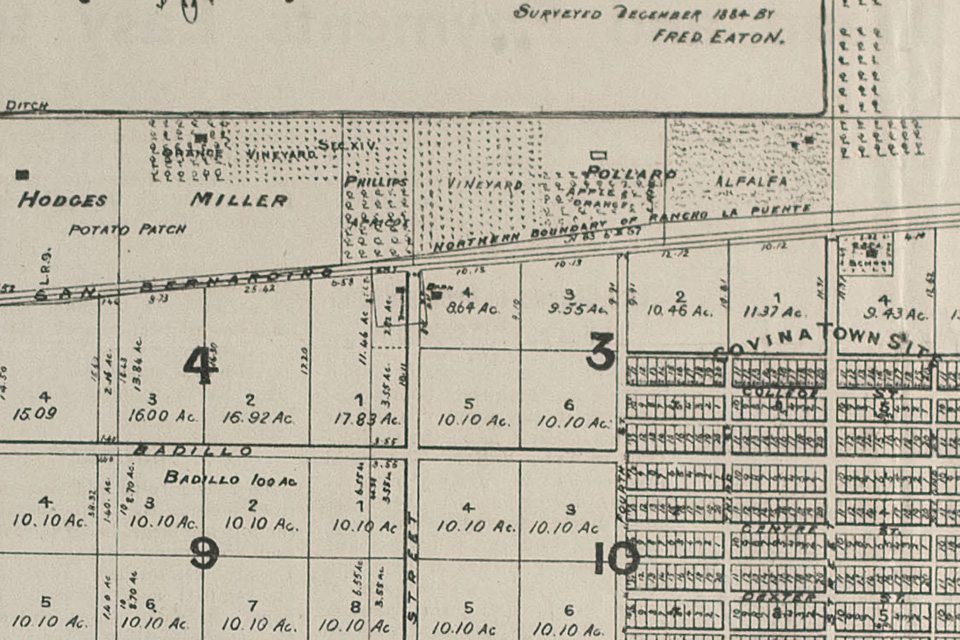
Covina's main east/west street was named "Badillo" on the original Phillips Tract survey map in 1884.
Courtesy Covina Valley Historical Society.
I briefly mentioned my own theory about the spelling difference at the end of the article about Hollenbeck and the Badillas that I posted back in 2021. I noted that the family themselves appeared to use a terminal –o in their surname on occasion, and theorized that the street was named "Badillo" because that was the name the farming brothers were best known by.
I didn't have sufficient supporting evidence for either claim, though, until I recently found this letter published in a newspaper in 18771 that was signed "J. Julian Badillo." This was the first time I'd seen one of the famous coffee-growers using the Badillo spelling himself (and also the first I've seen the name of their coffee plantation was "San Isidro Ranch.")
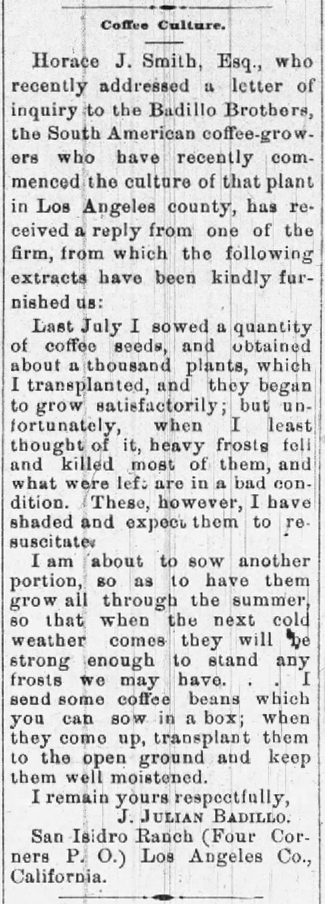
Santa Barbara Daily Press, February 7, 1877.
(See also Los Angeles Evening Express, February 10, 1877.)
With that revelation, I did more specific searches on the newspaper archive website to manually tally the number of times the two surname spellings were used, and the contexts in which they appeared.
• Total number of unique newspaper mentions of the family name as Badilla between 1876-1879: 29
Contexts: Travel, 1; Post office, 13; Legal matters, 13; Agriculture, 2.
• Total number of unique newspaper mentions of the family name as Badillo between 1876-1879: 44
Contexts: Travel: 2, Post office, 9; Legal matters, 2; Agriculture, 31.
When a mention concerned legalities—like a land purchase or sale, lawsuit, or other matters of official record—their name was almost always given as Badilla. However, when a newspaper wrote specifically about the family's agricultural enterprises, the –o spelling occurred in print 15x more often than –a, and all 22 of the mentions related to coffee-growing used the name Badillo.2
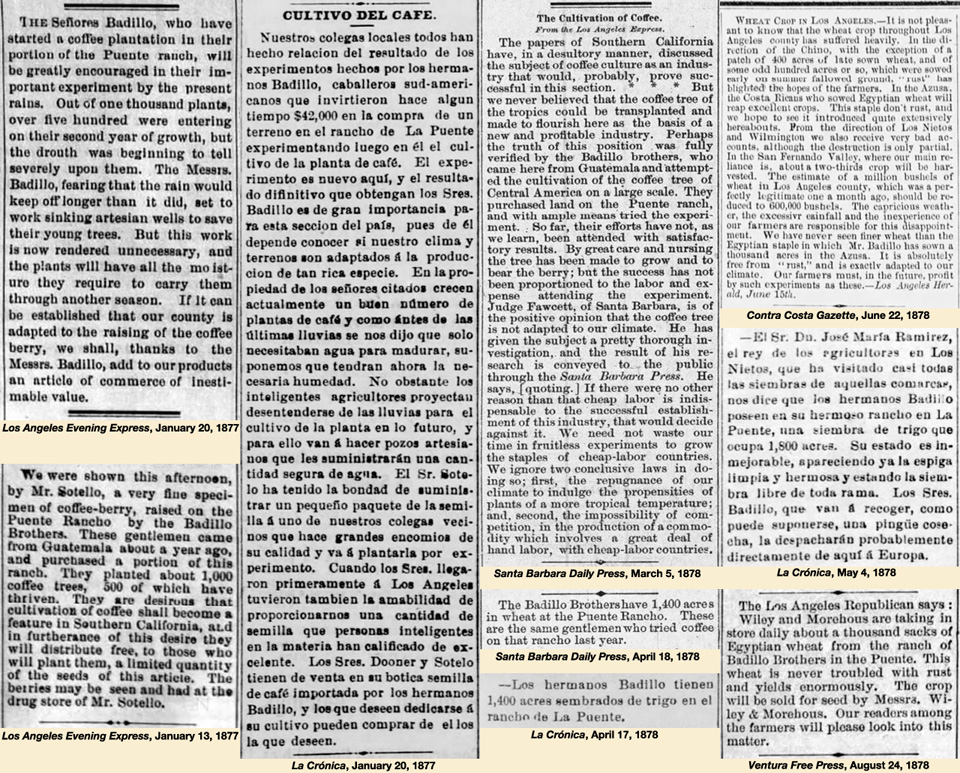
Widely publicized in California, almost all newspaper reports of the family's agricultural ventures used the "Badillo" spelling, even in Spanish.2
Clippings © Newspapers.com.
One may wonder why the farming brothers might have chosen to use an alias or a trade name instead of their true name. An answer to that question is apparently lost to history. However, robustly non-random data like the 31-2 occurrence of one spelling versus the other in publicity about agriculture (and 100% in reference to coffee) does give me sufficient confidence to reject the latter-day hypothesis that "Badillo" was simply the chance outcome of mistaking one vowel for another.

Now, about that street name in particular. It's often overlooked that, from 1882-1886, Antonio Badilla and Covina founder J. S. Phillps lived less than a hundred yards from one another on San Bernardino Road.3 They doubtless spoke frequently during their many years as next-door neighbors, and when Phillips' new tract was surveyed and subdivided, surely he would have told Antonio that he intended to name a street after him. Furthermore, because Phillips himself knew that the family went by both Badilla and Badillo at times,4 it seems plausible he would have asked his neighbor which spelling he preferred, and then honored his choice. (Admittedly that's speculation, but wouldn't that be the proper thing to do?)
It also seems reasonable to conclude that Badillo Street was named in honor of Antonio specifically, as Joseph Phillips never knew nor had personal dealings with anyone else in the Badilla family. It's also easy to see from the map at the top why that one particular street in the new town of Covina was named for Antonio, because it passed straight through the heart of his 100-acre farm.
When Phillips's new tract was surveyed and laid out in 1884, he named only five of its new streets after other people: his then-newborn son, Dexter,3 his partner, J. Edward Hollenbeck, the late owners of Rancho La Puente—"Don Juan" Rowland and "Don Julian" Workman—and finally, his neighbor and friend—the locally famous coffee grower, "Anton"5-9 Badillo.
To summarize:
• The Badilla brothers used the alternate spelling themselves.
• Newspaper accounts of the coffee venture all reported the name as "Badillo." (This alone eliminates chance as a possibility.)
• Both official maps of the Phillips Tract spelled the street name Badillo (see the 1884 Eaton map above, and a detail of the 1886 Culver map here).
Additionally:
• When J. E. Hollenbeck gifted Antonio 100 acres of land in 1881—three years before Covina existed—the recorded deed conveying legal ownership gave his surname as Badillo:

Grant deed from J. E. Hollenbeck to Antonio Badillo, filed September 10, 1881, at 2:03 PM, Los Angeles County Recorder.
Crucially, all of the facts listed above are backed up by published and verifiable evidence, while none of the alternative scenarios given by others rise above the level of speculation. The overall conclusion is clear: the family name of Badilla and the local variant Badillo are both historically correct; the latter especially so with respect to Covina.
I also feel confident concluding that Antonio Badilla was of generally greater historical importance than either of his two elder brothers, and not just in Covina, but later on in Costa Rica, as well, as you will soon learn. For one thing, Antonio lived here far longer than either of his brothers. Both Julian and Fr. Pedro Badilla were only in California for 28-30 months, while Antonio lived in his home on San Bernardino Road for 9-1/2 years: long enough to become a well-known and apparently well-liked and respected local figure.10
Unfortunately, past historical accounts have grievously misrepresented Antonio Badillo. For decades he has been portrayed as a repeated agricultural failure, a landowner who borrowed large sums of money which he never repaid, and who then lost his land to foreclosure.3,5 Those characterizations are all completely false.
As I described previously,11 the Badillo brothers actually did manage to grow coffee plants here, and they were spectacularly successful growing wheat the following year. They were in fact highly skilled agriculturists, and the exact opposite of failures. However, despite his farming partnership with Julian, it is now known for certain that Antonio was never a co-owner of the San Isidro Ranch, and furthermore, there's no record that he ever borrowed a cent from Hollenbeck's bank, let alone failed to repay debts.
Quite the opposite, J. E. Hollenbeck held Antonio in such high regard that he freely gave him 100 acres of his brothers' former lands:3,11 an act of extraordinary goodwill that allowed Antonio's family to keep their home and farmstead even after Julian and Fr. Pedro lost everything. No bank president in his right mind would extend such extreme altruistic generosity to someone they'd just dispossessed through foreclosure, as the old story told. Such a scenario is so patently absurd it's amazing anyone ever wrote or believed such nonsense.
At last, in February, 1886, Antonio sold his Covina property to Daniel Houser for $12,000,12 returned to Costa Rica, and there he resumed growing coffee.5 That's all the history books have said about him until now. Remarkably, I was surprised to discover only recently that, in the remaining years of his life, Antonio Badilla became a fabulously wealthy man.13
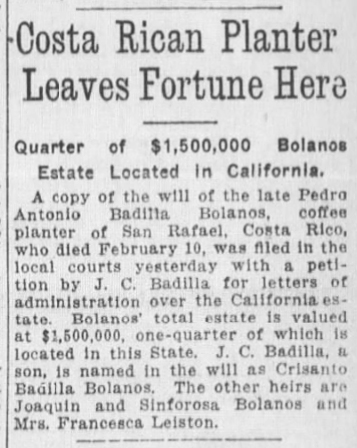
San Francisco Examiner, July 10, 1913.
As you can see in the clipping above, at the time of his death in 1913, Antonio Badilla's multinational estate was valued at $1,500,000: a sum that this inflation calculator says is equal to $49.7 million today. If true, I think it's pretty safe to say that, after he left Covina, Pedro Antonio Badilla Bolaños went on to become one of the richest men in Central America: a fitting happy ending for this admirable gentleman who for far too long has been wronged by false history.
References:
1 Santa Barbara Daily Press, February 7, 1877, p.2. (also Los Angeles Evening Express, February 10, 1877, p.3.)
2 My detailed Badilla/Badillo newspaper search results can be viewed by clicking here.
3 Pflueger, D. H. 1964. Covina: Sunflowers, Citrus, Subdivisions. Castle Press, Pasadena, California, 372pp.
4 "Badillo – Badilla – or Eaton," by Glenn Reed. Originally published in The Covina Citrus Peal, Covina Valley Historical Society, October, 2016.
5 Covina Argus, May 4, 1912, p.20.
6 Covina Argus, February 26, 1926, p.4.
7 Los Angeles Sunday Times, July 31, 1927, p.78.
8 Pasadena Star-News, October 20, 1928, p.32.
9 Pomona Progress-Bulletin, November 25, 1930, p.32.
10 Eckles, C. M. 1960. Memoirs of Clara Margaret Eckles (1874-1966), Karl W. Blackmun, ed. Unpublished manuscript, Covina Valley Historical Society, 16pp.
11 "Hollenbeck and the Badillas," Covina Past weblog, September 7, 2021.
12 Los Angeles Times, February 3, 1886, p.3.
13 San Francisco Examiner, July 10, 1913, p.3.
Article updated July 18, 2025 and September 14, 2026.


2 comments:
Thanks for the information on the Badillo/Badilla question. I've wanted to know for years if it was a typo or deliberate.
I grew up in Covina from 1965 through 1979 and remember it well. I still have relatives in the Valley and the Inland Empire.
Over the time I've been reading your incredible blog, I've seen you occasionally comment about weather it was worth the effort given what is apparently a smaller audience than you wish. I'm just here to say that I think your work is remarkable and that I deeply appreciate every single post. With gratitude
Post a Comment
To post a comment, you must login to this page with the Google Chrome web browser. That is the only way that works now.