Wednesday, March 7, 2018

The Ruddock Mansion

"Mountain View" was the winter home of Chicago lumberman Charles Homer Ruddock (1848-1929) and family.1,2 In March, 1888, Charles's father, Thomas Sanderson Ruddock, had purchased 204.6 acres of Hollenbeck Ranch land from Moye Langley Wicks:3 a huge parcel which lay east of Grand Avenue and the new town of Covina. However, the elder Ruddock died suddenly in Los Angeles on January 17, 1890,4 so he didn't live to see the grand estate that his son built and completed there in 1891.5

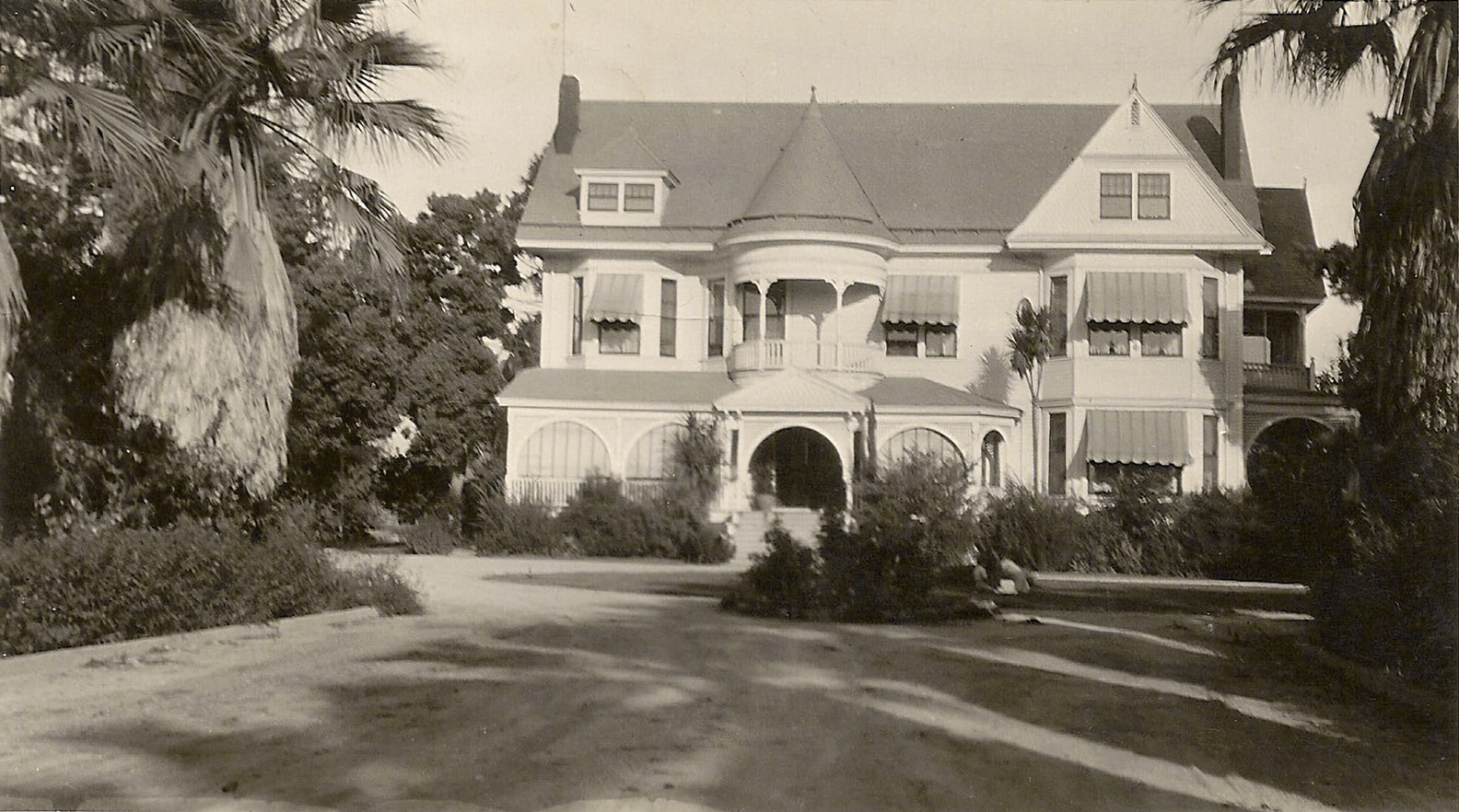
In pioneer times, the extravagant 3-story Queen Anne-style mansion1 was the showpiece of the entire Azusa Valley (as the Eastern San Gabriel Valley was called back then).6 According to Covina historian Barbara Ann Hall, Mountain View...

...had 11 7 bedrooms, 5 4 bathrooms, and 7 8 fireplaces of Belgian tile and rosewood. A stained-glass window looked down upon the staircase. There were stained-glass chandeliers in the ballroom. Surrounding the mansion were stables, a carriage house, a bunkhouse, servants' quarters, and a caretaker's cottage. The 800-foot 650-foot drive was lined with palm trees and roses.1

In 1910, Mountain View was sold to Conrad C. Kohlmeier,7 and through his son, William, portions of the former Ruddock lands stayed in the Kohlmeier family into the 1940s.

Ironically, for all its local fame in bygone days, few photographic images of Mountain View were known to have survived. Recently, however, I made the acquaintance of Mary Elarton Kidd–whose great aunt was one of the last residents of Mountain View–and she has shared with me many photos of the ranch which have never before been seen by the public.

To the best of my knowledge, this is the most detailed picture in existence of Covina's lost Victorian treasure. It shows Mountain View not long after John and Mary Chrastka bought the 27-acre mansion property in 1927.8


The Ruddock Mansion, 1891-1956. Photo courtesy Mary Kidd. Click image to enlarge.

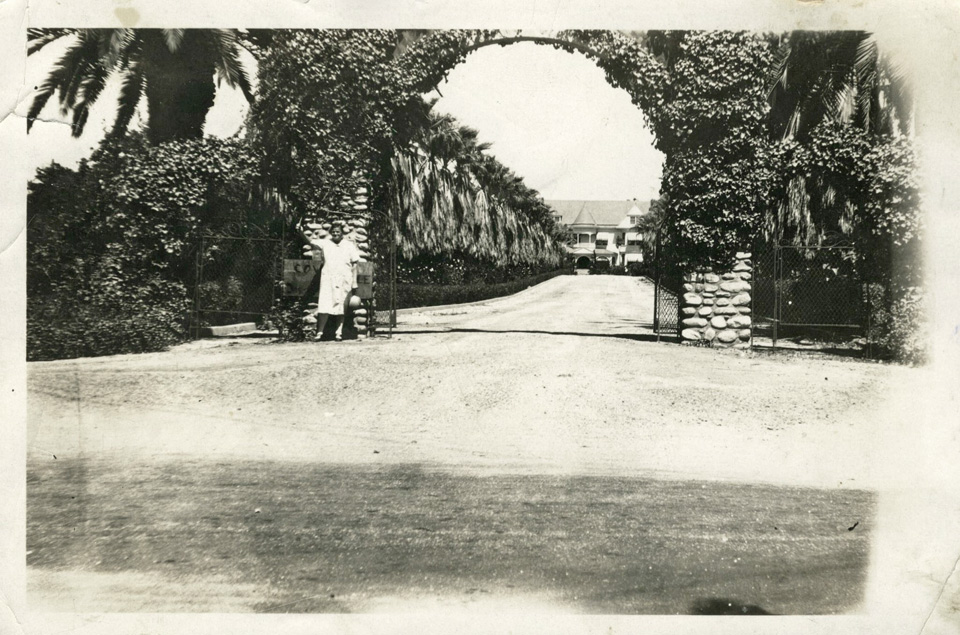
The entrance to Mountain View, formerly located at 522 North Grand Avenue9 at the eastern end of San Bernardino Road. The mansion itself was located immediately east of the intersection of today's East Wingate Street and South Westridge Avenue.


Photo courtesy Mary Kidd.

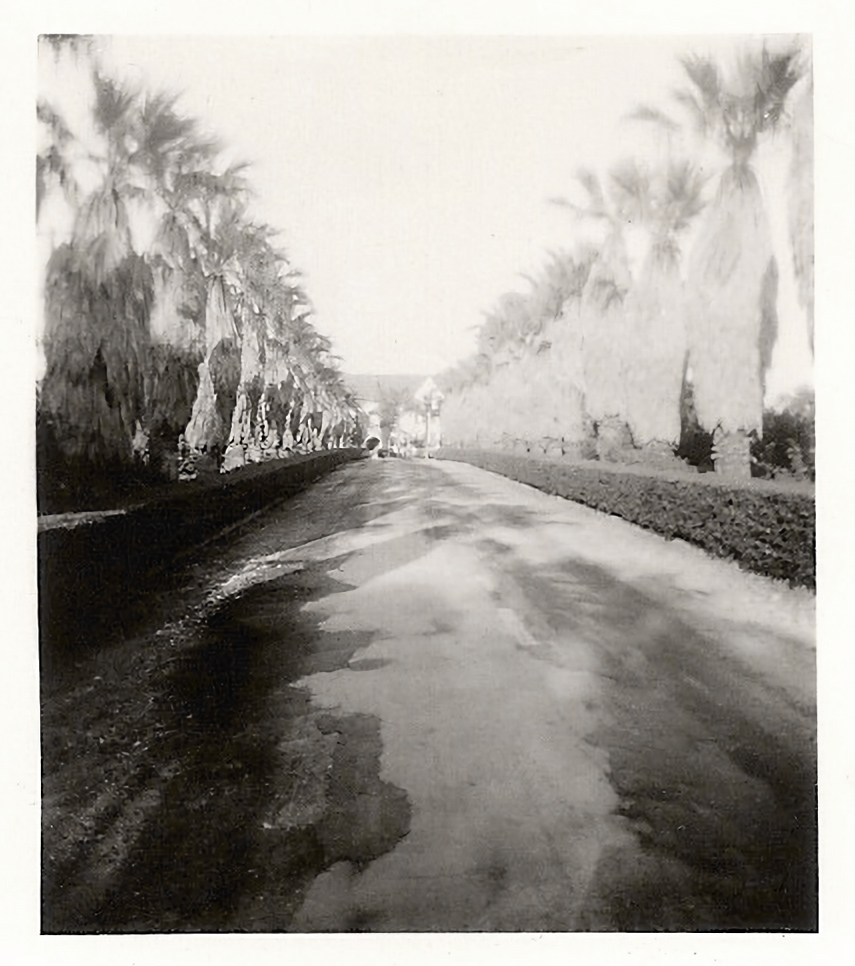
Planted over 130 years ago, the Washingtonia filifera fan palms that still stand today along East Wingate Street are among the oldest trees in Covina (together with the palms that line Hollenbeck Street). Here they are in the 1940s, when they were already six decades old.


Photo courtesy Mary Kidd.

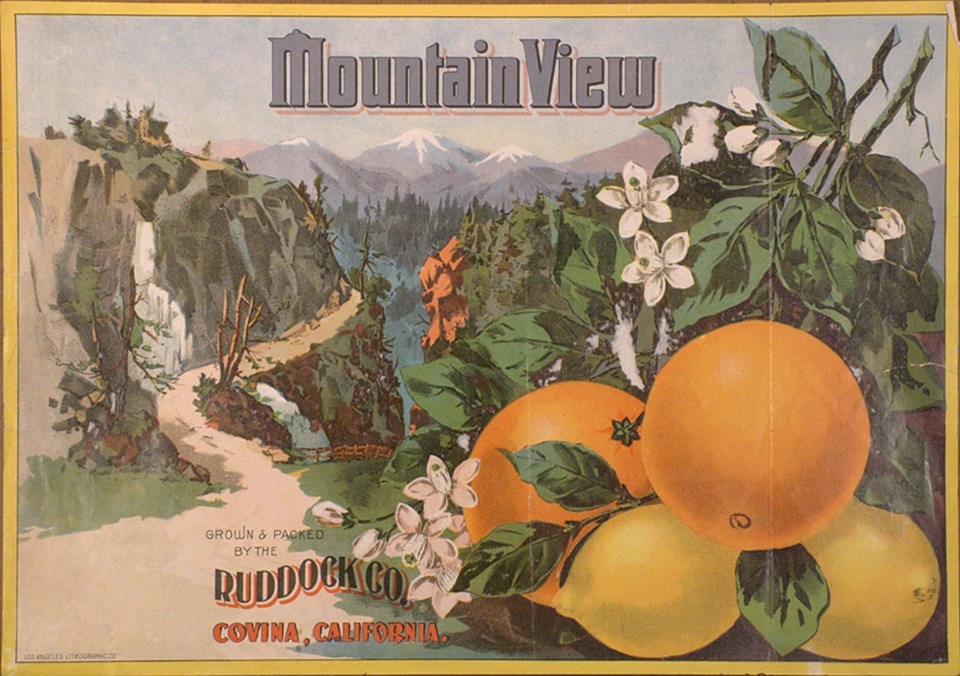
A Ruddock Company citrus crate label:


Image courtesy Calisphere.

Continuing on:

Saturday, February 17, 2018

Covina Banknotes

Most people today don't know this, but from 1863-1935, local National Banks could issue their own banknotes, which were legal tender anywhere in the United States.

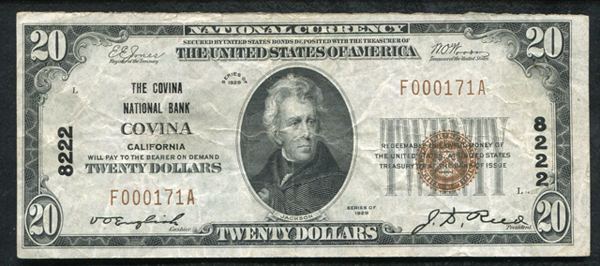
Here are some examples of U.S. currency produced by the two National Banks in Covina in the early years of the 20th century. (The first two are the old, large "horse blanket" banknotes; the third is the same size as our bills are today.)


$5 note, Series of 1882, Charter date 1901. Portrait depicts the late President James Garfield. Click image to enlarge.


$10 note, Series of 1902, Charter date 1921. Portrait depicts the late President William McKinley. Click image to enlarge.


$20 note, Covina National Bank, Series of 1929. Image courtesy seller jscabani1988 on eBay.

Below are some historical photos of Covina's two chartered National Banks.

Sunday, January 21, 2018

Old Covina High, 1961

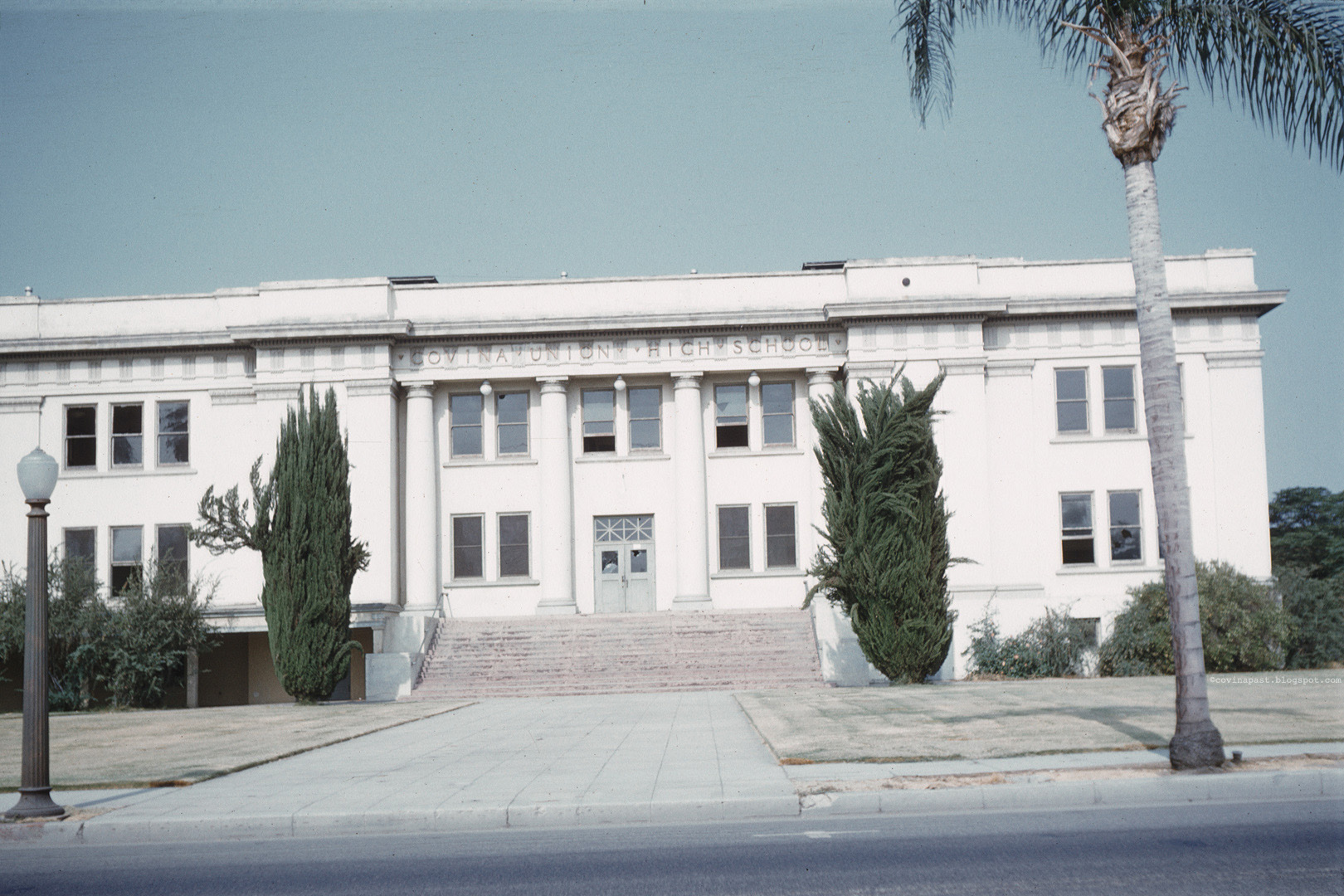
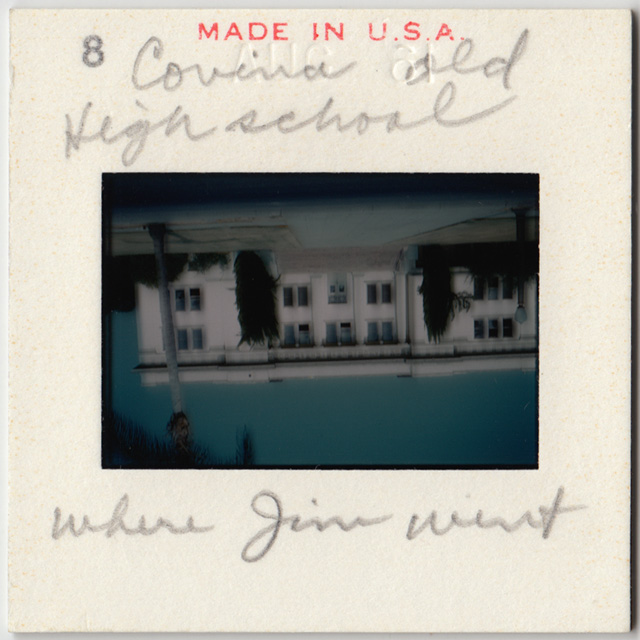
Covina Union High School, formerly located on the west side of Citrus Avenue between Puente and Dexter Streets.


Click image for an enlargement.

Opening in 1909, CUHS graduated 48 classes of seniors until it was replaced by the present high school in 1956. West Covina High School got its start on the old campus in academic year 1957-58, with Edgewood High following in 1958-59. This photo was taken in the summer of 1961 after the main building was abandoned, as the numerous broken windows attest.

The gymnasium of the old high school was burned down by child arsonists on the night of June 10, 1962. It was a spectacular fire. We could see the flames all the way from our house in the Covina hills. The Pasadena Independent reported that the presence of over a thousand spectators on the surrounding streets hampered efforts to contain the blaze. The entire campus was razed for redevelopment in Summer, 1963.


Wednesday, January 10, 2018

Strapping Youth

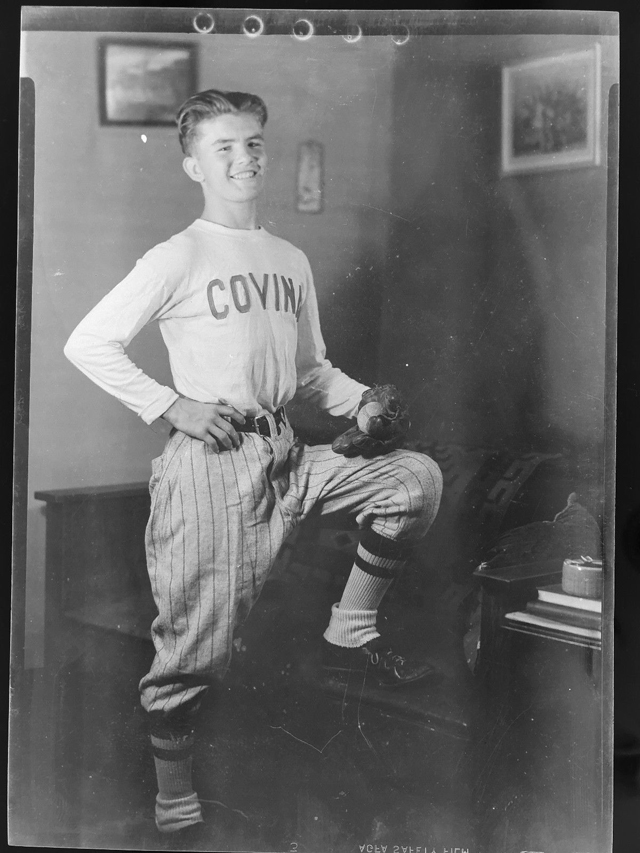
Unknown Covina Union High School Colt varsity baseball player from the 1930s. Photo attributed to Burton O. Burt, who was active in California and the Southwest in the early 20th century.


Image courtesy of seller tobeacat66 on eBay.

Some people I showed this to thought it might be a picture of a young "Doc" Sooter–the semi-legendary CHS sports coach–but one of them asked his surviving brother about it and it turns out Doc was still living with his family in Missouri at the time this photo was taken. So the young man's identity remains a mystery.

Anyway, regardless of who it is, this is a great image of a pre-War Covinan! His face really lights up the room, doesn't it?


Monday, July 17, 2017

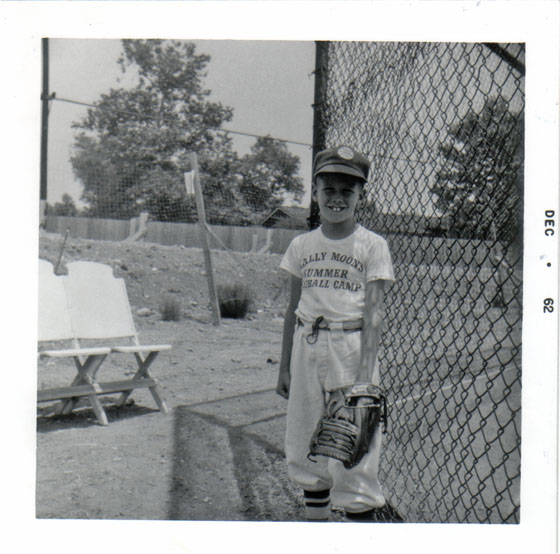
Wally Moon's Baseball Camp

In the early Sixties, Los Angeles Dodgers outfielder Wally Moon started a baseball summer camp at the Baptist Seminary in the Covina Hills, only about a mile from our house. Since we were a big "baseball family," it was natural that I attend.


That mitt's bigger than my whole chest!

Recently, I had some old home movies converted into DVDs, and was delighted to discover footage of me playing my first game at Wally Moon's in the summer of '62, when I was 7 going on 8. I have a ton of fond memories about the camp, but it was great to actually see the place again. It reminded me of just how much fun I really had there.

Anyway, my play here is pretty terrible, but don't watch me, watch the surroundings! If you attended Wally Moon's Summer Baseball Camp back then, I'm sure this will bring back great memories for you, too. :-)

Also in those home movies was a clip of me pitching little league at Barranca Park in 1964. Not at the main ballfield, though; it was on the minors' diamond on the grounds of Barranca School. I was a lot better pitcher than I was a batter, but that's not saying much. I did have a pretty good wind-up and delivery, though...

Monday, May 1, 2017

The Adams Ranch

...by guest author Glenn Reed

James H. Adams was the owner of a ranch in Covina that he named El Dorado. Most of it was located between San Bernardino Road to the north, Badillo Street to the south, Fourth Street on the east, and Hollenbeck on the west. The land had been planted to oranges in 1886 by the previous owner Joseph S. Phillips. Mr. Phillips had previously raised raisin grapes but felt that grapes did not bring a large enough profit. The grove was protected on the east and north by a tall hedge of eucalyptus and cypress trees, outside of which were planted alternately pepper trees and palms. The ranch is described in the 1896 and 1898 holiday supplements of the Covina Argus newspaper which is clearly intended as a promotional pamphlet for the town and its real estate. The editor, Louie Matthews, suggests that the locals send copies to their friends and relatives in the east to encourage them to move to California. It is interesting that while the supplement describes the beauty and elegance of many of the Covina ranch homes, such as Antone Kerckhoff's "Francisquita" and C.H. Ruddock's "Mountain View," when it describes the Adams ranch it says, "All the buildings on this property are neat and modern structures, conspicuous among them being the barn and coach-house, which...is one of the handsomest and best-appointed structures of its kind in the county of Los Angeles." High praise for a barn. The outstanding feature of the Adams barn is a cupola on posts above the center of the roof that resembles one of the domes of Saint Basil's Cathedral in Moscow. The barn also had windows, a rarity in barns. The Covina Argus describes the ranch as "One of the finest ranches of this justly-celebrated citrus-fruit-growing locality, both for beauty of situation, fertility of soil and high state of cultivation in which it is maintained, and the number of ornamental trees surrounding it, is the forty-five-acre ranch of Mr. J.H. Adams."
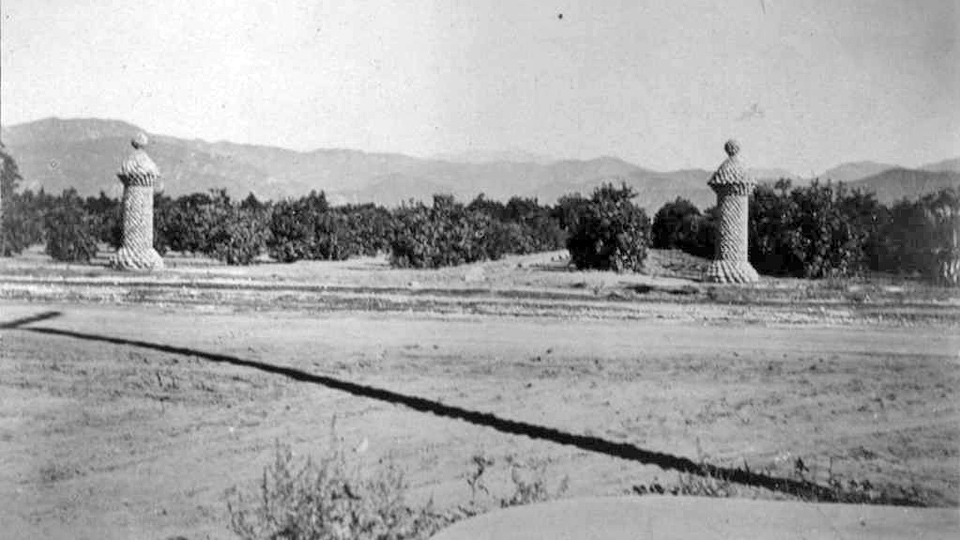

Two of the Adams stone pillars on Badillo Street in the 19-aughts. The east curb of Fifth Street can be seen in the foreground.
Photo courtesy Covina Public Library.

Today, perhaps the only remaining physical feature of the Adams Ranch is the pair of stone pillars on the east side of Hollenbeck about 125 feet south of San Bernardino Road. These were built at the entrance to the ranch house and barn by Jack Nelson, the caretaker. Originally there were at least eight other identical pillars on the perimeter of the ranch. There were single pillars at the diagonally opposite corners, one at Hollenbeck and Badillo and one at San Bernardino and Fourth Street. There was a pair on the north side of Badillo about 60 feet apart in front of the former Pitzer residence. There were two pair on the east side of Fourth Street, one pair flanking Orange Street, and the other pair on each side of Cottage Street. They were about 45 feet apart. The single pillar at San Bernardino and Fourth was also on the east side of Fourth. Apparently Mr. Adams felt that the land comprising Fourth Street belonged to him. Even with that land, his pillars enclosed slightly less than 40 acres. The Argus said that this ranch included 40 acres of oranges planted in 1886 and five acres of lemons. That five acres was most likely south of Badillo.
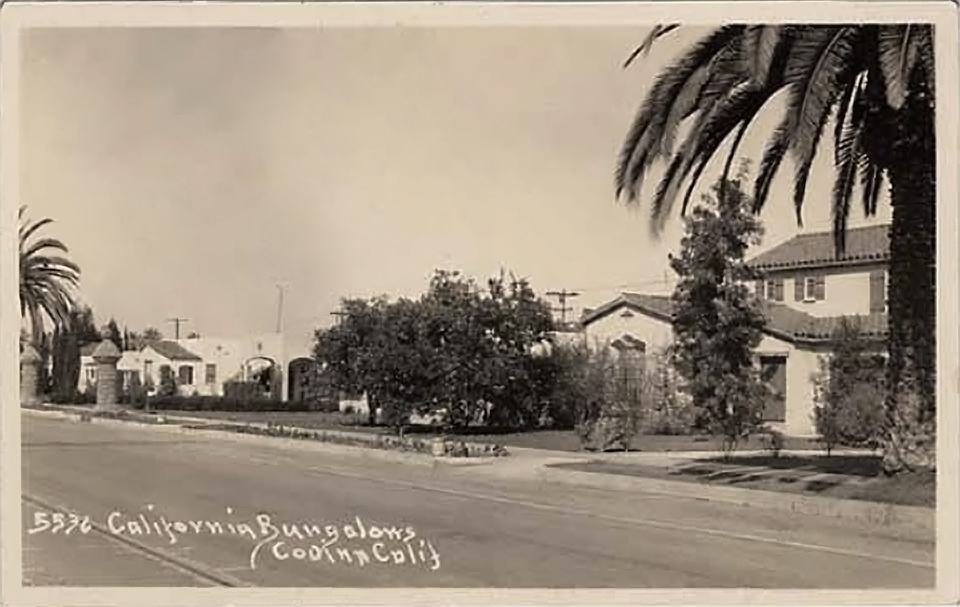

Postcard from the 1930s showing the same two Adams stone pillars on Badillo Street (far left). Several of these houses still stand today.

In 1921, the easterly ten acres of the ranch was sold to the City of Covina for $2,000 an acre, and became the City Park. At that time the Covina Union High School had a single classroom building located on the west side of South Citrus Avenue between Dexter and Puente and felt the need for more room. The trustees were ready to buy the remaining 30 acres of the Adams Ranch between Badillo and San Bernardino at the same price but found that the seller wanted $2,500 per acre for the remainder. The school district appointed a committee to study the matter and they decided instead of buying the land, to build an additional building on the existing campus next to Puente Avenue. It was called the Science Building.

The westerly 30 acres was sold to be subdivided in 1924. I am pleased that my parents Tom and Edith Reed were among the early purchasers of a lot in the subdivision in 1924. They chose a lot just east of the location of the old Adams barn. I still live there. Mr. Raymond Finch bought the lot next door that must have been at least partially under the barn.

Two lots of the Adams Park subdivision were not purchased for residential purposes but instead were developed as a miniature golf course. These were the two lots on San Bernardino Road next to Valencia Street directly across the street from the city park. Unfortunately the Great Depression occurred and made such entertainment as miniature golf unprofitable. The golf course was abandoned and became overgrown with shrubs, trees, and weeds. That made it an almost perfect playground for all the kids in the area. It was a wonderful place to play "Hide and Seek" or "Indians."

As El Dorado, the Adams Ranch was as the Argus stated, "a model place, one which is the pride of its owner and the neighborhood, and the admiration of visitors." Now the City Park and Adams Park are the pride of their owners and of the neighborhood.

Sources:
     Covina Argus Holiday Supplements 1896 and 1898
     Covina Argus February 1921
     "Covina" by Pflueger
     "Images of America–Covina" by Barbara Ann Hall Ph.D.
     1932 Spence Air Photo
     Conversations with my father, Thomas B. Reed
     Conversation with Jack Milliken
     Conversation with my nephew, Dr. Thomas Armbruster
     Powell Camera and Marty Getz

This article was originally published in the April, 2017 issue of "The Covina Citrus Peal," the official newsletter of the Covina Valley Historical Society, and is reproduced here with the permission of the author, Covina historian Glenn Reed.